
 Guards + Retainers
 Custom Night Guard
 Retainer
 Emergency Order

 Whitening
 Whitening Kit
 Teeth Whitening Gel
 Dual-Action Foam
 Cleaning + Care
 Ultrasonic Cleaner Pro
 Water Flosser
 UV Toothbrush Sanitizer
 Deep Clean + Freshening Tablets
 Accessories
 Guard Removal Tool
 Replacement Nozzles
 Bundles

If you've been told you need a night guard, retainer, or other dental appliance, you're probably wondering how long do dental impressions take, and whether the process means burning through a lunch break or blocking off an entire afternoon. The short answer: the actual impression itself usually takes just a few minutes, but there's more to the timeline than what happens in the chair.
Between preparation, setting time, and the wait for your finished appliance, the full process involves several steps worth understanding before you book that appointment. And if you'd rather skip the office visit entirely, Remi's at-home impression kit lets you take your own dental impressions for custom night guards and retainers on your own schedule, no chair time required.
This article breaks down exactly what to expect at each stage, from the moment the tray goes in your mouth to the day your final appliance arrives.
Why dental impressions matter for fit and comfort
Before you think about how long do dental impressions take, it helps to understand why the accuracy of that impression matters so much. A dental impression is a physical mold of your teeth and gums. Labs use that mold as the foundation for whatever appliance they're making, whether that's a night guard, retainer, crown, or bridge. If the mold is slightly off, the finished product will be slightly off too, and slight mismatches in dental appliances translate directly into discomfort, poor function, or an appliance you stop wearing.
The connection between accuracy and comfort
Your mouth is far more precise than it might seem. Teeth meet each other at very specific angles and contact points, and an appliance that ignores those details by even a fraction of a millimeter can cause pressure in the wrong place, irritation along your gum line, or a bite that feels unbalanced. For night guards specifically, a poor fit can actually worsen jaw tension rather than relieve it, which defeats the entire purpose of wearing one.
A well-fitted night guard or retainer should feel snug but not tight, with no rocking, gaps, or pressure points.
Custom impressions capture the exact contours of your teeth, so the lab can build an appliance that matches your anatomy rather than an average approximation of it. That precision is what separates a custom appliance from a generic boil-and-bite guard you find at a pharmacy.
What a poor impression costs you
A failed or inaccurate impression doesn't just mean discomfort. It means going through the entire process again, which adds both time and money to the equation. In a dental office, that might mean rebooking an appointment, waiting for another slot, and paying for additional materials. With an at-home impression kit, redoing the process is typically straightforward since replacement putty is easy to request, but it still delays the arrival of your finished appliance.
Getting the impression right the first time protects your investment and gets you to a comfortable, functional appliance faster.
How long impressions take in the chair
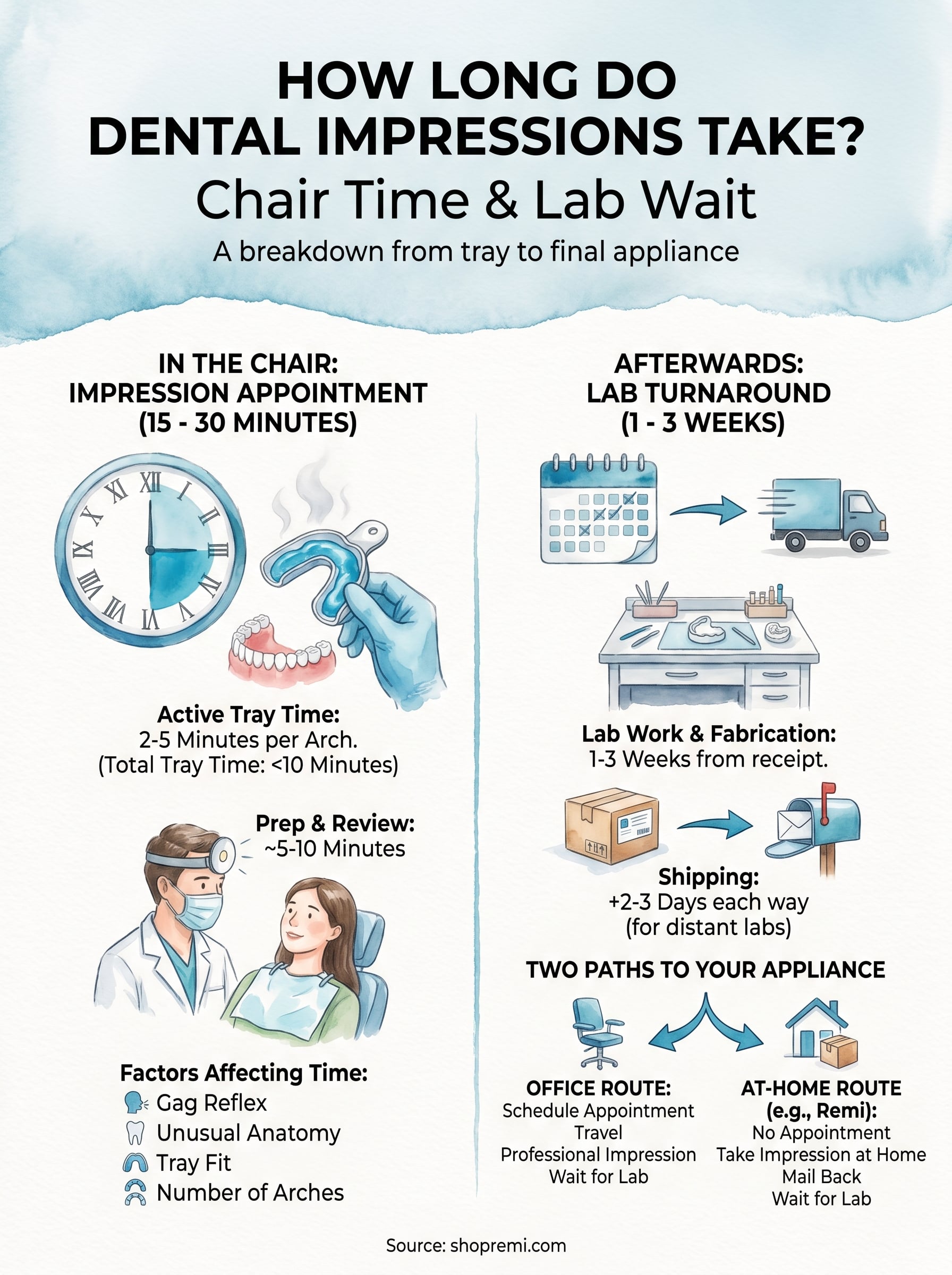
When people ask how long do dental impressions take, they usually mean the hands-on portion of the appointment. For a standard tray impression, the dentist loads material into a tray, places it over your teeth, and holds it there while it sets. That active portion typically runs two to five minutes per arch, so upper and lower impressions together take under ten minutes of tray time.
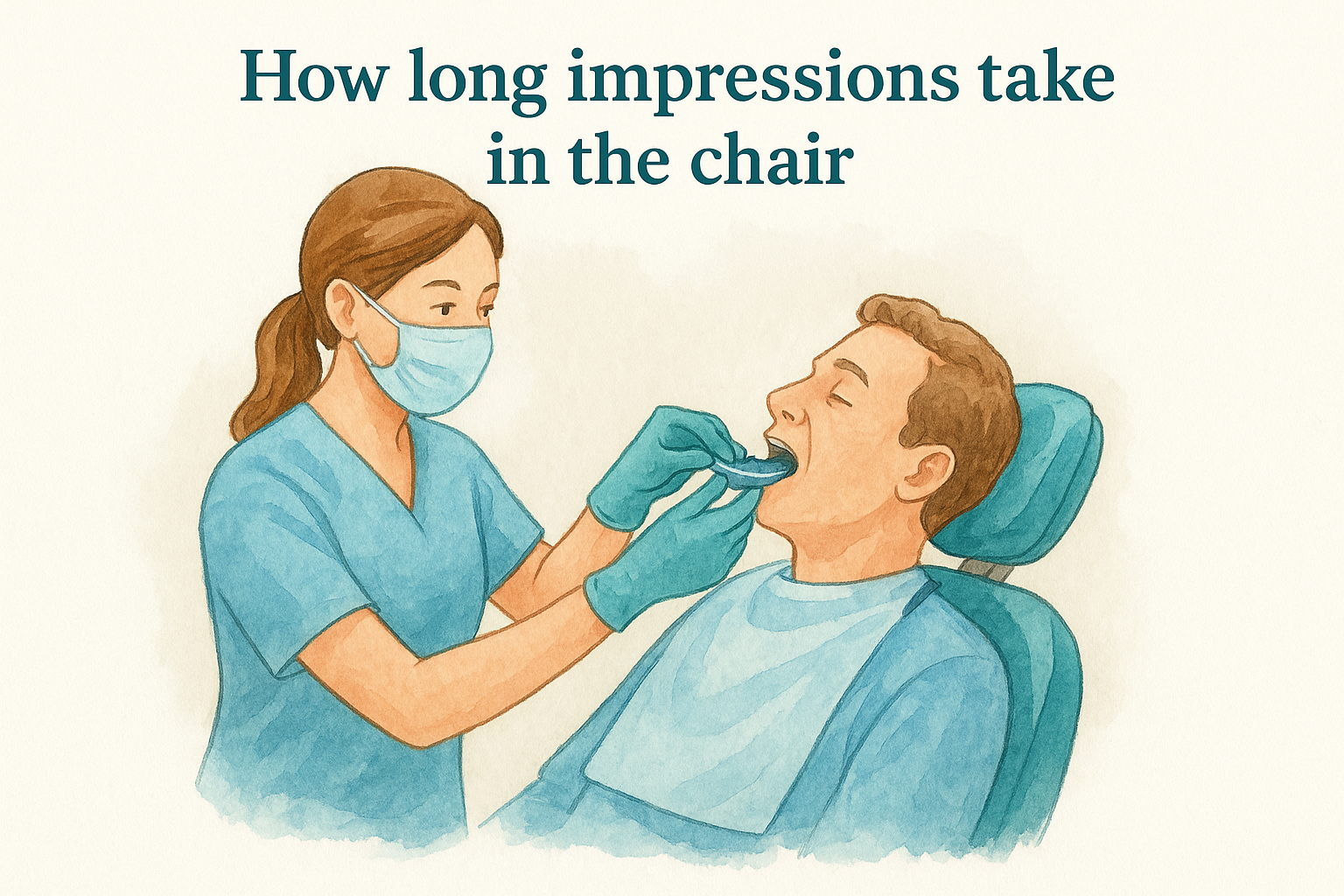
Traditional tray impressions
The most common approach uses alginate or polyvinyl siloxane (PVS) material, both of which need a short setting period inside your mouth. Alginate sets in two to four minutes, while PVS takes slightly longer but produces a more precise result. During that window, you hold still and breathe through your nose while the material firms up around your teeth.
The total chair time for impressions is usually 15 to 30 minutes once you include preparation, placement, and a quick review of the mold before you leave.
The setting window
Setting time is not the only factor adding minutes to your visit. Tray selection, material mixing, and positioning all happen before the tray touches your teeth. After the impression comes out, the dental team checks it for voids or distortions that could compromise the final appliance.
Your overall impression chair time stays in the 15 to 30 minute range for most single-arch or dual-arch appointments. If impressions are part of a longer visit that includes an exam or X-rays, your total time will run higher, but the impression portion itself stays consistent.
What changes the time during your appointment
Several factors can push your chair time past or under that typical 15 to 30 minute window. Understanding them before your visit helps you plan your schedule and reduce the chance of surprises.
Your gag reflex and anatomy
A strong gag reflex is one of the most common reasons impressions take longer than expected. If you gag during tray placement, your dentist may need to pause, reposition the tray, or try a smaller size before the material can set properly. Unusual tooth anatomy, such as deep palatal vaulting or crowded teeth, also adds time because the tray needs to seat fully to capture an accurate mold.
Breathing slowly through your nose and focusing on a fixed point on the ceiling can reduce gagging during the impression process.
The number of arches and appliance type
How long do dental impressions take also depends on whether you need one arch or both. A single upper or lower impression adds less time than a full dual-arch session. Beyond that, the type of appliance being made influences what the dental team needs to capture. A night guard impression requires the full occlusal surface, while a simple retainer may allow for a faster setup overall.
Material preparation and tray fit
Mixing and loading impression material takes roughly one to two minutes before anything touches your teeth. If the first tray does not fit well, selecting and testing an alternative adds more time before the dentist can proceed with the impression.
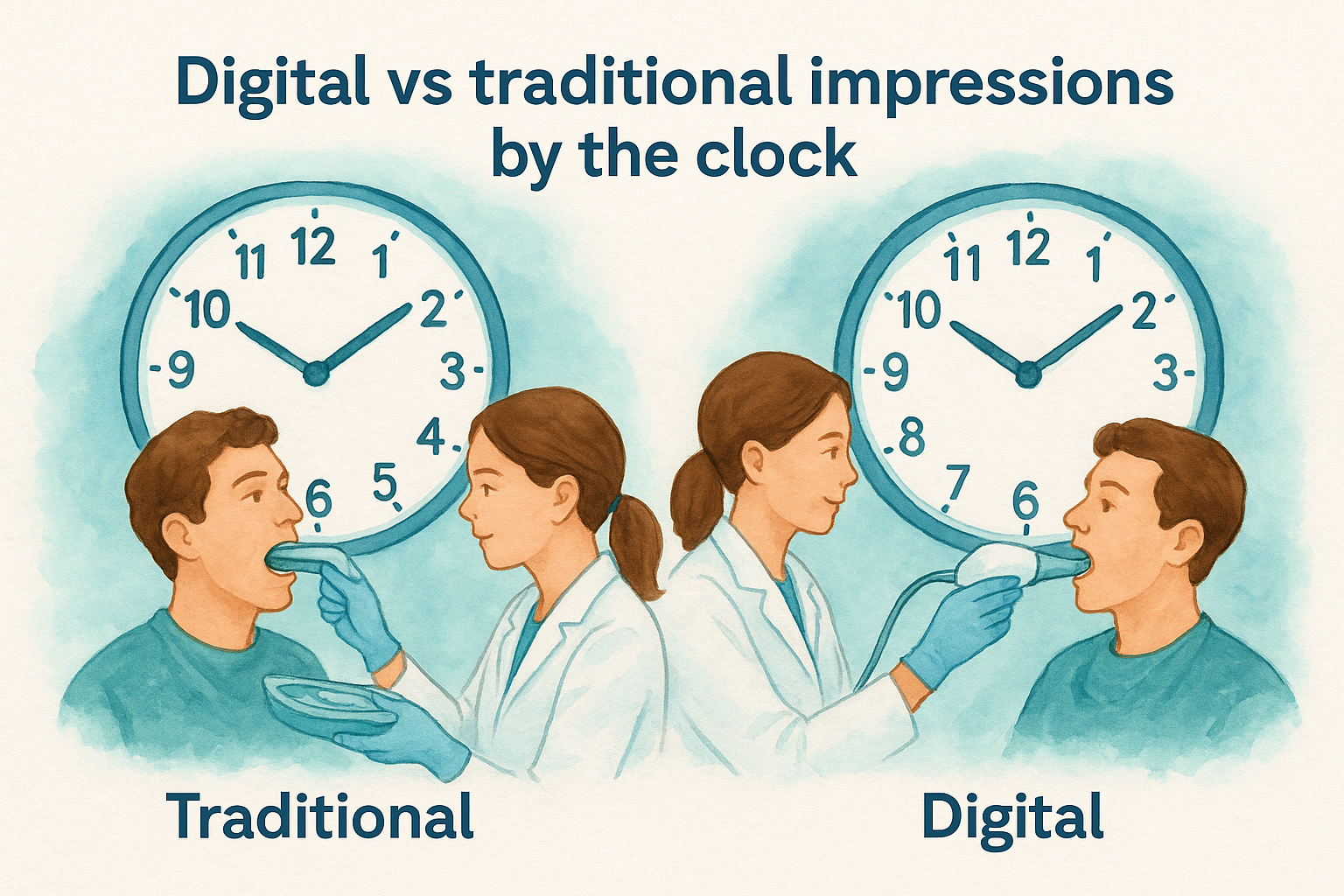
Digital vs traditional impressions by the clock
The method your provider uses directly affects how long dental impressions take in the chair. Traditional and digital approaches capture the same anatomical information, but they do it through very different processes, and that gap shows up clearly when you compare the two side by side.
Traditional impressions
Traditional impressions rely on physical tray materials like alginate or polyvinyl siloxane that require mixing, loading, and a set period inside your mouth. From tray selection through removal, most traditional impressions run 15 to 30 minutes for a standard appointment. That window includes material prep, placement time, and a post-removal check for voids or distortions. If your gag reflex is sensitive or a tray needs swapping, add several more minutes on top.
Traditional impressions remain the standard for many at-home kits, including Remi's, because the process requires no specialized scanning equipment and works well outside of a clinical setting.
Digital impressions
Digital impressions use an intraoral scanner, a handheld wand that captures thousands of images per second and builds a 3D model of your teeth in real time. The active scanning portion typically takes five to ten minutes, with no tray, no material, and no setting time to wait through. Your provider sees the model build on screen as they work, which cuts down on the post-scan review step. Overall chair time drops noticeably compared to traditional methods, though scanner availability varies widely by provider and location.
How long you wait for your appliance after impressions
The chair time is just one part of how long do dental impressions take from start to finish. Once your impressions leave the office, a dental lab takes over, and that lab's turnaround schedule determines when your finished appliance actually arrives.
Lab turnaround for common appliances
For most custom night guards and retainers, standard lab turnaround runs one to three weeks from the date the lab receives your impressions. Crowns and bridges can take a similar window, though some offices offer same-day restorations using in-office milling machines. The lab's workload, shipping distance, and the complexity of your appliance all influence where your wait lands within that range.
If your office ships impressions to an out-of-state lab, factor in two to three extra business days for transit in each direction.
At-home impression kits and delivery timelines
With an at-home kit like Remi's, the process skips the office visit entirely. You take your impressions at home, mail them back using the included prepaid packaging, and the lab begins work once your molds arrive.
Your custom night guard or retainer typically ships within a few business days of Remi receiving your impressions. That faster intake process means your total wait, from mailing your kit to holding your finished appliance, is often comparable to the traditional office-plus-lab route, without the scheduling hassle of booking an appointment in the first place.
Next steps if you need an impression
Now that you know how long do dental impressions take from start to finish, you can plan around the actual timeline instead of guessing. If you need a night guard or retainer, your two main paths are booking an office appointment or ordering an at-home impression kit. The office route works well if you already have a provider and want someone to guide the process in person. Expect 15 to 30 minutes of chair time plus a one-to-three-week lab wait once your impressions are sent out.
Remi's at-home kit removes the scheduling step entirely. You take your impressions when it fits your day, mail them back with the included prepaid packaging, and your custom appliance ships shortly after the lab receives your molds. If teeth grinding or jaw clenching is disrupting your sleep, the Remi custom night guard is a straightforward, affordable place to start.

