
 Guards + Retainers
 Custom Night Guard
 Retainer
 Emergency Order

 Whitening
 Whitening Kit
 Teeth Whitening Gel
 Dual-Action Foam
 Cleaning + Care
 Ultrasonic Cleaner Pro
 Water Flosser
 UV Toothbrush Sanitizer
 Deep Clean + Freshening Tablets
 Accessories
 Guard Removal Tool
 Replacement Nozzles
 Bundles

If you already wear a retainer at night, you've probably wondered: can a retainer work as a night guard to protect against grinding? It's a fair question. Both sit over your teeth while you sleep, and buying one appliance instead of two sounds like a smart move.
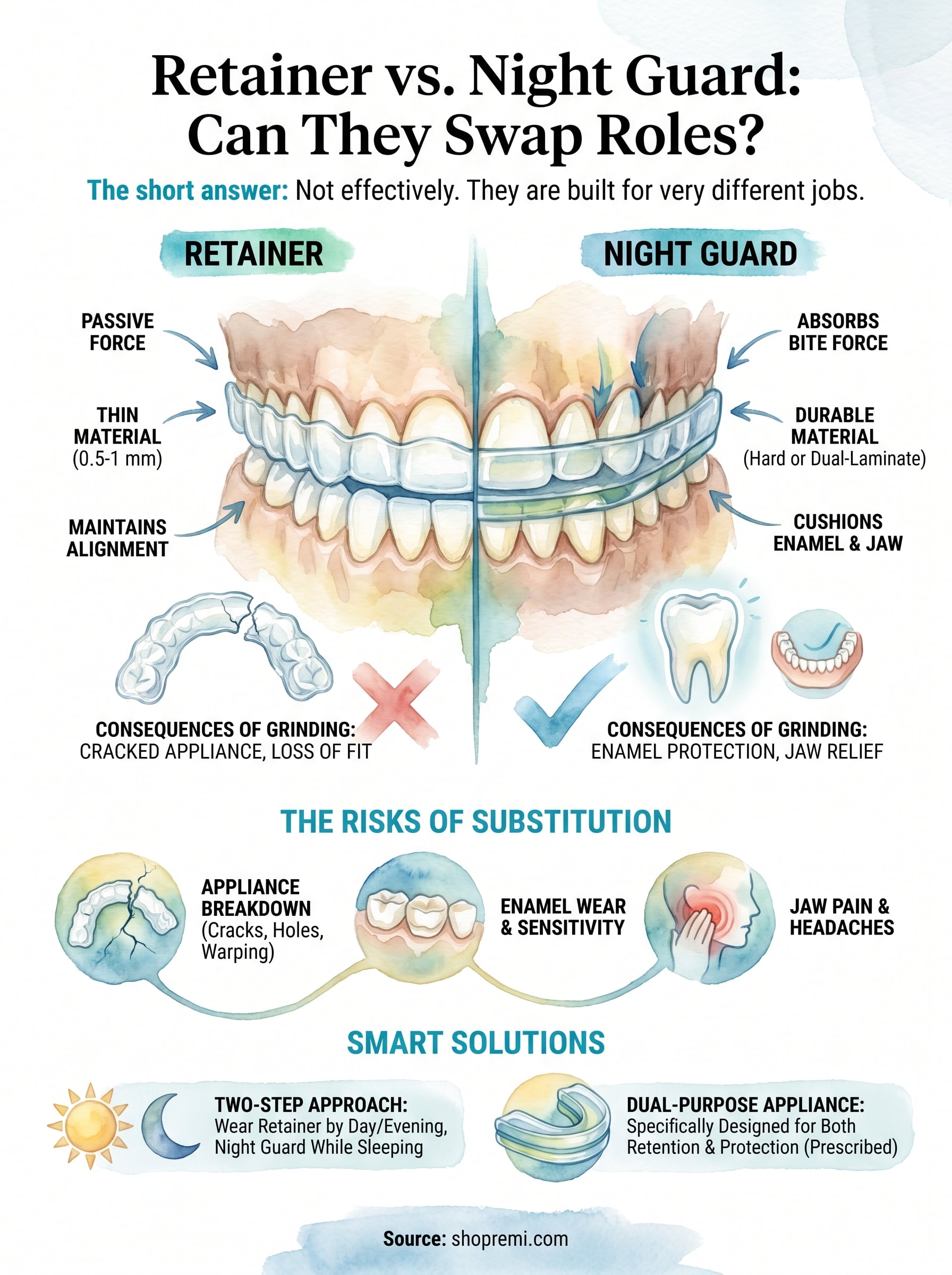
The short answer is that retainers and night guards are built for very different jobs. A retainer holds your teeth in position after orthodontic treatment. A night guard absorbs the force of clenching and grinding (bruxism) to prevent enamel damage, jaw pain, and headaches. Using one in place of the other can lead to cracked appliances or worsening dental issues.
At Remi, we make custom night guards designed specifically for bruxism, fitted from at-home impressions and delivered to your door at a fraction of dental office prices. This article breaks down exactly how retainers and night guards differ, what happens when you substitute one for the other, and when a dual-purpose appliance might actually make sense.
Why retainers and night guards are not interchangeable
Retainers and night guards look similar at a glance, but their designs reflect completely different goals. Asking can a retainer work as a night guard is a bit like asking whether a seat belt can work as an airbag. Both are safety features in a car, but each one is engineered to handle a specific type of force. The same logic applies to dental appliances.
How retainers are built
A retainer's job is to maintain tooth position after braces or aligners have finished moving your teeth. The material is typically thin thermoplastic, which is rigid enough to hold alignment but not designed to absorb repeated impact. Retainers are built for passive wear, meaning they keep things in place when your jaw is at rest. They are not reinforced for the kind of stress that bruxism generates.
Retainers are precision tools for tooth stability, not shock absorbers, and treating them as one puts both the appliance and your teeth at risk.
Most standard retainers are 0.5 to 1 mm thick, which leaves very little material between your upper and lower teeth. When your jaw muscles generate the force that comes with grinding, that thin layer provides almost no meaningful cushion. You could crack or distort the retainer within days of grinding against it.
How night guards are built
A night guard is specifically engineered to absorb and redistribute bite force. Depending on how severe your grinding is, the material and thickness vary. Soft night guards work well for mild grinders, while hard acrylic or dual-laminate guards handle heavy clenching without deforming or cracking. The added thickness also keeps your upper and lower teeth from making direct contact throughout the night.
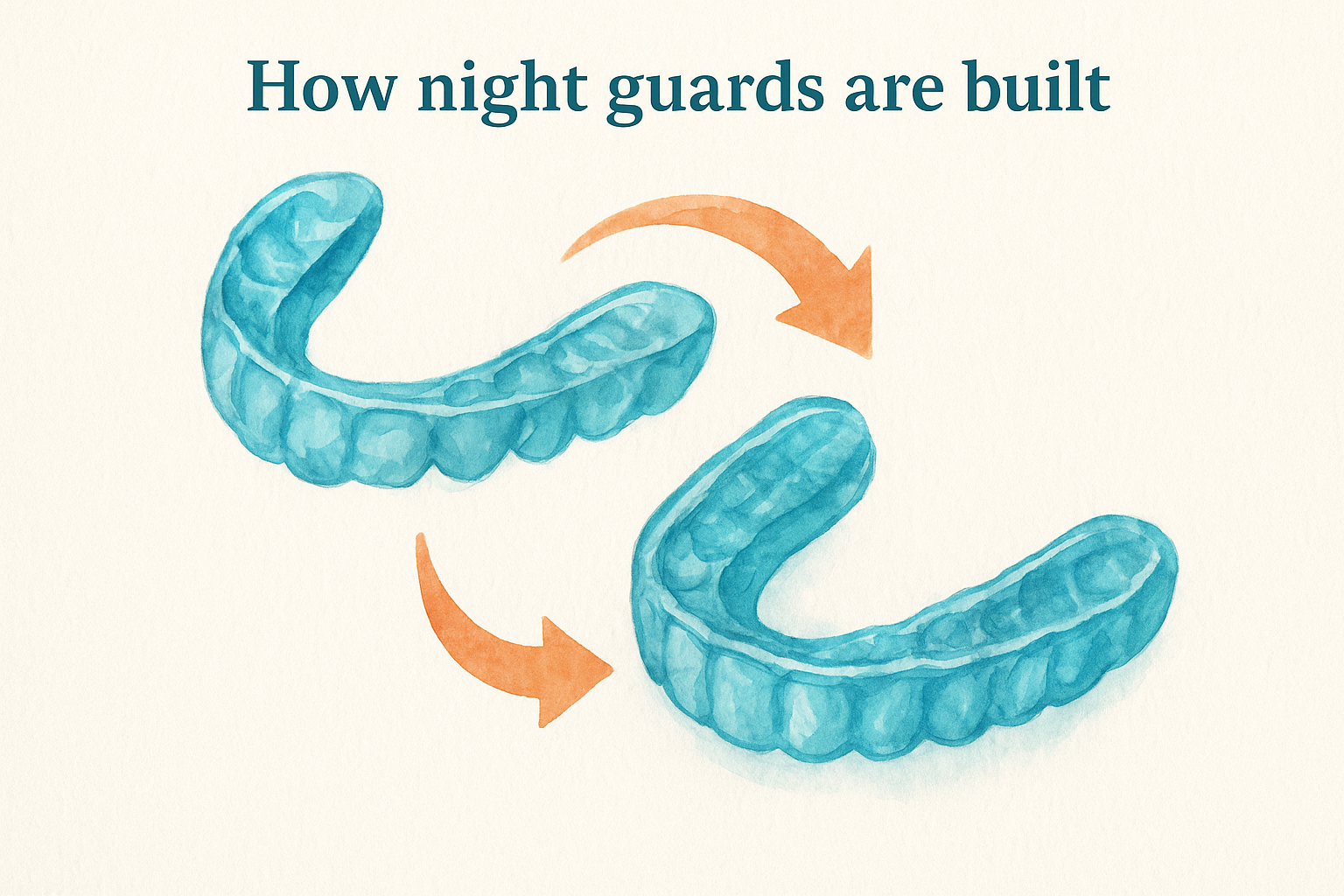
Custom night guards are fitted to your exact bite geometry, and that precision matters. An ill-fitting guard can shift your bite or cause jaw discomfort over time. A well-made night guard keeps your jaw in a neutral, relaxed position so your muscles can decompress rather than stay braced against the pressure of grinding.
What happens if you grind while wearing a retainer
When you grind your teeth while wearing a retainer, you put serious mechanical stress on an appliance built for passive, low-force wear. The results show up fast, and they affect both the retainer itself and your underlying dental health.
The appliance breaks down fast
Retainers are made from thin thermoplastic, and bruxism generates enough force to crack, warp, or puncture that material within days of heavy grinding. Once the retainer deforms, it no longer sits accurately over your teeth, which means it stops holding your alignment. Common signs that grinding has damaged your retainer include:
- Visible cracks or holes in the plastic
- A noticeable change in fit or comfort
- Rough or sharp edges along the bite surface
- Increased tooth shifting despite nightly wear
Your teeth bear the real cost
So when someone asks can a retainer work as a night guard, the practical answer shows up in how you feel each morning. Without adequate cushioning between your upper and lower teeth, enamel wears down faster, and you may wake up with jaw soreness, headaches, or sharp tooth sensitivity.
Using a retainer as a night guard substitute does not just risk the appliance. It puts your enamel, jaw joints, and orthodontic results all at risk at the same time.
Unprotected grinding over weeks and months can lead to fractures, flattened tooth surfaces, and TMJ strain that takes far more time and money to address than a proper night guard ever would.
When a retainer can act like a night guard
Most of the time, a retainer is the wrong tool for bruxism. But there are specific, limited situations where your retainer provides some degree of protection, and understanding those situations helps you make a smarter decision about your dental health.
When your grinding is very mild
If you experience occasional, low-force grinding rather than heavy nightly bruxism, a thicker retainer may offer short-term protection. People who grind lightly during periods of stress sometimes find that their standard retainer holds up without cracking or warping quickly. This is not a long-term strategy, but it explains why some people assume a retainer is adequate when it really only functions under very narrow conditions.
Whether a retainer can work as a night guard in your situation depends almost entirely on how hard and how often you grind, not simply whether you grind at all.
When you use a retainer designed with added thickness
Some dental labs and direct-to-consumer brands produce thicker, dual-purpose clear appliances built to maintain tooth position while also offering a cushioning layer. These use denser material than a standard retainer and are designed with bruxism in mind from the start. They are not the same as a basic orthodontic retainer. If you want both functions in one device, you need an appliance deliberately engineered for both jobs, not a standard retainer repurposed after the fact for grinding protection.
What to do if you need both a retainer and night guard
Many people with bruxism have also completed orthodontic treatment, which means they genuinely need both appliances in their routine. The good news is that you have clear, practical options without doubling your discomfort or your budget.
Wear your retainer during the day and your night guard at night
The simplest solution is to separate the jobs by time. Wear your retainer during the day or for a few hours before bed, then swap to your custom night guard while you sleep. This keeps your teeth aligned and protects your enamel from grinding forces without asking either appliance to do a job it was not built for. If you keep wondering whether can a retainer work as a night guard long-term, separating each appliance's function is the most reliable answer.
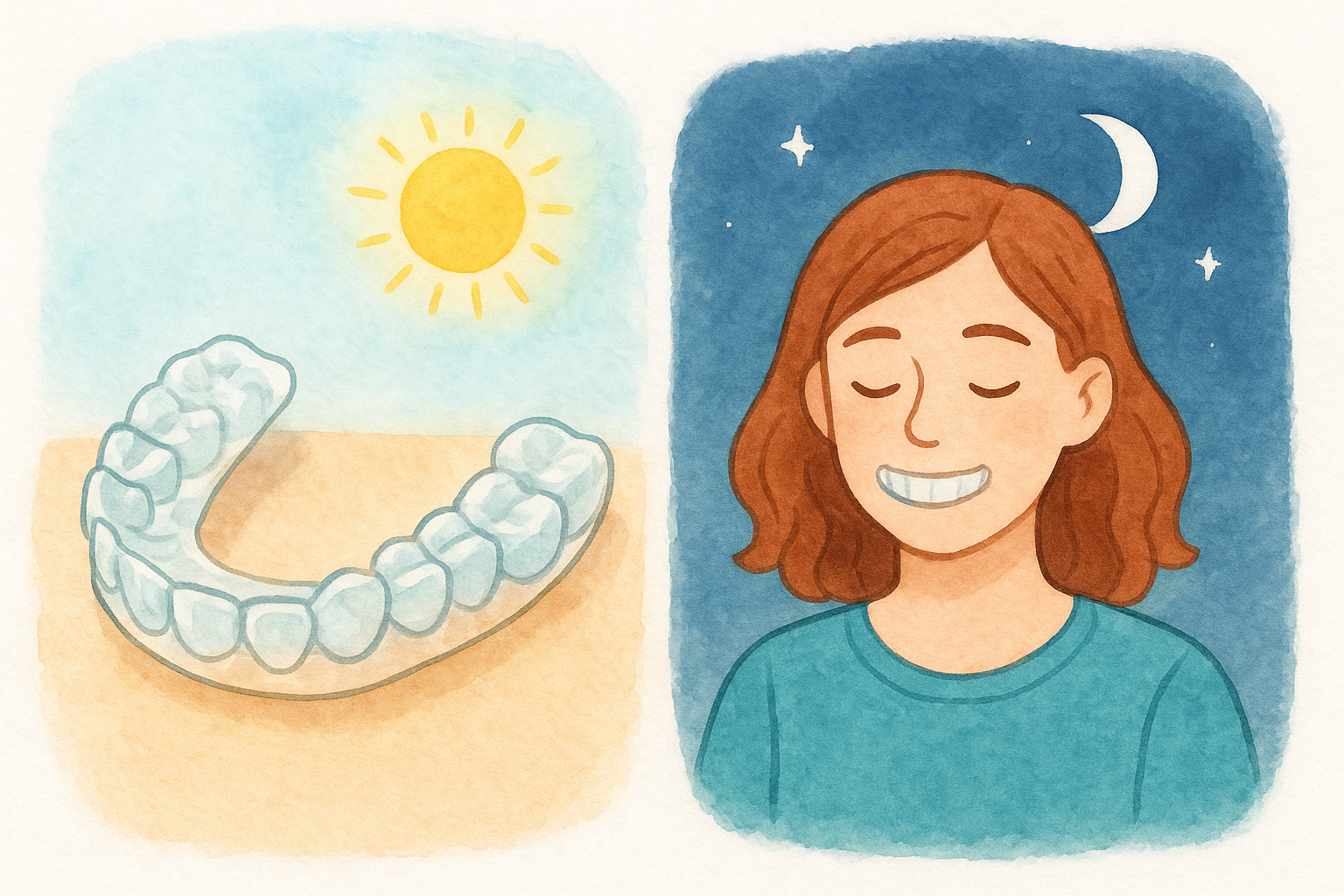
Keeping your retainer and night guard roles separate almost always produces better outcomes for both your orthodontic results and your enamel protection.
Consider a dual-purpose appliance
If managing two separate devices feels impractical, ask your dentist about a dual-laminate or thicker custom appliance designed to handle both alignment retention and grinding protection. These exist specifically for people in your situation, but they must be prescribed and fitted with bruxism in mind from the start.
A standard retainer retrofitted for grinding will not perform the same way. You need an appliance that accounts for bite force from the design phase, not one that is repurposed after the fact.
How to choose the right appliance for your needs
The decision comes down to what your mouth actually needs, not what is most convenient. Before you ask can a retainer work as a night guard in your specific case, identify whether you are dealing with active grinding, an orthodontic retention need, or both.
If you only grind your teeth
Your priority is protecting your enamel and jaw joints, which means a dedicated night guard is the right call. Look for a custom-fitted option made from material matched to your grinding severity. Soft guards suit light grinders, while hard acrylic or dual-laminate guards handle heavier bruxism without breaking down. Avoid over-the-counter boil-and-bite guards since their loose fit can shift your bite and strain your jaw muscles over time.
A properly fitted custom night guard costs a fraction of the dental work you will need if you leave heavy grinding unaddressed for months or years.
If you grind and need to retain your orthodontic results
Your best path is two separate appliances with clearly defined roles: a retainer for daytime or early evening wear and a custom night guard for sleeping. This approach keeps each device performing the job it was built for. If wearing two appliances feels unmanageable, talk to your dentist about a dual-purpose appliance designed with both retention and bruxism protection in mind from the start. Never substitute a standard retainer for that conversation.
Key takeaways and next steps
The core answer to can a retainer work as a night guard is no, not in most cases. Retainers use thin thermoplastic built for passive alignment, not for absorbing the repeated force that bruxism generates. Grinding against a standard retainer damages the appliance quickly and leaves your enamel, jaw joints, and orthodontic results all exposed at the same time.
Your practical path forward depends on what you actually need. Grinding only calls for a dedicated night guard matched to your bite and grinding severity. Both grinding and retention calls for separate appliances with clearly defined roles, or a dual-purpose device designed with bruxism in mind from the start. Either way, a properly fitted custom appliance protects far more than it costs.
If grinding is your main concern, get a custom-fitted night guard made from dental-grade material at a fraction of what a dental office charges.

