
 Guards + Retainers
 Custom Night Guard
 Retainer
 Emergency Order

 Whitening
 Whitening Kit
 Teeth Whitening Gel
 Dual-Action Foam
 Ultrasonic Cleaner Pro
 Water Flosser
 UV Toothbrush Sanitizer
 Accessories
 Guard Removal Tool
 Replacement Nozzles

If you grind your teeth at night, you've probably run into the night guard vs retainer for teeth grinding debate. Both are custom-fitted oral appliances that sit over your teeth, and they can even look similar. So it's a fair question, can one do the job of the other, or do you need to pick the right tool for the specific problem you're dealing with?
Here's the short answer: night guards and retainers are built for different purposes. A night guard absorbs and distributes the force of grinding and clenching. A retainer holds your teeth in position after orthodontic treatment. Using the wrong one can mean inadequate protection for your enamel or unnecessary wear on an appliance that wasn't designed to take that kind of abuse. Some people need both, and the distinction matters more than most realize.
At Remi, we make both custom night guards and custom retainers, so we're not here to push one over the other. We're here to help you figure out which one actually fits your situation. This article breaks down how each appliance works, where they overlap, where they don't, and how to decide what belongs on your teeth while you sleep.
What a night guard and retainer do
Understanding the night guard vs retainer for teeth grinding question starts with knowing what each appliance was actually built to do. Both sit over your teeth, often worn at night, and both can be custom-fitted to your exact bite. But their internal design, materials, and functional goals are completely different from the start.
How a night guard works
A night guard's primary job is to absorb and redistribute force. When you grind or clench, your teeth press against each other with significant, repeated pressure. Over time, that stress wears down enamel, causes microfractures in your teeth, and puts strain on your jaw joints and surrounding muscles. A night guard places a physical barrier between your upper and lower teeth, redirecting that bite force away from your enamel and into the appliance material instead.
The guard takes the damage so your teeth don't have to.
Night guards are made from harder acrylic or layered soft-hard material, depending on how severe your grinding is. The thickness and density of the material matters a great deal here. A thin, flexible appliance won't hold up to aggressive grinding the way a properly constructed hard guard will. The fit also has to be precise and stable so the guard stays in place throughout the night without putting excess pressure on your gums or shifting while you sleep.
How a retainer works
A retainer's primary job is to hold your teeth in position. After orthodontic treatment, your teeth have a natural tendency to drift back toward where they started. A retainer applies gentle, consistent pressure to keep your teeth in the corrected alignment your braces or clear aligners achieved. Think of it as a maintenance device, not a protective one.
Retainers are typically made from thin, clear thermoplastic material that fits snugly around your teeth. That thin profile is intentional. Your retainer doesn't need to absorb heavy bite force; it just needs to keep your teeth from moving. Because of that specific purpose, the material is lighter and far less dense than what you'd find in a proper night guard. Most dentists and orthodontists recommend wearing your retainer every night indefinitely to prevent your teeth from regressing over time.
Both appliances can look nearly identical at a quick glance, especially when comparing a clear retainer to a soft night guard. But the material thickness, construction density, and design intent separate them in ways that directly affect your dental health when you're grinding in your sleep.
How they differ for teeth grinding
When you look at the night guard vs retainer for teeth grinding comparison directly, the differences come down to three things: material, thickness, and durability under pressure. Each of those factors determines whether the appliance can actually protect your teeth during a grinding episode or simply hold position overnight.
Material and thickness
A night guard uses thicker, denser acrylic or layered material specifically engineered to absorb repeated bite force without cracking or warping. A retainer uses thin thermoplastic that forms tightly around your teeth to prevent drifting. That thinness is a feature for retention purposes, but it becomes a serious liability when grinding pressure enters the picture.
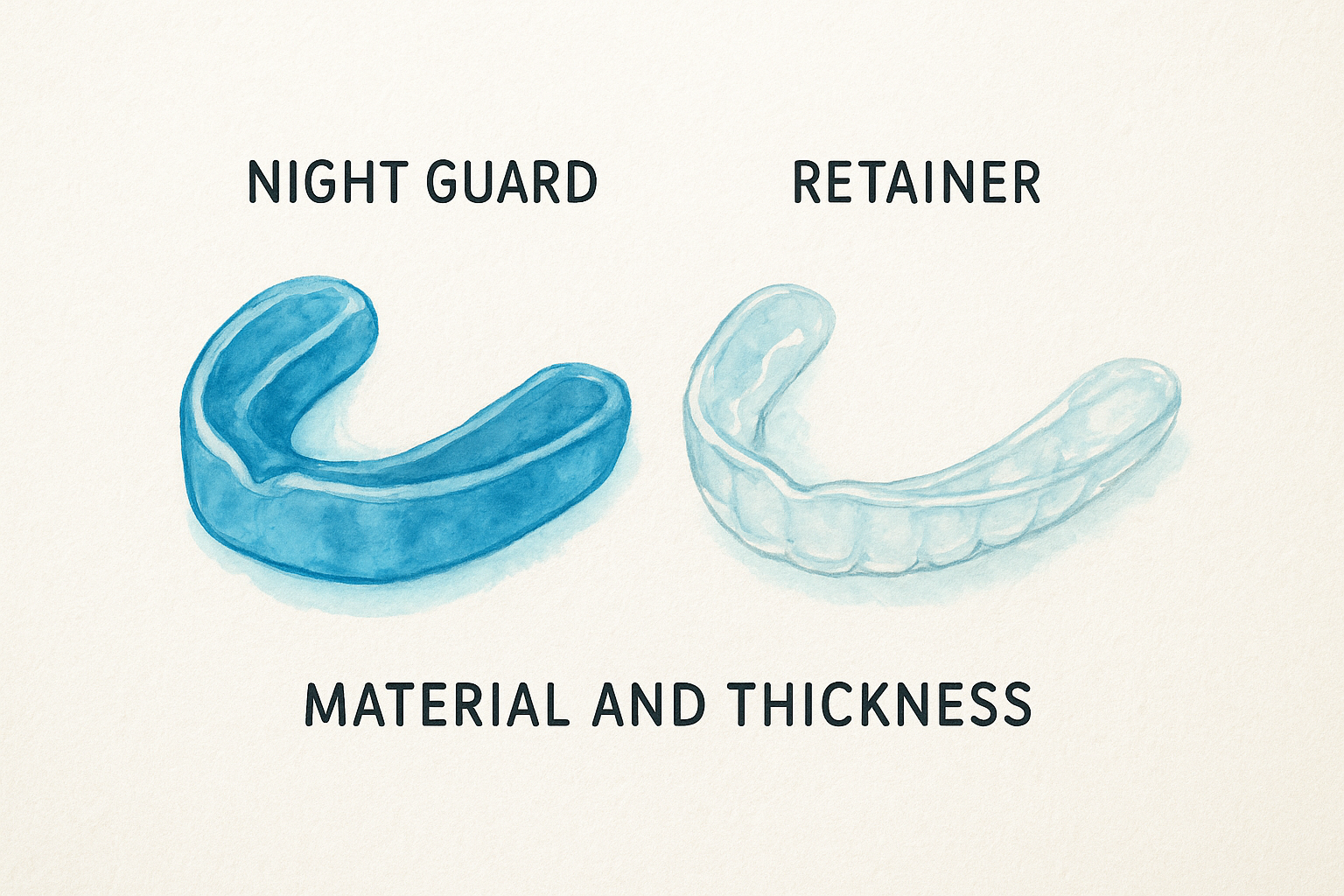
Your retainer was not built with enough material density to absorb what grinding produces. When you grind, you can exert up to 250 pounds of force per square inch on your teeth according to dental estimates. A retainer's thin walls have no realistic way to handle that load repeatedly over weeks and months.
Durability under bite force
Night guards are designed with surface-level give and internal hardness to distribute bite force across the full arch rather than concentrating it at individual contact points. Retainers have no such design feature. They hold alignment by fitting snugly against the tooth surface, not by absorbing impact.
A retainer worn for grinding is not protecting your teeth. It is wearing out without doing the job a proper night guard would do.
The practical result is that a retainer used for grinding will show visible wear, cracking, or distortion far faster than a night guard would under the same conditions. And while the retainer degrades, your teeth continue absorbing direct bite pressure without real protection in place.
Why using the wrong one causes problems
The night guard vs retainer for teeth grinding question matters practically, not just technically. Getting it wrong in either direction puts your teeth at risk in ways that often build up slowly before you notice the damage has already happened.
Using a retainer to protect against grinding
When you wear a retainer during heavy grinding, your teeth continue to absorb direct bite force without real protection. The thin thermoplastic that makes a retainer effective for alignment maintenance is the same reason it fails quickly under grinding pressure. You may not realize it is breaking down until cracks appear or the fit changes noticeably.
Your enamel does not grow back, so relying on the wrong appliance to protect it is a risk with permanent consequences.
Beyond the immediate protection failure, grinding accelerates the retainer's functional lifespan significantly, meaning you replace it far more often than you should need to. That ongoing cost adds up quickly compared to simply using the right appliance from the start.
Using a night guard when you need alignment maintenance
If you grind and skip your retainer in favor of wearing only a night guard, you solve one problem while ignoring another. A night guard does not apply the specific, gentle pressure required to keep your teeth in their corrected positions. Your teeth can still shift over time, even while you wear a properly fitted guard every night.
Some people assume that a snug-fitting night guard holds their teeth in place well enough to replace a retainer. It does not. The fit of a night guard is designed to protect tooth surfaces and stabilize your jaw, not to prevent long-term positional drift. Both problems need their own dedicated solution.
How to choose the right appliance
Choosing between the two comes down to what your teeth actually need right now. Start by asking yourself two questions: are you actively grinding or clenching at night, and have you had orthodontic treatment that requires retention? Your answers to both of those questions point you directly toward the right appliance, or whether you need to consider using both at the same time.
If you grind but have not had orthodontic treatment
Your situation is straightforward. A custom-fitted night guard is what you need, and a retainer adds nothing to your care in this case. Focus on getting a guard with the right thickness for your grinding severity. Light grinders typically do well with a soft or dual-laminate guard, while moderate to heavy grinders need a hard acrylic appliance with enough density to hold up over repeated use. Getting the right thickness matters because an undersized guard will not provide adequate protection against the forces your jaw generates during sleep.
If you have had orthodontic treatment and also grind
The night guard vs retainer for teeth grinding question becomes more layered when you are both a grinder and an orthodontic patient. You need retention to prevent drift, but you also need protection against bite force. Wearing only your retainer at night puts that thin appliance at serious risk and leaves your enamel exposed to grinding pressure without real protection.
Talk to your dentist or orthodontist about your grinding symptoms before assuming your retainer is enough to handle both jobs.
Your dental provider can assess the severity of your grinding and help you determine whether you need a dedicated night guard alongside your retainer, or whether a specific type of night guard can serve a dual role in your case. Do not rely on assumptions here, since the stakes for both your enamel and your orthodontic results are too high to leave to guesswork.
What to do if you need both
Some people genuinely need to tackle the night guard vs retainer for teeth grinding problem from both sides at once. If you grind and also have orthodontic work to maintain, you do not have to choose between protecting your enamel and holding your alignment. You just need a clear plan for how to use both appliances without creating more confusion or extra cost than necessary.
Wear them in sequence, not simultaneously
Stacking a night guard over a retainer is not a workable solution. Wearing both at once distorts the fit of each appliance and creates uneven bite pressure across your arch that neither device was designed to handle. Instead, most dentists recommend a sequential approach: wear your retainer during the day when you are not grinding, and switch to your night guard when you go to sleep.
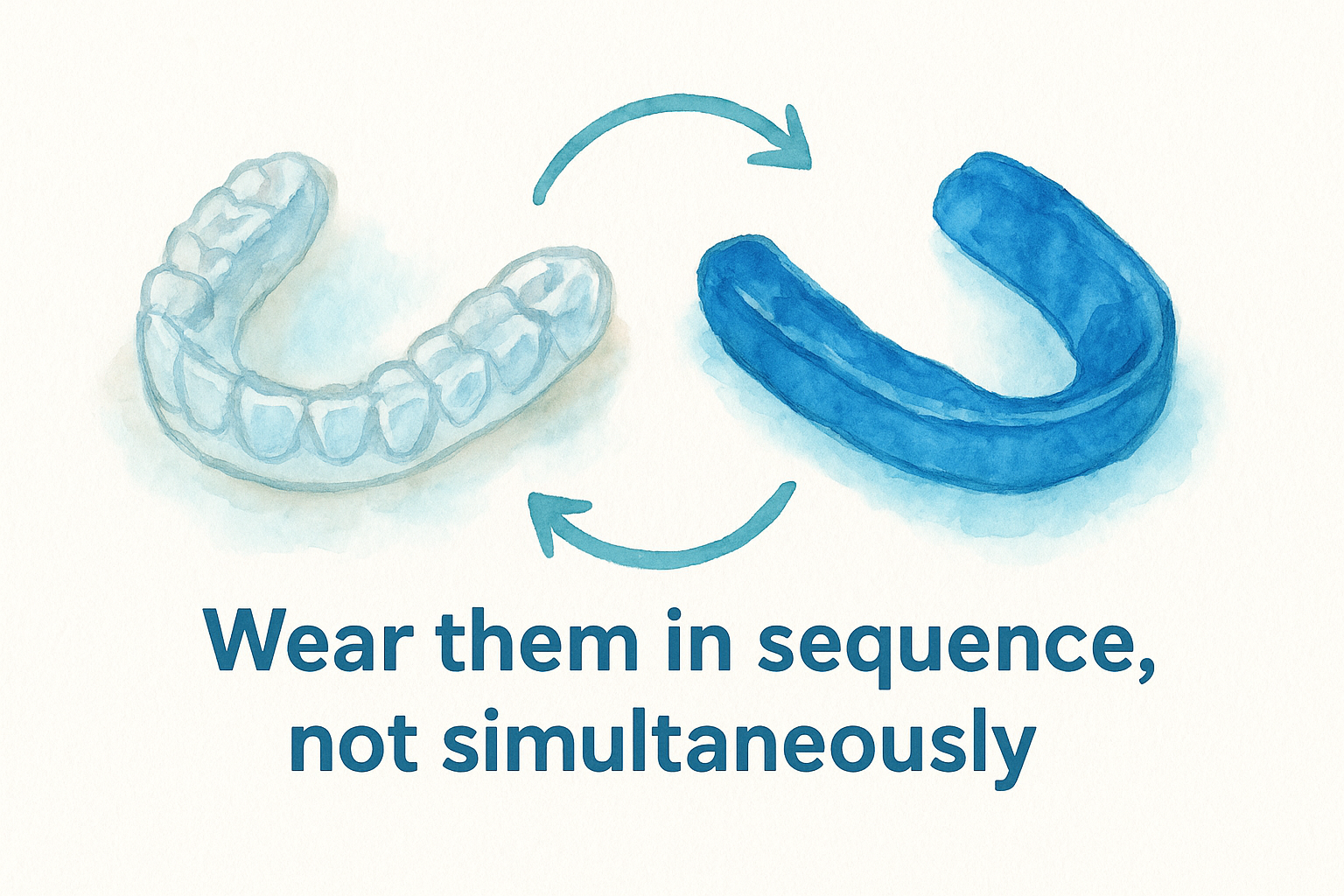
This approach keeps each appliance doing the job it was built for, without compromising either one.
If your grinding is severe enough that you worry about skipping the retainer at night, bring that concern directly to your dentist. There are cases where a specific type of night guard can be fabricated to provide some positional stability alongside bite force protection, but that requires a professional assessment and a custom design, not a standard over-the-counter solution.
Keep both appliances properly maintained
Two appliances mean twice the maintenance responsibility. Rinse each one after every use, store them in separate ventilated cases, and inspect them regularly for cracks, distortion, or changes in fit. A worn or warped appliance in either category stops performing its function without always showing obvious signs of failure. Replacing them on a consistent schedule protects both your teeth and your investment in each device.
Key takeaways and next steps
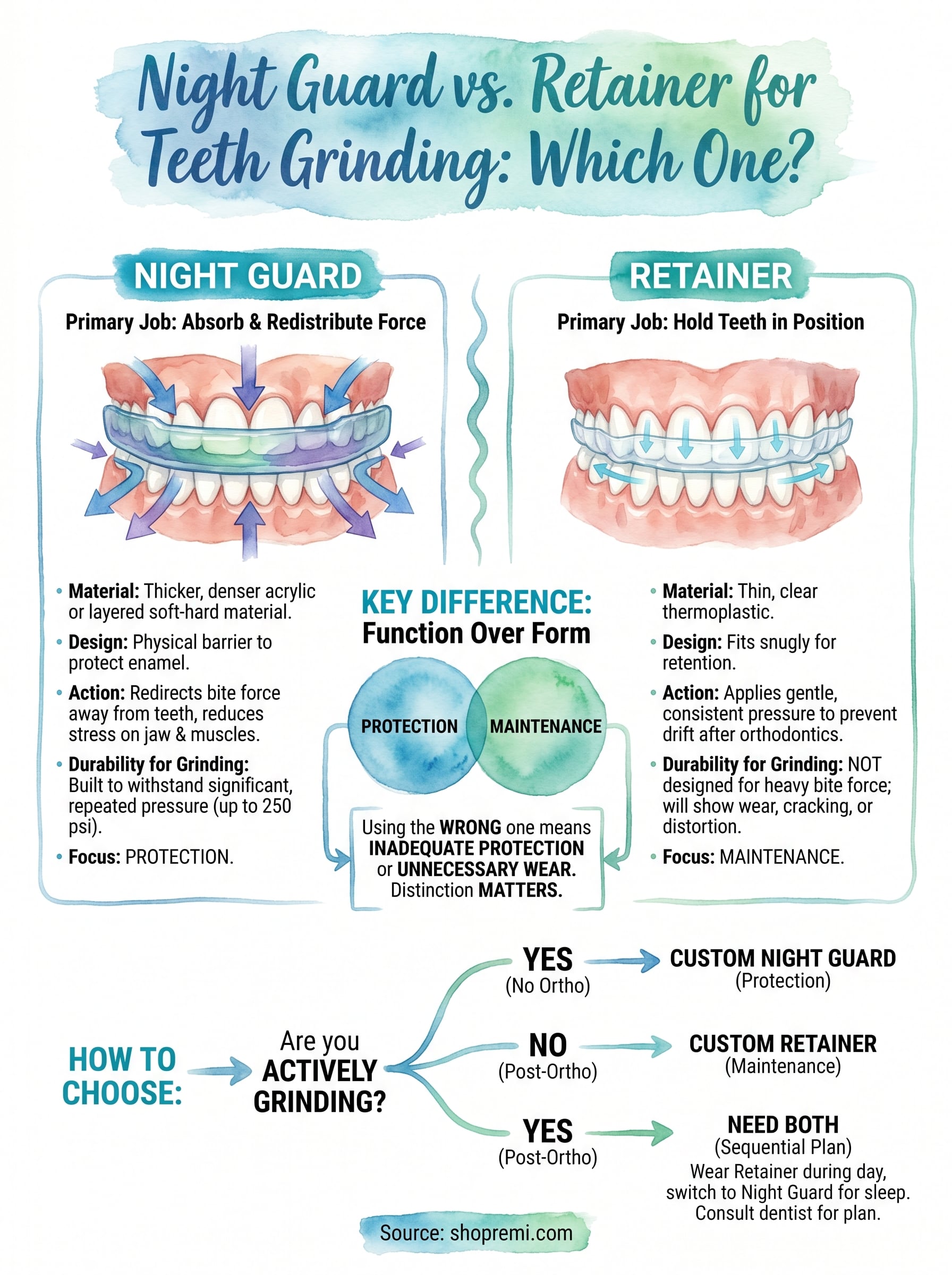
The night guard vs retainer for teeth grinding comparison comes down to function. A night guard protects your enamel by absorbing bite force. A retainer holds your teeth in position after orthodontic treatment. They look similar, but using one in place of the other leaves a gap in your care that shows up as worn enamel, a broken appliance, or shifting teeth over time.
If you grind, get a night guard built for that purpose. If you have had orthodontic work and also grind, you likely need both appliances and a simple plan for rotating them. Do not assume one device covers everything.
Taking the right step now protects your teeth from damage that cannot be reversed. If you are ready to stop grinding down your enamel, start with a custom night guard from Remi and get a precise fit without the dental office price tag.

