


Whitening products are everywhere, strips, gels, LED kits, charcoal powders, even whitening pens you can toss in your bag. With so many options fighting for your attention (and your money), it's hard to know which ones actually work without wrecking your enamel. That's exactly where ADA teeth whitening guidelines come in. The American Dental Association's Seal of Acceptance is one of the few markers that tells you a product has been independently tested for both safety and effectiveness.
But here's the thing: most people don't know what the ADA Seal actually means, which products carry it, or how ADA recommendations apply to newer whitening methods. And the difference between a clinically vetted product and a trendy one with good packaging can mean the difference between real results and sensitive, damaged teeth.
At Remi, we work alongside dental professionals to develop oral care products, including our Night Guard Cleaning + Teeth Whitening Foam, so understanding what the ADA recommends is something we take seriously. This article breaks down ADA-approved whitening products, the clinical guidelines behind them, safety tips to protect your enamel, and how to make smarter choices the next time you shop for a brighter smile.
What ADA teeth whitening means
The term ADA teeth whitening refers to whitening products and practices that align with the standards set by the American Dental Association, specifically those that have earned the organization's Seal of Acceptance. The ADA is a nonprofit professional association founded in 1859, and it has long served as one of the most trusted voices in dental health in the United States. When you see the ADA name attached to a whitening product, it signals that the product has gone through a formal review process, not just marketing claims reviewed by a company's own team.
The American Dental Association and oral care standards
The ADA sets clinical guidelines, publishes peer-reviewed research through the Journal of the American Dental Association, and runs a voluntary product-acceptance program that manufacturers can apply to participate in. This program is not a government regulation, which means companies are not required to seek ADA approval. Products that carry the Seal have chosen to submit their formulas and clinical data for independent review, which already tells you something about the manufacturer's confidence in their product.
A product without the ADA Seal isn't necessarily unsafe, but a product that has earned it has been held to a measurable standard by an outside body.
The ADA also issues official clinical recommendations for patients and dentists on whitening methods, including over-the-counter strips, in-office bleaching, and dentist-supervised take-home trays. These recommendations are based on clinical evidence, not trends or consumer demand, which is why they carry weight when you're trying to make an informed decision.
What "ADA-accepted" actually means for whitening products
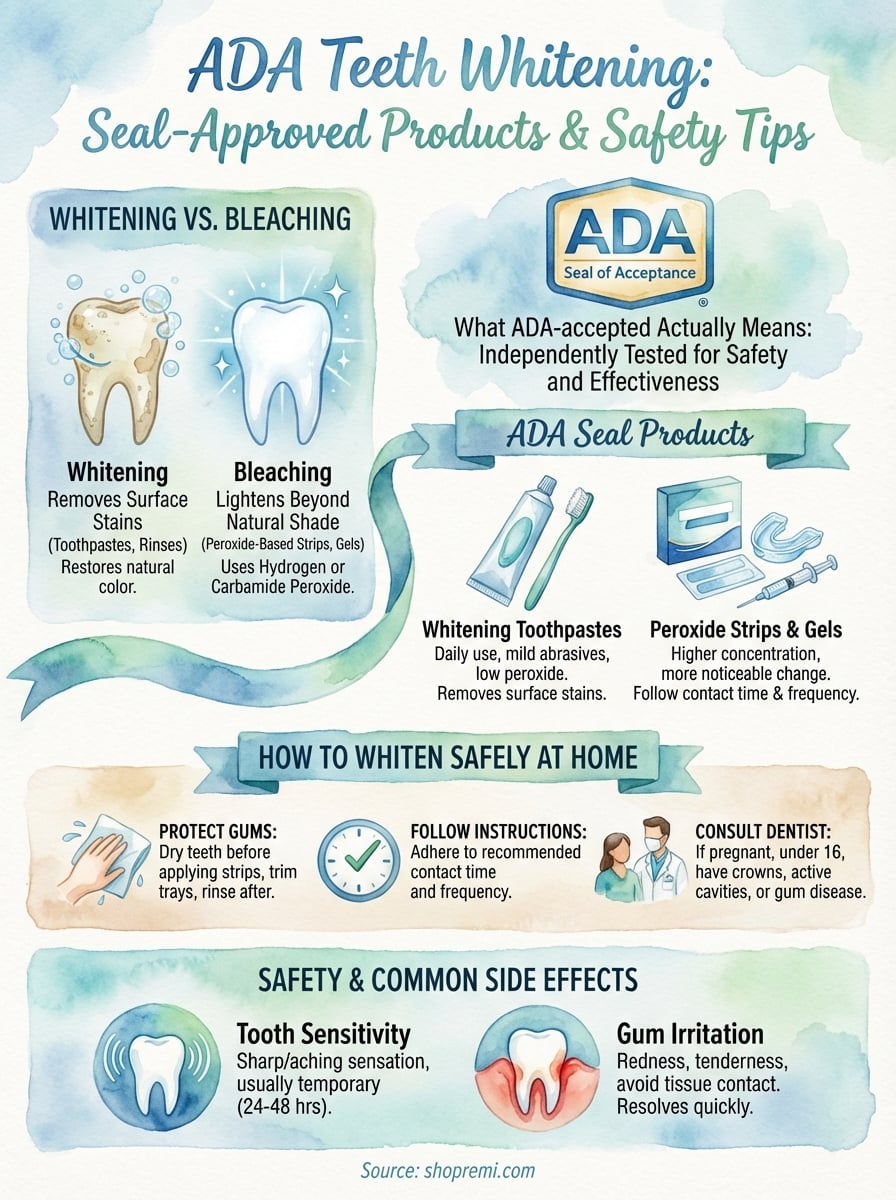
When the ADA grants its Seal of Acceptance to a whitening product, it means the product has demonstrated two things: it is safe for use on teeth and oral tissues, and it delivers the benefit claimed on the label. For whitening products, the active ingredient under review is almost always hydrogen peroxide or carbamide peroxide, both of which break down surface and subsurface stains through an oxidation process.
The ADA evaluates supporting data that includes clinical trials, laboratory studies, and ingredient safety profiles. Companies must also agree to honest, non-misleading labeling and advertising as part of accepting the Seal. If a product's formula changes significantly after earning the Seal, the company must resubmit for review.
For consumers, this means a Seal-bearing whitening product has been scrutinized beyond a company's own testing. The concentration of peroxide, the delivery method, and the contact time have all been assessed against safety benchmarks for enamel integrity and gum tissue health.
The difference between whitening and bleaching
These two words get used interchangeably all the time, but the ADA draws a clear distinction between them. Bleaching refers specifically to products that contain peroxide and can lighten teeth beyond their natural shade. Whitening, in the broader sense, refers to any process that restores the natural color of teeth by removing surface stains, which includes abrasive toothpastes and certain rinses.
Most products marketed as "whitening" that carry the ADA Seal are actually bleaching agents because they contain hydrogen or carbamide peroxide. Understanding this distinction helps you evaluate what a product can realistically do for your teeth and set accurate expectations before you spend money on a whitening routine.
Why the ADA Seal matters for whitening
The whitening market is crowded with products that make bold promises backed by thin evidence. When you search for ada teeth whitening options, you'll find hundreds of products competing for your attention, and most of them are not evaluated by any independent body. The ADA Seal of Acceptance cuts through that noise by giving you a concrete signal that an outside organization has reviewed the product's claims and found them credible.
The problem with unverified whitening products
Without independent verification, a whitening product only needs to avoid causing immediate, obvious harm to stay on the shelf. Marketing claims like "professional strength" or "enamel safe" carry no legal definition in the cosmetic product space, meaning any manufacturer can use them freely. You have no way to know if the peroxide concentration is appropriate, if the abrasive level is safe for daily use, or if the claimed whitening effect has been measured in a real clinical setting.
The absence of a verified standard means you're trusting the brand's own assessment of its own product, which is a significant conflict of interest.
Overuse of products with high peroxide concentrations or aggressive abrasives can wear down tooth enamel and increase tooth sensitivity, sometimes permanently. A product that whitens your teeth by two shades in a week but causes lasting nerve sensitivity is not a worthwhile outcome, and without a standard in place, you have no reliable way to screen for that risk before you buy.
What the Seal signals specifically for whitening
When a whitening product carries the ADA Seal, it tells you that the active ingredient has been tested at the concentration listed on the label and that the whitening benefit has been demonstrated under clinical conditions, not just captured in a before-and-after photo. The Seal also confirms that the product's labeling is accurate, meaning the directions, warnings, and ingredient list meet ADA standards for transparency.
For you as a consumer, this narrows your choices in a practical way. Instead of sorting through dozens of competing claims, you can start with Seal-bearing products and build your routine from there, knowing the baseline safety and effectiveness criteria have already been reviewed by an independent professional body before the product reached your bathroom counter.
How the ADA Seal of Acceptance works
The ADA Seal of Acceptance is a voluntary program, which means no company is required to apply. Manufacturers who choose to pursue the Seal are signaling that their product can hold up to independent scrutiny. For ada teeth whitening products specifically, this process is particularly rigorous because peroxide-based formulas interact directly with enamel and soft tissue, both of which need to be protected.
The application and review process
When a company applies for the Seal, it submits detailed documentation to the ADA's Council on Scientific Affairs. That documentation includes clinical trial data, laboratory testing results, full ingredient disclosures, and the product's labeling and advertising materials. The Council reviews all of it to confirm that the product delivers the benefit it claims and does so without posing a meaningful risk to your teeth or gum tissue.
The review is conducted by dental scientists and clinicians, not by the company that makes the product, which is what gives the Seal its credibility.
For whitening products, the Council pays close attention to peroxide concentration and the method of delivery, since the same active ingredient can behave very differently in a strip versus a tray versus a rinse. The contact time with enamel, the pH of the formula, and the potential for gum irritation all factor into the evaluation before the Seal is granted.
What happens after a product earns the Seal
Earning the Seal is not a permanent status. Companies must renew their Seal authorization on a regular basis and must resubmit for review if the product formula changes in a significant way. This ongoing requirement prevents a product from coasting on an old approval while quietly altering its ingredients or concentrations after the initial review.
The ADA also reserves the right to revoke the Seal if new safety data emerges or if a company's marketing strays into misleading territory. For you as a buyer, this means a product currently displaying the Seal has passed a recent review, not just a one-time check years ago. That ongoing accountability is a meaningful part of what the program actually delivers.
ADA Seal whitening products you can buy
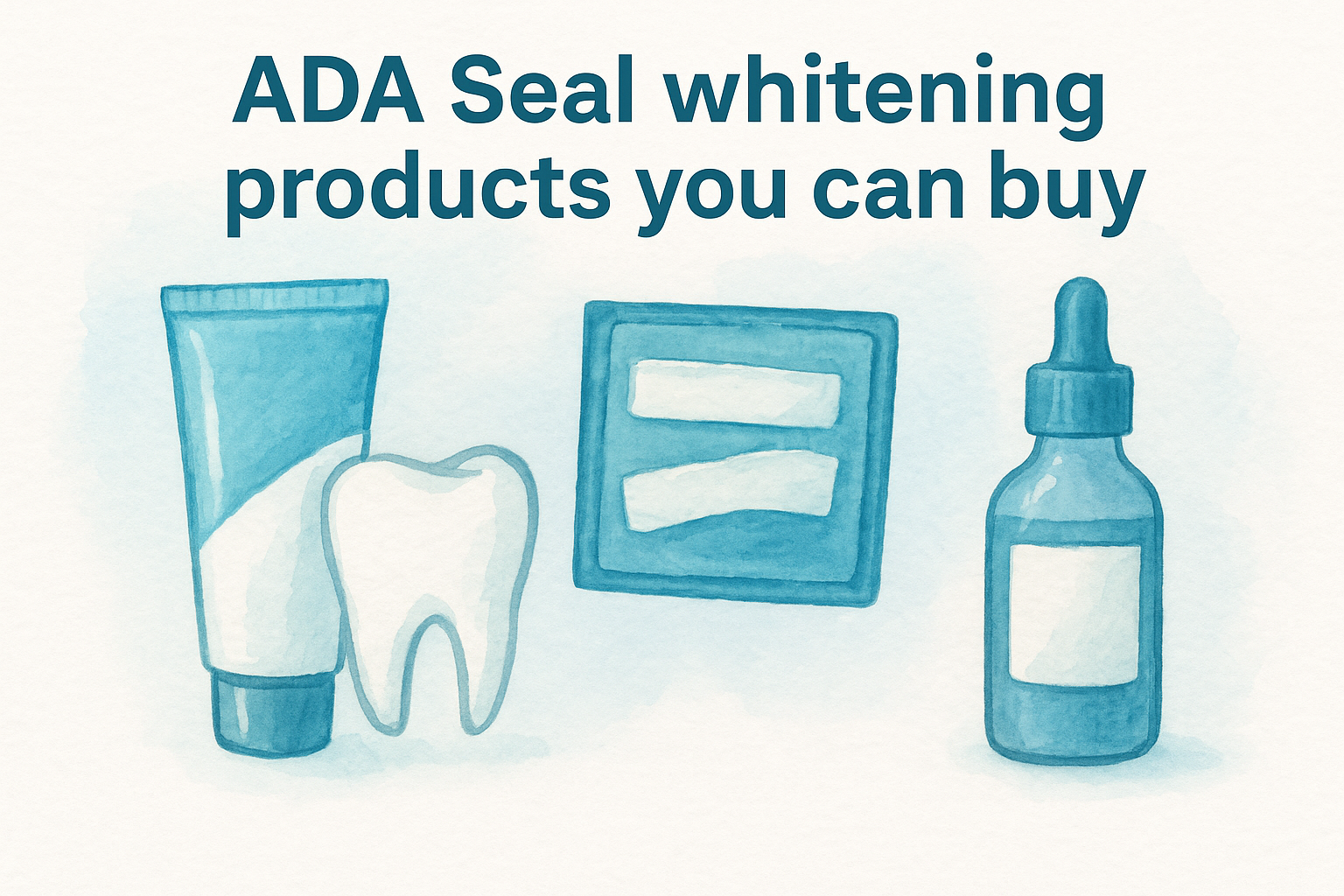
When you shop for ada teeth whitening products that carry the Seal, your choices fall into a few clear categories. The ADA has granted its Seal of Acceptance to products across multiple formats, including whitening toothpastes, whitening strips, and peroxide gels. Knowing which category fits your situation helps you pick a product that matches your sensitivity level, lifestyle, and whitening goals without overcomplicating your routine.
Whitening toothpastes
Whitening toothpastes with the ADA Seal use a combination of mild abrasives and low-concentration peroxide or other active agents to remove surface stains over time. Brands like Colgate and Arm & Hammer carry multiple Seal-accepted whitening toothpaste products that you can find at most grocery stores and pharmacies. These are a practical starting point if you have sensitive teeth or want to maintain existing whitening results rather than dramatically change your shade.
Whitening toothpastes work on surface stains only and will not lighten teeth beyond their natural color, which makes them a maintenance tool rather than a primary whitening treatment.
These products are designed for daily use, which is why the Seal evaluation for toothpastes places particular weight on abrasive safety. You can use them as a regular part of your brushing routine without worrying about exceeding the contact time that causes enamel wear.
Whitening strips and peroxide gels
Strips and gels deliver a higher concentration of hydrogen peroxide than toothpastes, which means they can produce more noticeable shade changes over a treatment period. Crest 3D Whitestrips with the ADA Seal is one of the most widely available strip products that has passed independent review for both safety and effectiveness. These products hold the peroxide gel against your enamel for a set amount of time, typically between 30 minutes and an hour depending on the product.
You apply them according to the package instructions, and sticking to that schedule matters. Using strips more frequently than recommended does not accelerate your results, but it does increase your risk of tooth sensitivity and gum irritation. Seal-bearing strips have been tested at their labeled concentrations for a reason, and following the directions is how you get the results the clinical data supports.
How to whiten safely at home
Following ada teeth whitening guidelines at home comes down to a few straightforward habits. Most whitening mishaps happen not because a product is fundamentally flawed, but because people use it inconsistently, apply it too often, or skip steps that protect their gums and enamel. Getting real results safely means paying attention to the process, not just the product.
Start with the right product for your sensitivity level
Your starting point should match your current tooth sensitivity. If your teeth already respond to hot or cold drinks, a high-concentration strip applied daily will make that worse, not better. Start with a Seal-accepted whitening toothpaste to gauge how your enamel responds before moving up to a strip or gel treatment. Give yourself at least two weeks of toothpaste use before introducing a peroxide strip, so you have a clear baseline.
When you do move to strips or gels, read the instructions before you open the packaging. The contact time and frequency listed on an ADA Seal product are based on clinical data reviewed during the approval process. Following those instructions is how you replicate the results the Seal was actually granted for.
Protect your gums during treatment
Strips and gels work best when the peroxide stays on your enamel and off your gum tissue. Before you apply any strip, dry your teeth lightly with a clean cloth or tissue so the strip adheres to the tooth surface rather than sliding toward your gums. If a gel tray comes with your product, make sure it fits your teeth well and trim any excess material that pushes the gel onto soft tissue.
Rinsing your mouth with plain water immediately after removing a strip or tray helps clear residual peroxide from your gum line.
If you notice redness or soreness along your gumline after a treatment session, skip the next scheduled application and let the tissue recover before continuing. Pushing through irritation does not speed up your results, it just extends the recovery time you will need later. Spacing your sessions out by an extra day or two when sensitivity flares is a minor adjustment that protects your long-term oral health.
Safety, side effects, and who should avoid it
Following ada teeth whitening guidelines reduces your risk significantly, but even Seal-accepted products carry some side effects you should know before you start. The most common ones are tooth sensitivity and mild gum irritation, both of which are typically temporary and resolve within a day or two after you finish a treatment cycle. Knowing what to expect helps you distinguish between a normal response and a sign that you need to slow down or stop.
Common side effects to expect
Tooth sensitivity is the most frequently reported side effect of peroxide-based whitening, and it happens because peroxide temporarily increases the permeability of your enamel. You may notice a sharp or aching sensation when you consume hot, cold, or sweet foods during or after a treatment period. This usually resolves within 24 to 48 hours after you finish the treatment, and using a sensitivity toothpaste with potassium nitrate in the days leading up to and following a whitening session can help reduce the discomfort.
If sensitivity lasts longer than 72 hours or becomes severe, stop the treatment and consult your dentist before continuing.
Gum irritation typically shows up as temporary redness or tenderness along the tissue closest to your teeth. It usually means the peroxide gel made direct contact with your soft tissue during application, which you can prevent by following the protective steps covered in the prior section. Most mild irritation clears up within a day.
Who should avoid whitening products
Certain groups should consult a dentist before using any peroxide-based whitening product, regardless of whether it carries the ADA Seal. If you have crowns, veneers, or bonding, peroxide will not lighten those restorations the way it lightens natural enamel, which means you could end up with uneven color across your teeth. People with active cavities or gum disease should also hold off, since peroxide can penetrate damaged enamel and irritate already-compromised tissue.
Children under 16 should avoid peroxide whitening products because their pulp chambers are larger and more vulnerable to sensitivity. Pregnant or nursing individuals should skip whitening treatments until after the relevant period ends, since the safety data on peroxide use during pregnancy is limited and not worth the risk.
Key takeaways and next steps
Navigating ada teeth whitening options is straightforward once you know what to look for. Products carrying the ADA Seal of Acceptance have been independently reviewed for safety and effectiveness, which takes the guesswork out of choosing between the dozens of options on store shelves. Whitening toothpastes work on surface stains and suit daily maintenance, while peroxide strips and gels produce more noticeable shade changes when used as directed. Stick to the instructions, protect your gums during treatment, and give your teeth recovery time if sensitivity flares up.
Certain groups, including people with crowns, active gum disease, or significant enamel wear, should check with a dentist before starting any peroxide-based treatment. Your oral health foundation matters before you add whitening to your routine. If you grind your teeth at night, protecting your enamel from grinding damage is just as important as whitening it, so consider a custom night guard as part of your complete oral care plan.

