
 Guards + Retainers
 Custom Night Guard
 Retainer
 Emergency Order

 Whitening
 Whitening Kit
 Teeth Whitening Gel
 Dual-Action Foam
 Cleaning + Care
 Ultrasonic Cleaner Pro
 Water Flosser
 UV Toothbrush Sanitizer
 Deep Clean + Freshening Tablets
 Accessories
 Guard Removal Tool
 Replacement Nozzles
 Bundles

You bite into an apple and something feels off. Your bottom teeth look a little crowded, or a gap appeared where there wasn't one before. These are common signs your teeth are shifting, and they're more normal than you might think. Teeth can move at any age, whether you wore braces years ago or never had orthodontic work at all.
The tricky part is that shifting often happens gradually, so many people don't notice until their bite feels wrong, a retainer no longer fits, or they catch a change in the mirror. Grinding and clenching at night can speed up the process, which is one reason we developed Remi's custom night guards, to protect teeth from the kind of repeated pressure that pushes them out of place.
This article breaks down ten clear signs that your teeth may be moving, what's causing it, and practical steps you can take to slow or stop the shift before it gets worse.
1. Your retainer or night guard no longer fits
A retainer or night guard that once slipped in effortlessly suddenly feels tight, pushes on certain teeth, or won't seat fully. This is one of the most concrete signs your teeth are shifting, because these appliances are molded to the exact position of your teeth. Any movement, even a fraction of a millimeter, shows up as a poor fit.
What you may notice
Your retainer might feel tight on one side but loose on the other, or it may leave red marks on your gums when you remove it. A night guard can start to rock or tilt instead of sitting flat against your teeth. Some people also notice a dull ache in specific teeth for the first hour or two after wearing an appliance that no longer fits correctly.
Why it happens
Teeth move in small increments throughout your life. The periodontal ligaments that anchor each tooth to the jawbone allow micro-movements in response to pressure. If you skip wearing your retainer regularly, nothing holds your teeth in the positions your orthodontist set. Night grinding adds repetitive lateral force to your teeth, pushing them out of alignment over months or years without you feeling it happen.
A retainer that fits poorly is not just uncomfortable; it means your teeth have already moved enough for the change to be physically measurable.
How to confirm it at home
Put your retainer or night guard in and bite down gently. If you feel uneven pressure or notice a visible gap between the appliance and your teeth on one side, the fit has changed. You can also hold the appliance up to a light source after removing it and look for light showing through areas that should sit flush against your teeth.
Fixes and your next step
Visit your dentist to rule out gum disease or bone loss driving the movement. If your retainer no longer fits, you will likely need a new impression for a replacement. Remi offers custom-fitted retainers and night guards made from at-home impressions, so you get a properly fitted replacement without scheduling multiple office visits or paying dental office prices.
2. New gaps or spaces appear
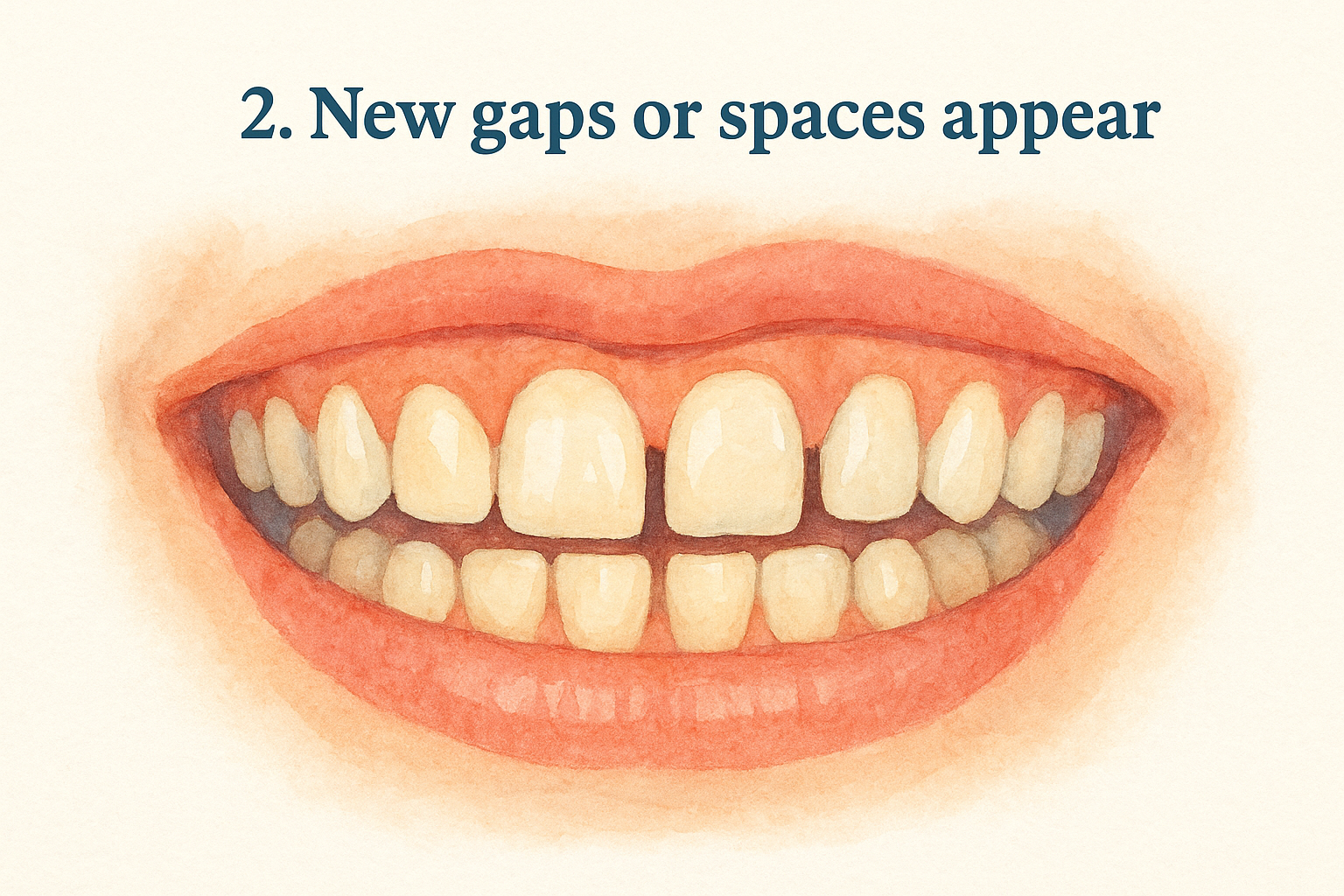
A space that wasn't there six months ago is one of the more visible signs your teeth are shifting. These gaps can appear between any two teeth, though they're most noticeable between the front teeth where they're hard to ignore.
What you may notice
You might spot a new gap between your front teeth or notice that food gets trapped in areas where it never did before. The change can feel sudden, but it almost always builds slowly over months before it becomes obvious in the mirror.
Why it happens
Gaps form when teeth drift apart due to gum disease, bone loss, or an unaddressed missing tooth. When a tooth is lost and not replaced, the surrounding teeth gradually migrate toward the empty space. Tongue thrusting and chronic grinding can also push front teeth forward and apart over time.
Gum disease is one of the leading drivers of tooth migration in adults, and gaps that appear without an obvious reason are worth investigating quickly.
How to confirm it at home
Take a close-up photo of your teeth in good lighting and compare it to an older photo if you have one. Running dental floss between your teeth can also reveal whether resistance has changed in certain spots.
Fixes and your next step
See your dentist to identify the root cause. If gum disease is involved, treating it early can stop further movement. A properly fitted retainer worn consistently helps hold your teeth in place once the underlying issue is under control.
3. Teeth crowd, overlap, or rotate
Crowding and rotation are among the more visible signs your teeth are shifting, and they tend to appear first in the lower front teeth. What starts as a subtle twist or slight overlap can deepen into noticeable misalignment if the pressure driving it goes unaddressed.
What you may notice
One tooth may begin to rotate slightly or push in front of its neighbor. You might also find that a tooth which sat straight now tucks slightly behind the others, making brushing and flossing specific areas harder than it used to be.
Why it happens
As you age, your jaw naturally narrows, which pushes the lower front teeth inward and forces them to crowd together. Grinding compounds this by applying repetitive lateral force that slowly rotates teeth out of the positions they held for years.
Crowding in adults rarely reverses on its own. The forces behind it keep working unless you take steps to address them.
How to confirm it at home
Run your tongue slowly along the front surfaces of your lower teeth and feel for any rotation or uneven ridging. Taking a close-up photo in direct lighting also makes overlapping or twisting far easier to spot than a quick glance in a bathroom mirror.
Fixes and your next step
Talk to your dentist about whether a retainer or orthodontic correction makes sense for your situation. Wearing a properly fitted night guard consistently can reduce the grinding pressure that speeds up crowding over time.
4. Your bite feels off
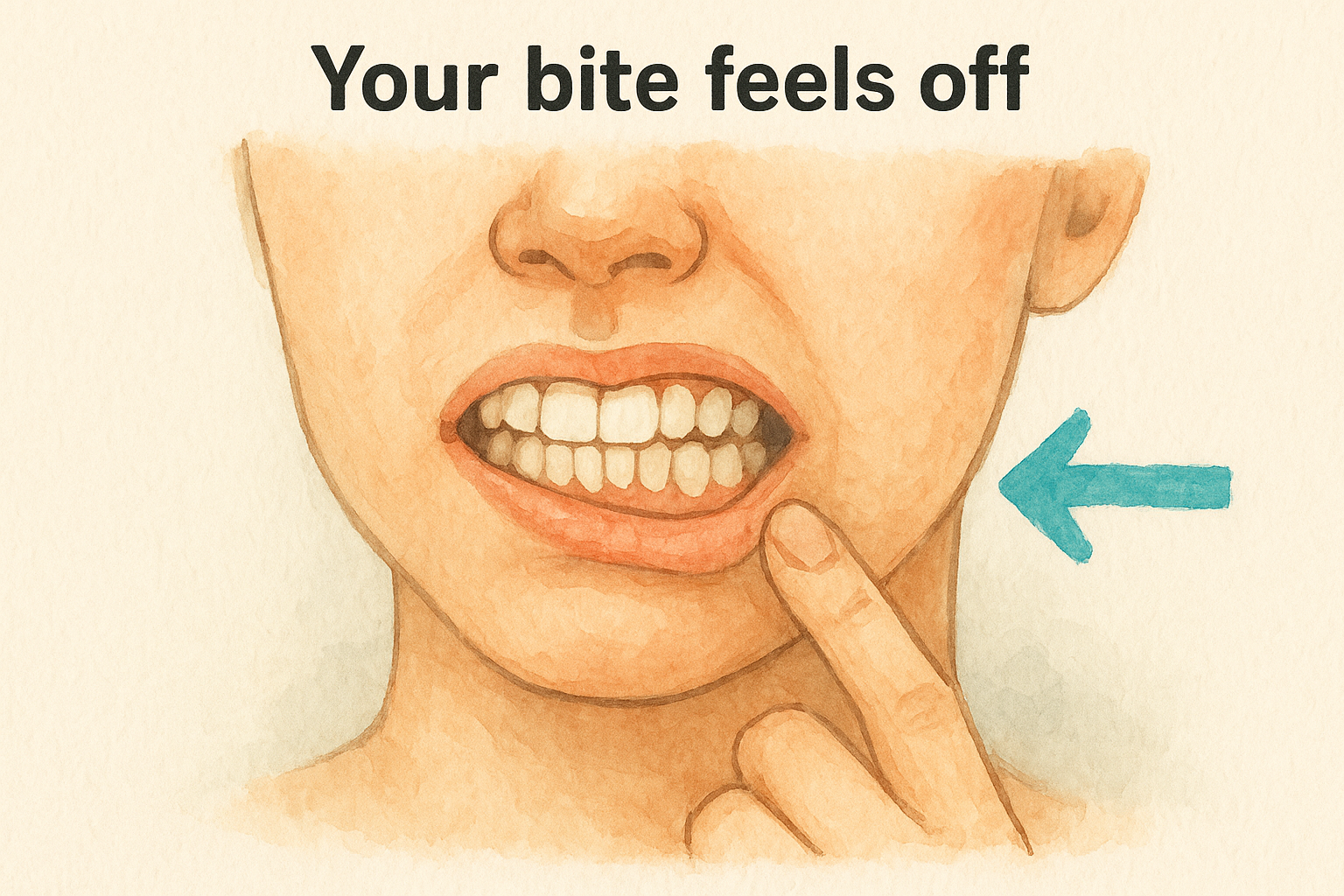
A bite that feels slightly different when you chew is one of the subtler signs your teeth are shifting, but it's worth paying attention to. When teeth move, the contact points between your upper and lower teeth change, and your jaw muscles register that difference almost immediately.
What you may notice
You might feel like your upper and lower teeth don't meet evenly when you bite down, or that one side hits before the other. Some people notice they unconsciously shift their jaw sideways to find a comfortable closing position, which is itself a signal that something has changed.
Why it happens
When teeth drift, the cusps and biting surfaces that once lined up perfectly no longer match. Grinding speeds this up by wearing down contact points unevenly, which shifts the way your teeth come together over months.
A bite that shifts noticeably can put extra strain on your jaw joints and trigger soreness that spreads to your temples or neck over time.
How to confirm it at home
Bite down slowly and pay attention to which teeth touch first. If one side consistently hits before the other, or if your jaw has to shift sideways to settle into a closed position, your bite has likely changed since your teeth last shifted.
Fixes and your next step
Tell your dentist exactly where and how the bite feels different so they can check for movement, wear, or joint strain. A properly fitted night guard reduces the grinding pressure that drives uneven wear and keeps bite changes from compounding over time.
5. You get new tooth sensitivity or soreness
New sensitivity to hot, cold, or pressure is one of the less obvious signs your teeth are shifting, but it often points to real movement happening beneath the surface. When a tooth moves, the surrounding bone and ligament tissue adapt to the new position, which can leave the root temporarily exposed or under unusual stress.
What you may notice
Sharp pain when drinking cold water or biting down on something hard can appear without any obvious cause like a cavity or cracked tooth. Some people also notice a dull, persistent ache in one or two specific teeth that wasn't there before. Common patterns include:
- Sensitivity in teeth that never bothered you before
- Soreness that fades within an hour of waking up
- Tenderness when you press on a specific tooth with your tongue
Why it happens
Shifting teeth put uneven pressure on the periodontal ligament, the tissue connecting each tooth to the jawbone. Grinding and clenching also wear down tooth enamel over time, exposing the more sensitive dentin layer beneath and making temperature changes feel sharp.
Sensitivity that appears in a tooth with no decay and no recent dental work is worth mentioning to your dentist, as movement is a likely cause.
How to confirm it at home
Drink a glass of cold water slowly and note which teeth react. Then press your fingertip gently against each tooth and check for unusual tenderness or soreness that seems unrelated to any existing dental work.
Fixes and your next step
Tell your dentist where the sensitivity is concentrated. A custom night guard limits the grinding pressure that strips enamel and irritates the ligament, reducing the soreness that follows ongoing tooth movement.
6. Your gums bleed, recede, or feel tender
Gum changes are among the most overlooked signs your teeth are shifting, partly because bleeding or tenderness is easy to blame on brushing too hard or skipping floss for a few days.
What you may notice
Your gums may bleed during brushing even when you're being gentle, or you may notice the gumline on certain teeth looks lower than it used to. Persistent tenderness along the gumline is another signal, especially when it concentrates around specific teeth rather than spreading evenly. Common patterns include:
- Gums that bleed with minimal brushing pressure
- Visible recession around one or two specific teeth
- Soreness that lingers after eating
Why it happens
Shifting teeth create uneven pressure on the surrounding gum tissue, which triggers inflammation, bleeding, and eventual recession. Gum disease also causes the bone and tissue supporting each tooth to break down, which is both a cause and a consequence of tooth movement.
Gum recession exposes the root surface of a tooth, making it more vulnerable to sensitivity, decay, and further movement.
How to confirm it at home
Run your finger along your gumline above and below your teeth and check for areas that feel swollen or tender. Then compare recent photos to older ones and look for teeth that appear longer than before.
Fixes and your next step
See your dentist if you notice consistent bleeding or visible recession. Treating gum disease early stops the tissue loss that allows teeth to drift further out of position.
What to do next
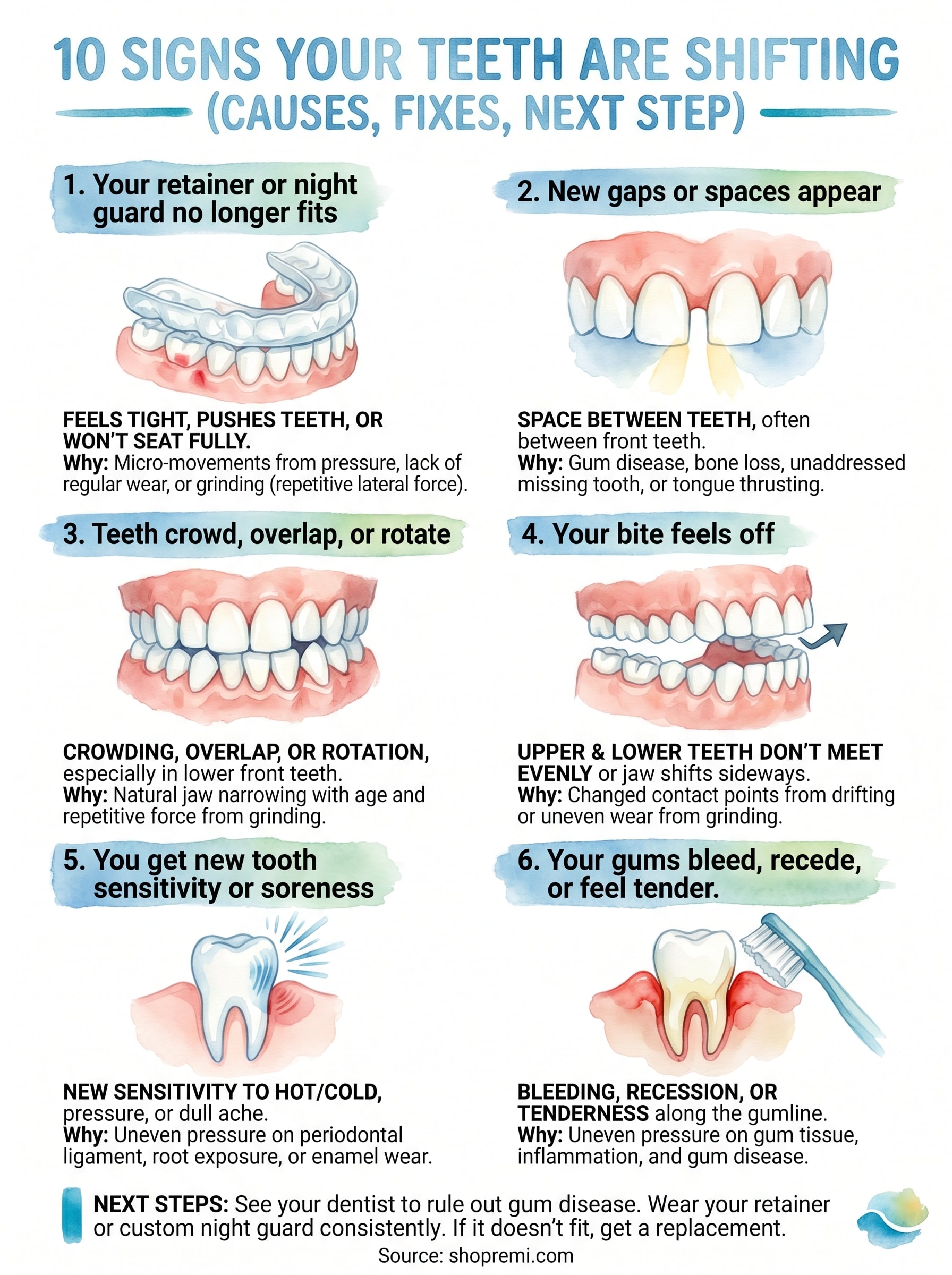
The signs your teeth are shifting covered in this article range from a retainer that no longer fits to gum recession that slowly exposes your roots. Any one of these symptoms deserves attention, but more than one appearing at the same time is a clear signal to act.
Start by booking an appointment with your dentist to rule out gum disease or bone loss. From there, the single most effective habit you can build at home is wearing your retainer or night guard consistently. If your current appliance no longer fits, replace it. A poorly fitting guard provides no real protection and can make shifting worse over time.
Remi makes it straightforward to get a properly fitted replacement without the dental office price tag. If grinding is part of your problem, a custom night guard built from your own impression is the most direct way to protect your teeth from further movement.

