
 Guards + Retainers
 Custom Night Guard
 Retainer
 Emergency Order

 Whitening
 Whitening Kit
 Teeth Whitening Gel
 Dual-Action Foam
 Cleaning + Care
 Ultrasonic Cleaner Pro
 Water Flosser
 UV Toothbrush Sanitizer
 Deep Clean + Freshening Tablets
 Accessories
 Guard Removal Tool
 Replacement Nozzles
 Bundles

You started wearing a night guard to protect your teeth from grinding, so it's understandably alarming when something feels off with your bite the next morning. If you've ever wondered "do night guards move teeth?" the short answer is: a properly fitted custom guard shouldn't, but a poorly fitted one absolutely can. It's one of the most common concerns we hear from customers at Remi, and it deserves a straight answer.
The difference usually comes down to fit. Generic, over-the-counter night guards and boil-and-bite options can apply uneven pressure across your teeth overnight, and that repeated force over weeks or months is enough to cause subtle, or not so subtle, shifting. A custom-fitted night guard, on the other hand, is made from an exact mold of your teeth, distributing force evenly and keeping everything where it belongs. That's exactly why Remi's night guards start with an at-home impression kit, so your guard matches your bite precisely, not approximately.
This article breaks down when and why night guards can change your bite, what warning signs to watch for, and how to make sure your guard is protecting your teeth rather than rearranging them.
Why night guards sometimes change your bite
When you ask "do night guards move teeth," the most honest answer starts with understanding how teeth respond to pressure. Your teeth are not anchored rigidly in your jaw. They sit in a periodontal ligament that allows for slight movement in response to sustained force, which is the same principle behind orthodontic treatment. A night guard sits between your upper and lower teeth for six to eight hours at a stretch, and if it applies uneven or incorrect pressure night after night, your teeth will respond to that force over time.
Poor fit is the main culprit
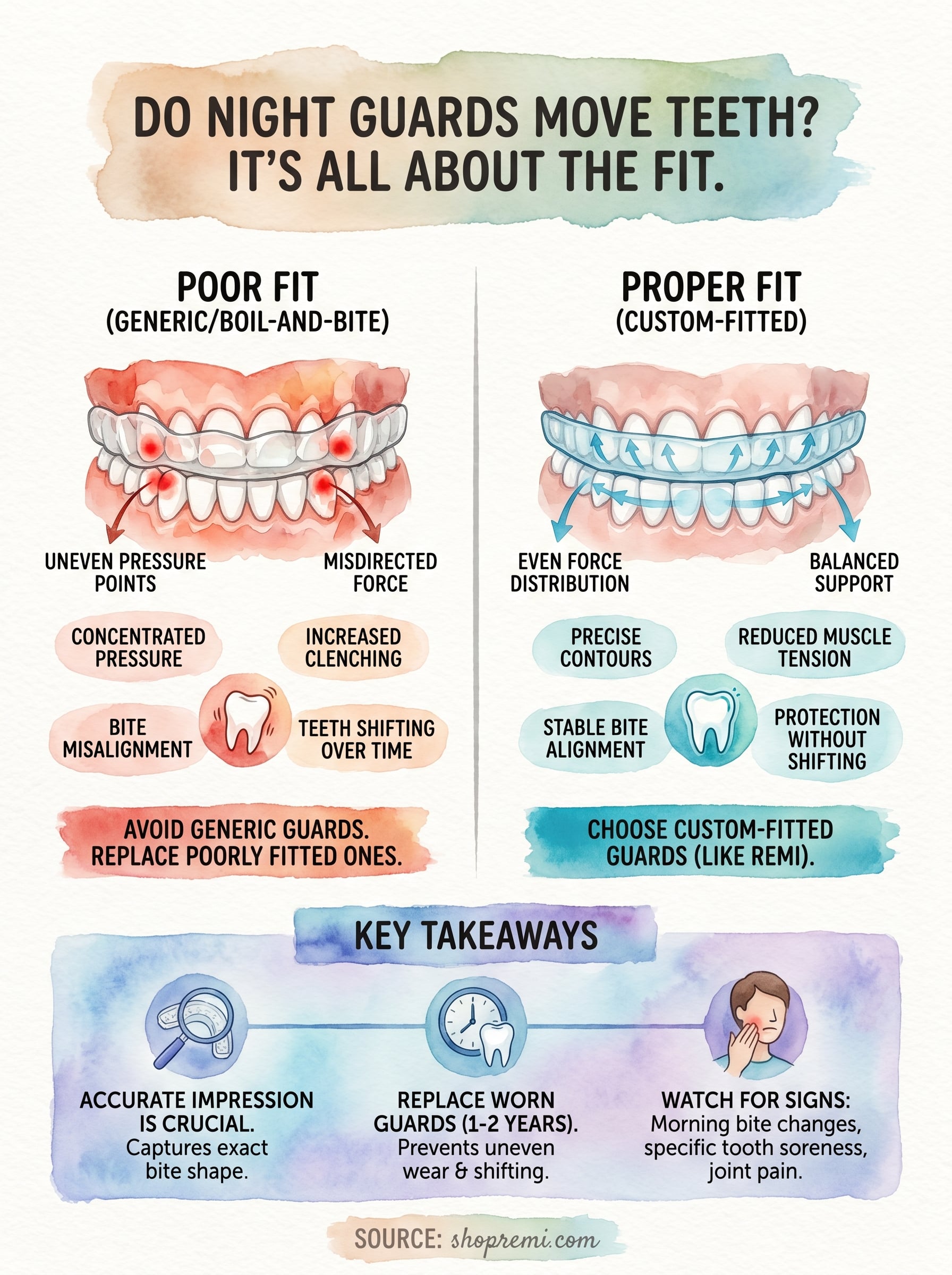
Over-the-counter and boil-and-bite guards are made to fit a generalized bite shape, not yours specifically. When a guard doesn't match the exact contours of your teeth, it creates concentrated pressure points in certain spots while leaving gaps in others. Those pressure points act like low-grade orthodontic force, and given enough repetition, they shift the teeth that bear the most load. You might not notice anything after a single night, but after several weeks of use the change can become obvious in how your back teeth meet or whether your front teeth close properly.
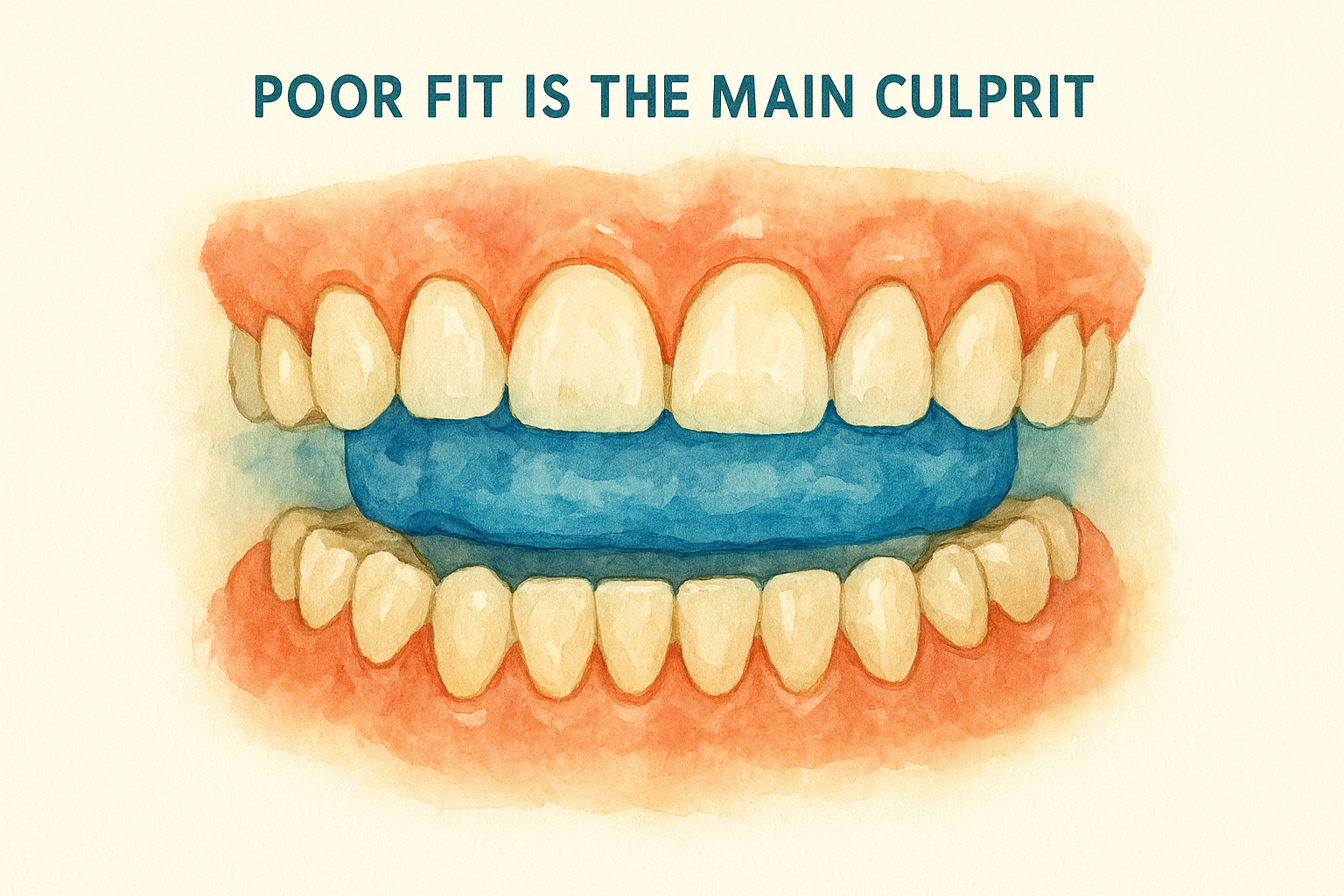
A guard that fits poorly doesn't just fail to protect your teeth, it actively works against them by applying misdirected force while you sleep.
Thickness and jaw repositioning
Another factor people rarely consider is guard thickness. A guard that is too thick forces your jaw into an unnaturally open position, which changes how your muscles and joints settle through the night. This altered jaw position can affect your bite alignment when you wake up. While morning bite changes are sometimes temporary in the early weeks of use, a guard that is consistently too thick can train your jaw muscles to settle in the wrong resting position. The result is a bite that no longer feels right without the guard in place, which is the opposite of what the guard was meant to accomplish.
Material hardness and pressure distribution
Hard acrylic guards, when made correctly from a precise dental mold, distribute grinding force across a wide, even surface. When that same hardness exists in a guard that doesn't fit well, the rigid material has no flex to compensate, so all the pressure concentrates at whatever contact points happen to land. Soft or semi-soft guards introduce a different problem: your teeth naturally want to bite into soft material, which tends to increase clenching rather than discourage it. That extra clenching raises the total force your teeth and jaw absorb overnight. Neither material type works in your favor unless the guard was designed specifically around the shape of your bite from the start.
How to stop a night guard from moving teeth
If do night guards move teeth is a concern you're actively dealing with, the fix usually starts with how the guard was made. Custom-fit guards eliminate the guesswork of generic sizing by capturing the exact shape of your bite before anything is manufactured. When your guard matches your teeth precisely, it applies even, distributed pressure rather than concentrating force on random contact points.
Start with an accurate dental impression
Getting a high-quality impression is the foundation of a guard that actually protects your teeth. Rushed or poorly taken impressions introduce inaccuracies that carry through to the finished guard, which means even a "custom" product can create problems if the mold wasn't accurate. Follow the impression instructions carefully, make sure all teeth are fully captured in the material, and don't cut the setting time short.
A guard is only as accurate as the impression it was made from, so taking that step seriously protects everything that comes after.
- Seat the tray evenly on both sides before biting down
- Allow the impression material to set completely before removing it
- Inspect the impression for voids or distorted areas before sending it in
Replace your guard when it wears down
Even a perfectly fitted guard eventually degrades. Worn-down material changes how your teeth contact the guard's surface, which can reintroduce uneven pressure over time. Most guards need to be replaced every one to two years, depending on how severely you grind. If you notice visible thinning, rough patches, or a change in how your bite feels in the morning, that's a clear sign the guard has reached the end of its useful life and needs to be swapped out before it starts working against you.
What a proper night guard fit should feel like
A well-fitted night guard should feel snug but not tight, and it should seat fully over your teeth without requiring force. When you first put it in, you'll feel slight resistance as the guard settles against your teeth, but after a few seconds that resistance fades. If it feels like you're constantly biting down to keep it in place, or if it rocks side to side, those are immediate signs the fit is off and the guard may do more harm than good.
Signs the fit is right
Your guard should stay in place without clenching your jaw to hold it there. It should cover all your teeth evenly, and when you close your mouth with the guard in, your bite should feel balanced rather than heavy on one side. Morning discomfort is normal in the first week or two as your jaw adapts, but that should fade as you get used to wearing it. If the adjustment period stretches past three weeks or the discomfort increases rather than decreases, something needs to be re-evaluated.
A properly fitted guard becomes easy to ignore within a few nights, which is exactly what you want when the goal is uninterrupted sleep.
Red flags that something is off
If you consistently ask yourself "do night guards move teeth," start by checking whether your bite feels different in the morning compared to before you started wearing the guard. Soreness in specific teeth rather than general jaw muscle fatigue is a warning sign that certain teeth are absorbing more pressure than others. Other red flags include a guard that feels loose after a few months of use, visible indentations from your teeth biting through the material, or difficulty closing your back teeth together when the guard is removed. Any of these signs warrant replacing your current guard with one built from a fresh, accurate impression.
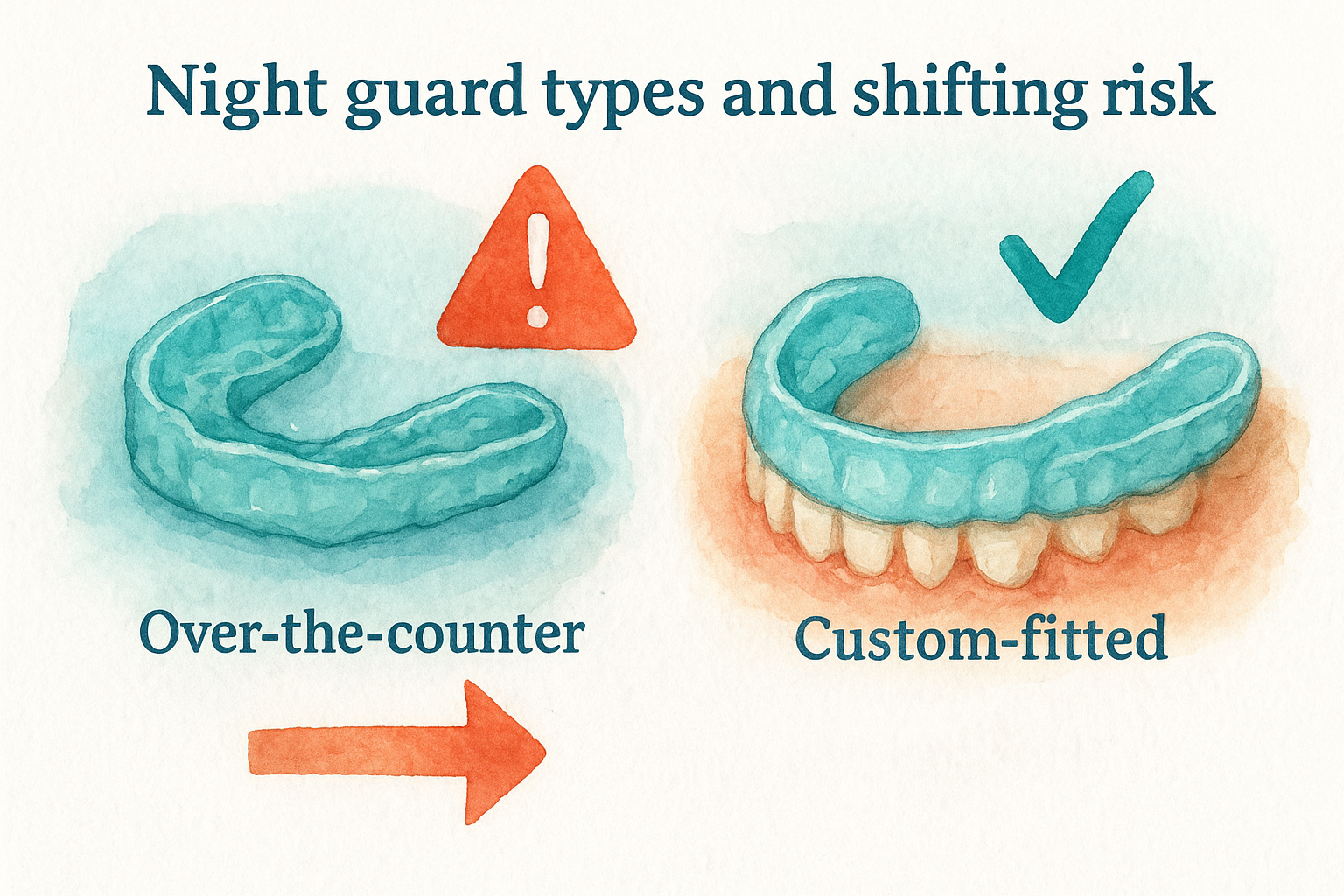
Night guard types and shifting risk
Not all night guards carry the same level of risk when it comes to shifting. The type you choose directly affects how force is distributed across your teeth each night, and some options create far more problems than they solve. Understanding where each type falls on the risk spectrum helps you make a smarter decision before you spend months wearing something that works against your bite.
Over-the-counter and boil-and-bite guards
Stock guards and boil-and-bite options are the highest-risk category when you're asking do night guards move teeth. Stock guards come in a fixed shape with no customization at all, which means pressure lands wherever the plastic happens to contact your teeth. Boil-and-bite guards allow some adjustment, but the softened material only captures a rough approximation of your bite, not an accurate one. Both types tend to sit unevenly, and that uneven contact is exactly what applies the kind of repeated pressure that shifts teeth over time.
Convenience is not worth much when the product you're using is actively misaligning the teeth it was supposed to protect.
Common risks with over-the-counter options include:
- Uneven contact points that concentrate pressure on certain teeth
- Material that encourages biting and clenching rather than reducing it
- Poor retention that causes your jaw to reposition itself overnight
Custom-fitted guards
Custom guards made from accurate dental impressions carry the lowest shifting risk because they distribute force across the full surface of your teeth rather than isolated contact points. When the guard was built around the actual shape of your bite, every tooth shares the load evenly. The material thickness is also calibrated to your jaw's natural resting position, so your muscles settle where they should rather than being pushed into a compensating posture. A properly fitted custom guard protects your teeth without the structural trade-offs that come with generic alternatives.
When to call a dentist or orthodontist
Self-monitoring goes a long way, but some situations require a professional to step in. If you've been asking do night guards move teeth because something already feels wrong with your bite, don't wait to see if it resolves on its own. Bite changes that persist beyond a few hours in the morning are not a normal adjustment phase and deserve professional attention before the problem compounds.
Signs your teeth have already shifted
You should book an appointment if you notice specific teeth hitting before others when you bite down, or if your front teeth no longer close the way they did before you started wearing a guard. These are not minor discomforts that go away with time. They indicate that sustained, uneven pressure has already moved something, and continuing to wear the same guard will only push things further in the wrong direction. Your dentist can take updated bite records, compare them to your baseline, and identify exactly what shifted and by how much.
The sooner you bring bite changes to a professional, the more options you have for correcting them before the shift becomes permanent.
Watch for these specific warning signs that warrant a call:
- Your back teeth don't touch evenly when you close your mouth
- You notice gaps or spacing between teeth that weren't there before
- Jaw soreness migrates to specific teeth rather than staying in the muscles
- Your guard no longer fits the way it did when you first received it
When bite changes involve your jaw joints
If your bite shift comes with clicking, popping, or pain in your jaw joints, that points to a temporomandibular issue rather than simple tooth movement. A guard that repositions your jaw incorrectly can irritate the temporomandibular joint (TMJ), and that requires evaluation by a dentist or oral specialist who can assess both the joint and the fit of your guard together.
What to do next
If do night guards move teeth has been your lingering concern, the answer is clear: fit determines everything. A guard built from an accurate impression of your exact bite distributes force evenly and keeps your teeth where they belong. A generic or poorly made guard does the opposite. The good news is that switching to a properly fitted option stops the problem before it becomes a permanent one, and you don't need a dental office visit to get there.
Remi's at-home impression process gives you a professional-grade custom night guard without the cost or inconvenience of multiple dentist appointments. Your guard is made from dental-grade materials designed specifically around the contours of your bite, so your teeth stay protected rather than repositioned while you sleep. If you're ready to stop guessing whether your guard is helping or hurting, start with a custom-fitted night guard from Remi and protect your teeth the right way.

