
 Guards + Retainers
 Custom Night Guard
 Retainer
 Emergency Order

 Whitening
 Whitening Kit
 Teeth Whitening Gel
 Dual-Action Foam
 Cleaning + Care
 Ultrasonic Cleaner Pro
 Water Flosser
 UV Toothbrush Sanitizer
 Deep Clean + Freshening Tablets
 Accessories
 Guard Removal Tool
 Replacement Nozzles
 Bundles

Maybe you wore your retainer religiously for a while after braces or aligners, and then life got in the way. You forgot a night, then a week, then months. Now you're wondering what happens if you stop wearing retainers, and whether the damage is already done. You're not alone. Orthodontic relapse is extremely common, and it can start sooner than most people think.
The truth is, your teeth never fully stop wanting to move. Without a retainer holding them in place, they gradually shift back toward their original positions. How fast that happens and how much movement occurs depends on several factors, but the good news is that catching it early gives you options. At Remi, we make custom-fitted removable retainers that ship directly to your door, so getting back on track doesn't require a full trip back to the orthodontist's office.
This article breaks down exactly what happens to your teeth after you stop wearing a retainer, the realistic timeline for shifting, and what you can do to fix it, whether you stopped wearing yours last week or years ago.
Why teeth shift after braces or aligners
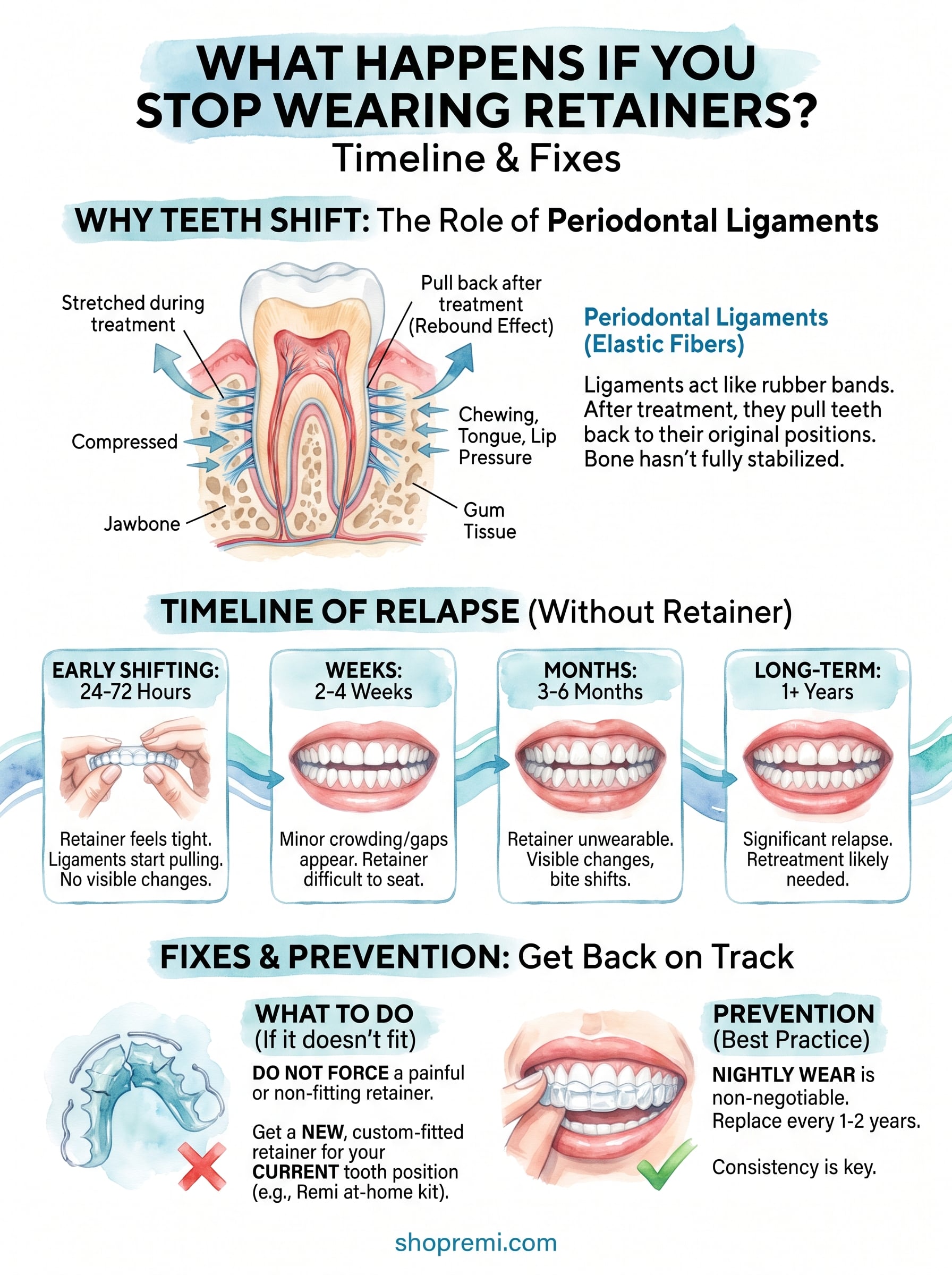
Your teeth are not locked rigidly into your jaw. They are held in place by a network of elastic fibers called the periodontal ligament, which connects each tooth root to the surrounding bone. These fibers have memory. During orthodontic treatment, braces or aligners gradually reposition your teeth, but those ligament fibers get stretched and compressed throughout the process. When treatment ends, the bone around your teeth has not fully stabilized in the new position, and the surrounding tissue still wants to return to where it started.
The role of the periodontal ligament
The periodontal ligament acts a lot like a rubber band. When your teeth are moved into a new position, the fibers on the tension side get stretched while the fibers on the pressure side compress. Once the orthodontic force is removed, those stretched fibers pull the teeth back toward their original position. This is the core mechanical reason why orthodontic relapse is so predictable when retainer use stops.
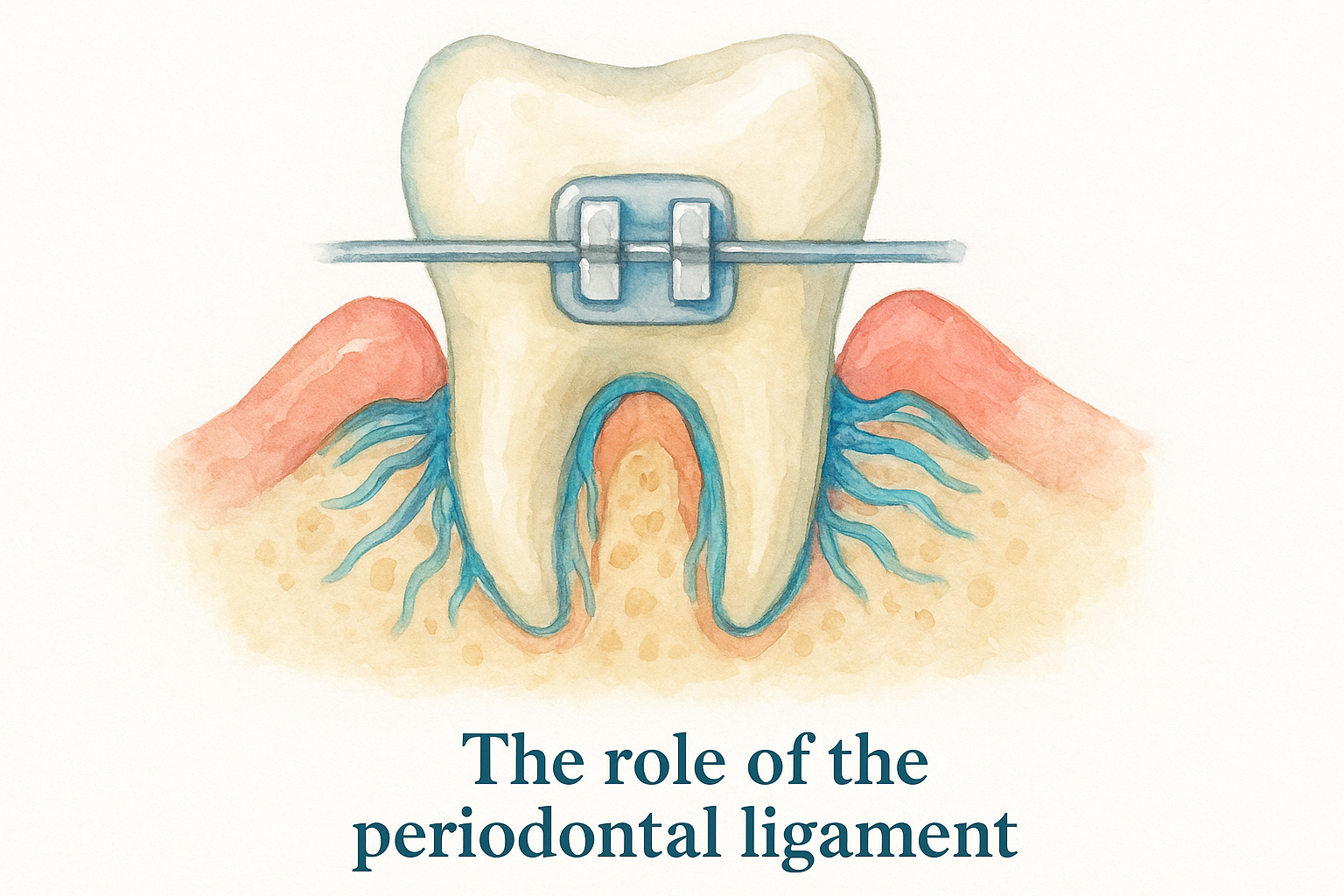
Without consistent retainer use, the periodontal ligament will exert enough force to cause noticeable tooth movement within weeks.
Natural forces that accelerate shifting
Beyond the ligament, several everyday forces push your teeth around constantly. Chewing pressure, tongue pressure, and lip pressure all act on your teeth throughout the day. Before braces, your teeth had settled into a position that balanced all of those forces. After treatment, your teeth sit in a new position, but those same pressures continue. Your jaw bone also remodels and grows over time, particularly in younger patients, which adds another layer of movement risk. Aging, gum tissue changes, and wisdom teeth can all contribute as well.
Knowing these forces helps explain why what happens if you stop wearing retainers is not a matter of if your teeth will move, but how much and how fast.
What happens when you stop wearing retainers
When you stop wearing your retainer, your teeth begin shifting almost immediately. The changes may be subtle at first, but the periodontal ligament starts pulling your teeth back toward their pre-treatment positions as soon as the retainer stops providing counter-pressure. Most people notice small gaps, crowding, or a change in their bite before they even realize what is happening.
The physical signs of relapse
The first sign you will likely notice is that your retainer feels tight or difficult to insert after any significant break. That tightness is not just discomfort. It means measurable tooth movement has already occurred, and your retainer no longer matches the current position of your teeth. Over time, you may see crowding return in the front teeth, gaps reopening, or your bite shifting in ways that feel unfamiliar when you chew.
Front teeth tend to move the fastest because they face the least resistance from surrounding bone. Lower front teeth are especially prone to crowding after treatment ends. Recognizing what happens if you stop wearing retainers means understanding that even minor shifts compound over time, making correction progressively more involved the longer you wait.
If your retainer feels painful to insert, do not force it in. Your teeth have already moved enough to warrant a conversation with a dental professional first.
Timeline of tooth shifting without a retainer
Understanding the timeline helps you recognize what happens if you stop wearing retainers at each stage. Tooth movement does not follow a perfect schedule for everyone, but clinical patterns consistently show that the longer you wait, the harder the correction becomes.
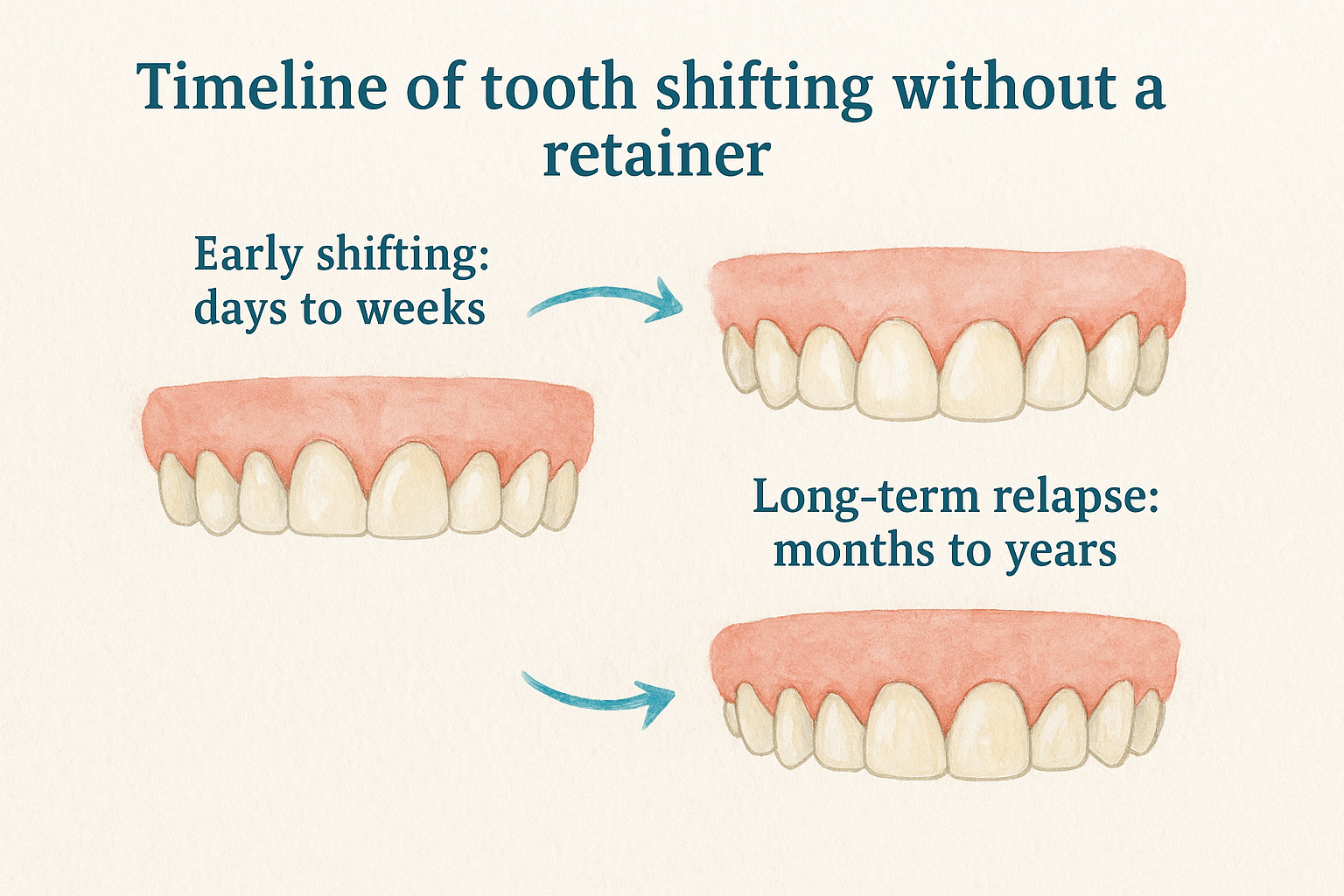
Early shifting: days to weeks
Within 24 to 72 hours of skipping your retainer, the periodontal ligament starts pulling your teeth. You will not see visible changes yet, but you will feel your retainer sitting tighter when you try it again. After two to four weeks, minor crowding can appear in the front teeth, and your retainer may feel genuinely difficult to seat.
By six to eight weeks, the movement becomes measurable. Your retainer may no longer fit at all, which signals that your teeth have shifted beyond what passive retention can correct on its own.
Long-term relapse: months to years
The table below shows what typically happens as months turn into years without a retainer. These timelines reflect general patterns, and individual results will vary based on age, original treatment, and how consistently you wore your retainer post-treatment.
| Timeframe | What you may notice |
|---|---|
| 3 to 6 months | Retainer unwearable, visible crowding begins |
| 6 to 12 months | Gaps or bite changes become noticeable |
| 1 to 3 years | Relapse approaches pre-treatment alignment |
| 3+ years | Retreatment with aligners or braces likely needed |
The longer you go without a retainer, the more your original correction investment works against you.
What to do if you stopped wearing your retainer
If you stopped wearing your retainer, your next step depends on how long you've been without it and whether your retainer still fits. Acting quickly gives you the best chance of stabilizing your alignment without needing full retreatment.
Try your retainer first
Put your retainer in carefully. If it seats without significant pain or resistance, you may still be within a window where consistent nightly wear can prevent further shifting. Wear it every night and monitor how it feels over the next several weeks.
If your retainer causes sharp pain or simply will not seat, do not force it in.
Get a new retainer if yours no longer fits
A retainer that no longer fits is a clear sign that your teeth have moved beyond what your current appliance can hold. Forcing it in risks damaging both your teeth and the retainer. Understanding what happens if you stop wearing retainers long-term makes clear why a replacement fitted to your current tooth position is the right move, not your original post-treatment shape.
Remi's custom clear removable retainers use an at-home impression kit, so you get a properly fitted retainer shipped directly to your door. If your relapse is significant, a dental professional can evaluate whether retreatment is needed before you order a replacement.
How to prevent relapse and keep retainers fitting
Understanding what happens if you stop wearing retainers is the first step, but building consistent daily habits is what actually protects your results long-term. The goal shifts from active correction to passive maintenance, which is far easier to manage once you have a reliable routine locked in.
Make nightly wear non-negotiable
Wearing your retainer every night is the single most effective way to prevent relapse. Most people can eventually transition to every-other-night wear after several years of consistent retention, but only after confirming stability with a dental professional. Keep your retainer stored in the same spot each night so it becomes automatic, like brushing your teeth, rather than something you have to remember.
A retainer sitting in a drawer protects nothing.
Replace your retainer on a regular schedule
Clear retainers do not last forever. Wear, warping, and small cracks reduce how well your retainer holds your teeth in position, even when you wear it consistently. Plan to replace yours every one to two years, or sooner if it feels loose, looks discolored, or shows visible damage. Remi's at-home impression kit makes ordering a fresh, properly fitted replacement simple without scheduling a dental office visit.
Keep your smile on track
Your teeth will always try to move. That is simply what happens if you stop wearing retainers, and no amount of time post-treatment changes that biological reality. Consistent nightly wear is the most straightforward way to protect the time and money you invested in your smile, and catching any drift early keeps your correction options simple and inexpensive.
Getting back on track does not have to involve another round of orthodontic treatment. Most people who catch shifting early can stabilize their results with a properly fitted replacement retainer and a renewed commitment to wearing it every night. The key is acting before minor movement becomes major relapse.
Whether you lost your retainer, outgrew it, or simply stopped wearing it, custom clear retainers from Remi let you order a professionally made, properly fitted replacement using an at-home impression kit that ships directly to your door. Skip the office visit and protect your smile today.

