
 Guards + Retainers
 Custom Night Guard
 Retainer
 Emergency Order

 Whitening
 Whitening Kit
 Teeth Whitening Gel
 Dual-Action Foam
 Cleaning + Care
 Ultrasonic Cleaner Pro
 Water Flosser
 UV Toothbrush Sanitizer
 Deep Clean + Freshening Tablets
 Accessories
 Guard Removal Tool
 Replacement Nozzles
 Bundles

You've invested time and money into straightening your teeth, now you want to keep them that way. Clear retainers do the job without the look of traditional wire retainers, but before you put anything in your mouth night after night, you probably want to know what are clear retainers made of. It's a fair question, especially when you're trusting a piece of plastic to protect your smile for months or even years.
The short answer: most clear retainers are made from medical-grade thermoplastic materials like polycarbonate, PETG, or polypropylene. These plastics are chosen for their durability, flexibility, and, most importantly, their safety for oral use. But not all retainer materials are created equal, and factors like BPA-free status and biocompatibility matter when something sits against your teeth and gums every day.
At Remi, we design custom clear retainers with these concerns in mind, working alongside dental professionals to ensure our products meet high standards for both fit and safety. This article breaks down the specific materials used in clear retainers, explains what makes them safe for long-term wear, and helps you understand what to look for when choosing a retainer that's right for you.
What clear retainers are and how they work
Clear retainers are thin, transparent plastic trays that fit snugly over your teeth to keep them in their corrected positions after orthodontic treatment. Unlike traditional wire retainers that clip onto your teeth with metal brackets, clear retainers (often called Essix retainers) cover the entire surface of your teeth like a protective shell. You wear them according to your dentist's instructions, typically full-time initially and then transitioning to nights only, to prevent your teeth from gradually shifting back to their original positions.
The basic design of clear retainers
Your clear retainer consists of a single piece of molded plastic that covers either your upper or lower arch of teeth. The material forms a precise replica of your teeth after orthodontic treatment, creating a custom fit that applies gentle, consistent pressure to keep each tooth in place. The retainer extends slightly over your gums to ensure it stays secure while you wear it, but it remains thin enough (usually 0.5 to 1 millimeter) that most people can speak normally once they adjust to wearing it.
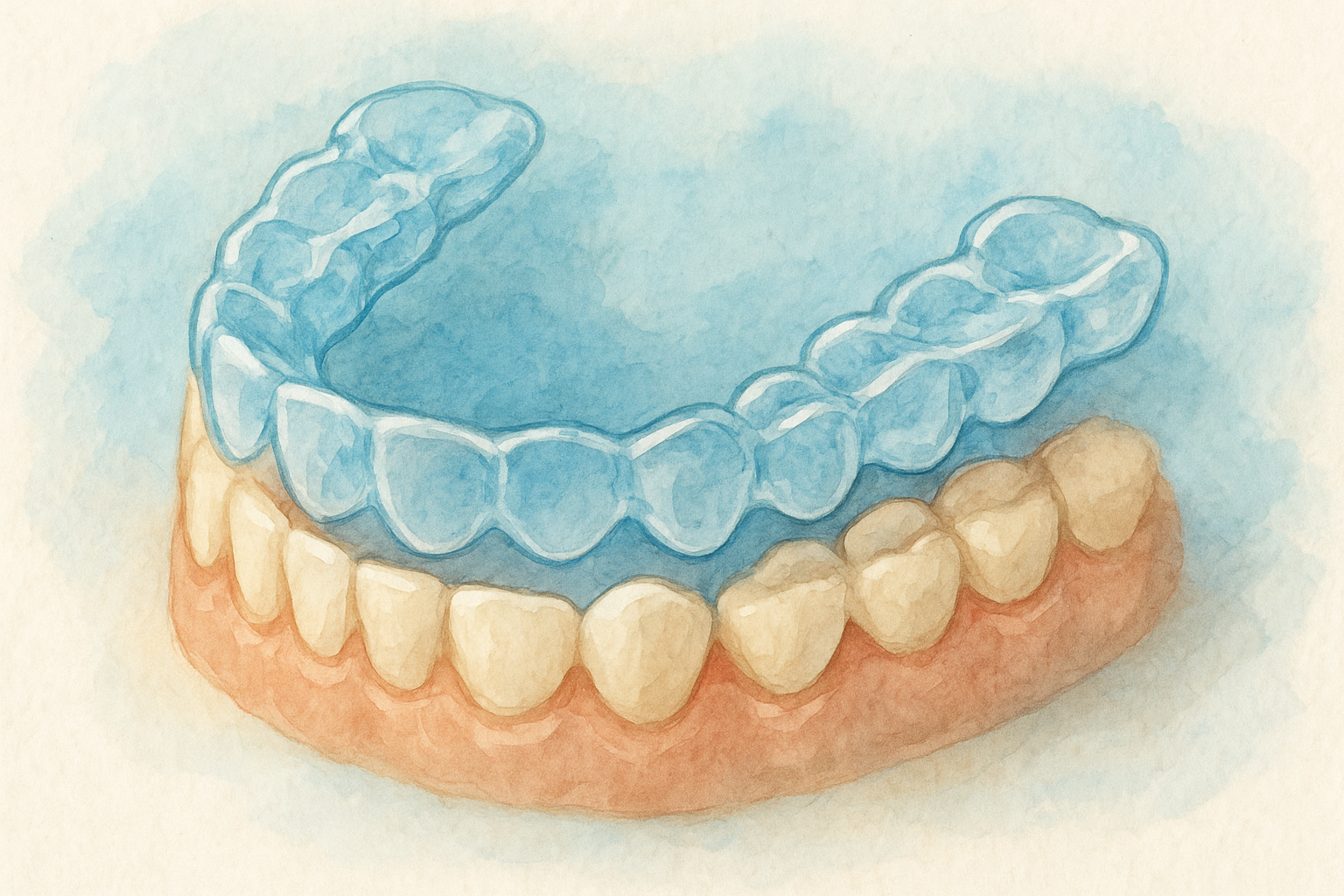
The transparency of the material makes these retainers nearly invisible when you wear them, which is why many people prefer them over traditional metal wire options. You can remove them for eating, drinking anything other than water, and cleaning your teeth, which gives you more flexibility than fixed retainers bonded to the back of your teeth. This removability also means you need to take responsibility for wearing them consistently, since your teeth can shift surprisingly quickly when you skip wearing your retainer for even a few days.
How retainers keep teeth in place
Your teeth sit in sockets within your jawbone, surrounded by periodontal ligaments that act like elastic fibers connecting the tooth roots to the bone. After orthodontic treatment moves your teeth, these ligaments need time to adapt to the new positions, which can take months or even years. Without a retainer, the ligaments naturally pull your teeth back toward their original positions, a process orthodontists call relapse.
Clear retainers prevent this relapse by applying constant, gentle pressure that holds your teeth exactly where they should be. The rigid plastic acts as a barrier, maintaining the spacing and alignment your braces or aligners achieved. When you wear your retainer regularly, you give the bone and surrounding tissues time to stabilize around your teeth in their new positions, reducing the likelihood of shifting over time.
Your teeth never truly "lock in" permanently after orthodontic treatment, which is why retention is just as important as the straightening process itself.
Why clear retainers work effectively
The effectiveness of clear retainers comes from their custom fit and the properties of the materials used to make them. When you wonder what are clear retainers made of, you're essentially asking about materials engineered specifically to maintain their shape under the constant stress of your jaw movements. These plastics resist deformation while remaining comfortable enough for nightly wear, creating the right balance between flexibility and strength.
Clear retainers work better for many people because they distribute pressure evenly across all your teeth rather than focusing force on specific anchor points like wire retainers do. This comprehensive coverage means every tooth receives support, not just the front ones that people see when you smile. The full-arch design also protects against unwanted tooth movement in any direction, whether your teeth want to rotate, tip, or shift sideways.
You get the added benefit of discretion with clear retainers, which encourages consistent wear. Studies show that patient compliance is one of the biggest factors in successful retention, and people who feel self-conscious about visible retainers often skip wearing them. Clear retainers remove that barrier, making it easier for you to stick with your retention plan and protect the investment you made in your orthodontic treatment.
What materials clear retainers use
The answer to what are clear retainers made of centers on medical-grade thermoplastics that meet strict safety standards for prolonged oral contact. Most clear retainers use one of three primary materials: polycarbonate, PETG (polyethylene terephthalate glycol), or polypropylene. Each of these plastics offers different advantages in terms of durability, flexibility, and clarity, but all share the fundamental requirement of being safe for daily use in your mouth.
The three main thermoplastic options
Polycarbonate ranks as the most common material for clear retainers because it combines optical clarity with impact resistance. This plastic maintains its shape well under the stress of normal jaw movements and resists cracking when you accidentally drop your retainer or clean it too vigorously. You'll find polycarbonate retainers stay clear longer than other options, though they can discolor over time with exposure to certain foods and beverages.
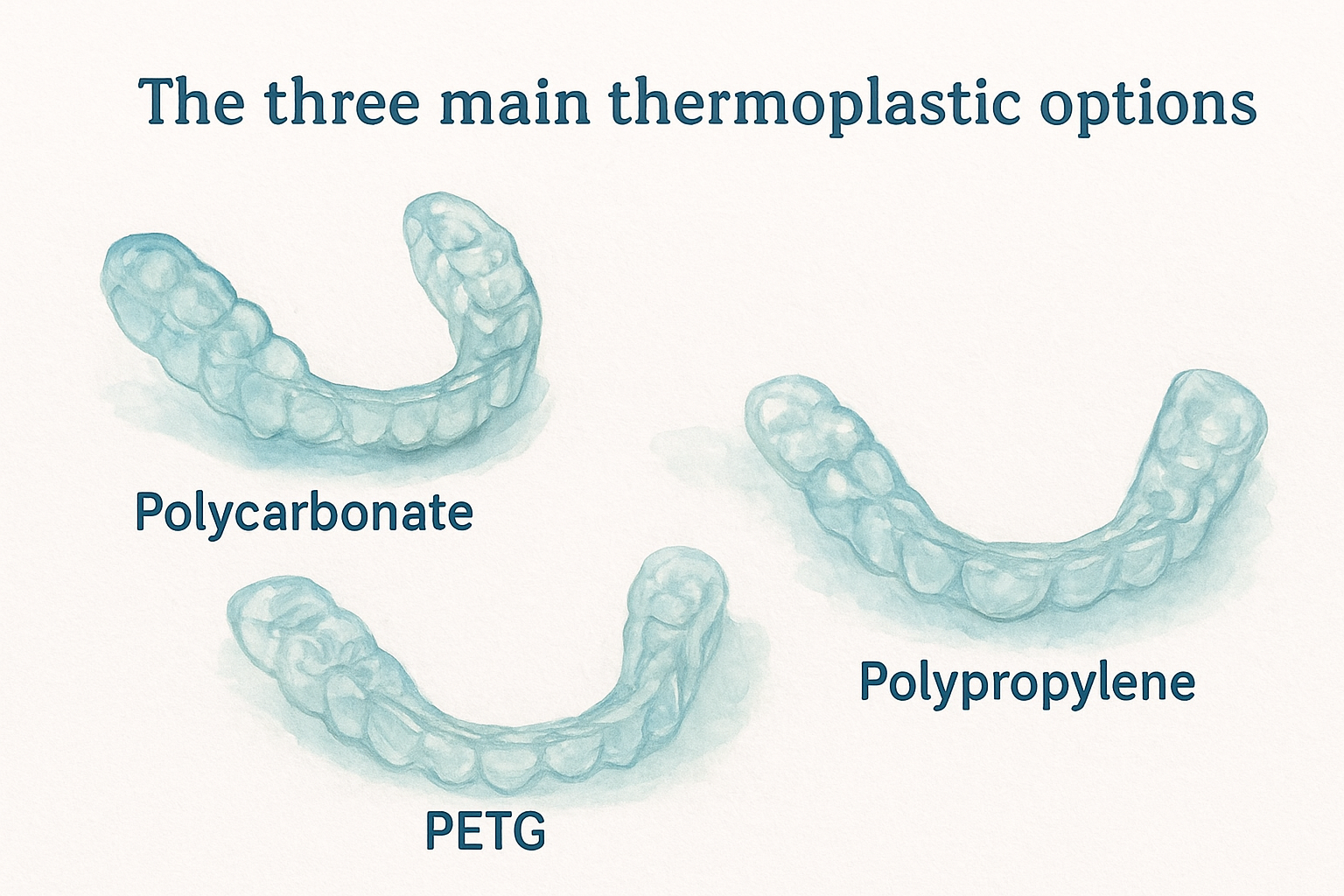
PETG offers a balance between rigidity and flexibility that many orthodontists prefer for custom retainers. This material molds accurately to capture fine details of your teeth, creating a snug fit that applies even pressure across your entire arch. PETG retainers typically feel slightly less rigid than polycarbonate versions, which some people find more comfortable for overnight wear, especially during the initial adjustment period.
Polypropylene appears in some retainer designs as a more flexible alternative, though it's less common than the other two materials. This plastic works well for retainers that need extra give, but it doesn't hold its shape as reliably over extended periods. Some manufacturers combine polypropylene with other materials to achieve specific performance characteristics.
The best material for your retainer depends on your specific retention needs, how long you'll wear it daily, and how well you maintain it.
Safety certifications and biocompatibility
All legitimate clear retainer materials must meet FDA regulations for Class II medical devices and pass biocompatibility testing that proves they won't harm oral tissues. These tests evaluate whether the plastic causes allergic reactions, irritates your gums, or releases harmful chemicals when exposed to saliva and the warm, moist environment of your mouth. Reputable manufacturers use only materials that pass ISO 10993 standards for biological evaluation of medical devices.
BPA-free certification has become a standard requirement for retainer materials since research linked bisphenol A to potential health concerns. Modern retainer plastics avoid BPA and similar compounds like BPS or BPF, using alternative formulations that maintain structural properties without questionable additives. You should always verify that your retainer comes from a manufacturer who explicitly states their materials are BPA-free and provides documentation of their safety testing.
The thickness of the material matters as much as its composition. Most clear retainers measure 0.75 to 1.0 millimeters thick, which provides enough strength to prevent warping while remaining thin enough for comfortable wear and normal speech. Thinner materials might feel less intrusive but risk cracking, while thicker plastics can cause excessive pressure on your teeth or make speaking difficult.
How clear retainers are made
Clear retainers go through a multi-step manufacturing process that transforms the materials we discussed into a custom-fitted device for your teeth. The process starts with capturing an accurate representation of your teeth and ends with a finished retainer that matches your unique dental anatomy. Understanding this manufacturing process helps you appreciate why proper materials matter and why custom retainers outperform generic, one-size-fits-all options.
The impression or digital scan process
Your retainer journey begins when your orthodontist or dentist captures the exact shape and position of your teeth. Traditional methods use impression putty or alginate, which you bite into for several minutes while the material sets around your teeth. This creates a negative mold that shows every contour, gap, and surface detail of your dental arch. Modern practices increasingly use digital intraoral scanners that capture thousands of data points in seconds, creating a 3D computer model without the mess or discomfort of impression materials.
Digital scanning offers superior accuracy because it eliminates distortions that can occur when impression materials shrink as they cure or get damaged during handling. The digital file goes directly to the lab, reducing the time between your appointment and receiving your finished retainer. Whether your dentist uses traditional impressions or digital scans, this initial step determines how well your retainer will fit and function.
Creating the mold or model
The lab converts your impression or digital scan into a positive model of your teeth, essentially creating a replica that the retainer will form around. With traditional impressions, technicians pour dental stone or plaster into the mold and let it harden, producing a physical model of your teeth. Digital scans get converted into physical models using 3D printing technology, which builds the tooth replica layer by layer from resin or similar materials.
Technicians inspect these models carefully to ensure accuracy before proceeding to the next step. Any imperfections in the model will transfer directly to your finished retainer, affecting its fit and ability to hold your teeth in position. This quality control step separates professional retainers from cheaper alternatives that skip verification.
Thermoforming the retainer
The actual retainer takes shape through vacuum thermoforming, where the sheet material gets heated until it becomes pliable. Technicians place the softened plastic over your tooth model and apply vacuum pressure, which sucks the material tightly against every surface of the model. The plastic conforms to each tooth, filling gaps and wrapping around contours to create a perfect replica. Once cooled, the plastic hardens into its final shape.
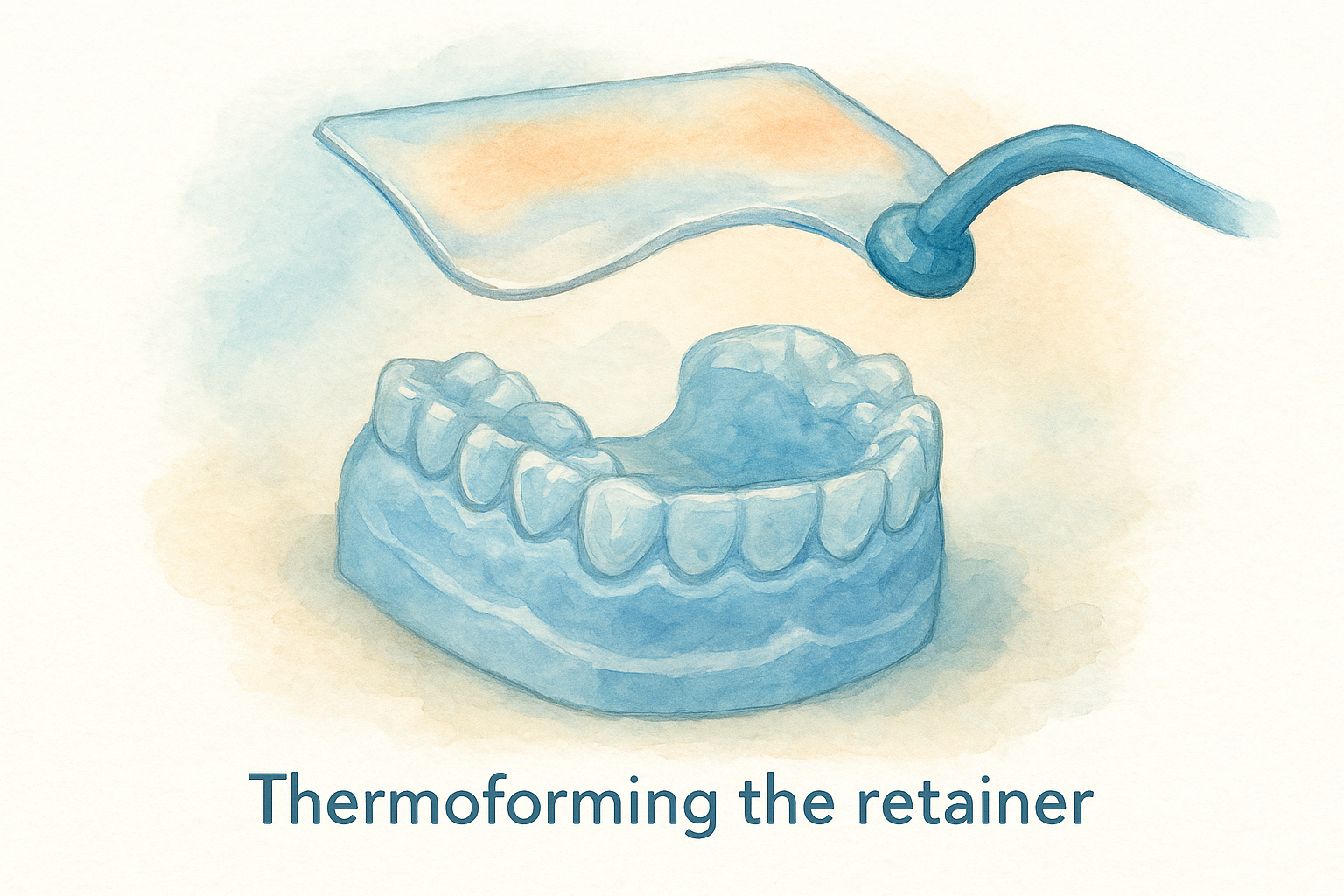
The precision of thermoforming explains why custom retainers fit better and work more effectively than generic designs that try to accommodate average tooth shapes.
After forming, technicians trim the excess material and smooth the edges so your retainer extends just slightly past your gum line without irritating your mouth. This finishing work requires skill because rough edges cause discomfort while insufficient coverage lets your retainer pop off easily. When you ask what are clear retainers made of, you're really asking about materials that survive this heating process while maintaining their biocompatible properties and structural integrity.
Are clear retainer materials safe
When you place something in your mouth for 8 to 12 hours every night, safety becomes your top concern. The materials used in clear retainers undergo rigorous testing and certification to ensure they won't harm your oral tissues, release toxic chemicals, or cause adverse reactions. Understanding what are clear retainers made of helps you evaluate whether a specific product meets safety standards you should demand for anything that sits against your teeth and gums long-term.
FDA approval and medical standards
Clear retainers fall under FDA Class II medical device regulations, which means manufacturers must prove their materials meet specific safety requirements before selling them to consumers. The FDA evaluates whether the plastics can withstand the oral environment without degrading in ways that could harm you. These regulations require biocompatibility testing that examines how the material interacts with living tissue, checking for cytotoxicity (cell damage), sensitization (allergic potential), and irritation.
Reputable manufacturers also follow ISO 10993 standards, an international benchmark for biological evaluation of medical devices. These tests expose the retainer material to conditions that simulate years of use in your mouth, measuring any chemical leaching or physical breakdown. You should verify that your retainer comes from a company that provides documentation of these certifications rather than relying on vague safety claims.
Your retainer should meet the same medical-grade standards as surgical instruments and other devices designed for prolonged contact with body tissues.
BPA and chemical concerns
Modern clear retainers use BPA-free formulations that eliminate bisphenol A, a chemical linked to hormonal disruption and other health concerns. Manufacturers have reformulated their plastics to achieve the same durability and clarity without BPA or related compounds like BPS and BPF. You should specifically ask whether your retainer carries BPA-free certification and avoid products that don't clearly state their chemical composition.
The thermoplastic materials in quality retainers remain chemically stable when exposed to saliva, temperature changes from hot and cold beverages, and the mechanical stress of chewing (though you remove your retainer before eating). This stability prevents the material from breaking down and releasing particles or chemicals you might ingest. Testing confirms that properly manufactured retainers don't leach harmful substances during normal use.
Allergic reactions and rare sensitivities
Allergic reactions to clear retainer materials occur rarely, but some people experience sensitivity to specific plastics or residual chemicals from the manufacturing process. Symptoms typically include gum irritation, redness, or swelling where the retainer contacts your tissues. If you notice these signs, contact your dentist immediately rather than continuing to wear a retainer that bothers you.
People with latex allergies can safely use clear retainers because the thermoplastics contain no latex proteins. The materials also avoid common allergens found in metal retainers, making them a safer choice if you have sensitivities to nickel or other metals used in traditional wire designs.
How to care for the material and avoid damage
Proper care extends the life of your clear retainer and keeps it functioning effectively, but the thermoplastic materials require specific handling to avoid damage that compromises fit or hygiene. Understanding what are clear retainers made of helps you recognize why certain cleaning methods work while others cause warping, discoloration, or cracking. Your daily maintenance routine directly impacts how well your retainer protects your teeth and how long it remains comfortable to wear.
Daily cleaning routines
You should rinse your retainer with cool or lukewarm water immediately after removing it each morning to wash away saliva and prevent bacterial buildup. Use a soft-bristled toothbrush dedicated solely to your retainer, gently scrubbing all surfaces with clear, unscented antibacterial soap or a retainer-specific cleaner. Never use regular toothpaste because its abrasive particles scratch the plastic surface, creating tiny grooves where bacteria accumulate and making your retainer appear cloudy over time.
Soaking your retainer once daily in a cleaning solution designed for dental appliances removes deposits that brushing alone can't eliminate. You can use denture cleaning tablets or specialized retainer cleaners, following the manufacturer's time recommendations (usually 15 to 30 minutes). Always rinse thoroughly after soaking to remove any chemical residue before placing the retainer back in your mouth.
Consistent daily cleaning prevents the material degradation that occurs when bacteria and plaque harden into stubborn deposits that require aggressive removal methods.
What damages the material
Hot water ranks as the most common cause of retainer damage because temperatures above 130°F (54°C) soften the thermoplastic, causing it to warp and lose its precise fit. Never rinse your retainer under hot tap water, place it in boiling water for sterilization, or leave it near heat sources like radiators or sunny windowsills. Even dishwashers and steam cleaners will permanently deform the material within seconds.
Harsh chemicals like bleach, alcohol-based mouthwashes, and hydrogen peroxide break down the plastic's molecular structure, making it brittle and prone to cracking. These substances also cause discoloration that turns your clear retainer yellow or opaque. Stick with cleaning products specifically formulated for retainer materials rather than improvising with household cleaners.
Storage practices
Store your retainer in its protective case whenever you're not wearing it, keeping the case away from heat and direct sunlight. The case prevents accidental crushing, protects the retainer from airborne contaminants, and keeps it away from pets who might chew on it. Choose a vented case that allows air circulation so your retainer dries properly between uses, preventing moisture buildup that encourages bacterial growth.
Never wrap your retainer in napkins or tissues because you'll likely throw it away accidentally. Keep the case in a consistent location at home and carry it with you when traveling, treating your retainer with the same care you give valuable items.
How long materials last and when to replace
Clear retainers don't last forever, and the specific materials they're made from determine how long you can expect yours to function effectively. Most clear retainers remain usable for one to three years with proper care, though this range varies significantly based on the thermoplastic type, your wearing schedule, and how well you maintain the device. Understanding when your retainer reaches the end of its functional life protects your orthodontic investment and prevents your teeth from shifting.
Expected lifespan by material type
Polycarbonate retainers typically last 18 to 24 months when you wear them nightly and clean them consistently. This material resists cracking better than alternatives but gradually loses clarity as microscopic scratches accumulate on the surface. PETG retainers often need replacement within 12 to 18 months because the material shows wear patterns faster, though its flexibility makes it comfortable for longer daily wear periods.
The durability you get from your retainer depends heavily on whether you wear it full-time or just at night. Full-time wear accelerates material breakdown because the plastic endures constant pressure, temperature changes, and exposure to saliva. When you ask what are clear retainers made of, you're really asking about materials engineered to withstand these stresses for a predictable period before replacement becomes necessary.
Signs you need a replacement
Your retainer shows several clear indicators when it stops functioning properly. Visible cracks or chips anywhere on the plastic mean immediate replacement because damaged retainers can't maintain proper pressure distribution across your teeth. You should also replace your retainer when it develops persistent cloudiness or discoloration that cleaning can't remove, as this suggests material degradation at the molecular level.
Fit changes signal that your retainer needs replacement even when it looks intact. If your retainer feels loose, doesn't snap into place with the usual resistance, or leaves gaps between the plastic and your teeth, the material has stretched or warped beyond its effective range. Difficulty inserting your retainer or pain when wearing it might indicate your teeth have shifted because your old retainer failed, requiring a new impression and fresh retainer.
Material fatigue occurs gradually, so you might not notice performance decline until your teeth have already moved slightly from their ideal positions.
Factors that affect durability
How you handle your retainer directly impacts its lifespan. Aggressive cleaning with hard-bristled brushes or abrasive cleaners accelerates surface damage, while exposure to heat causes immediate warping that shortens usable life to zero. Your natural saliva chemistry also plays a role, as some people produce more acidic saliva that breaks down plastic faster than others experience.
Replace your retainer proactively rather than waiting for obvious failure. Schedule a dental checkup every six months to let your orthodontist assess whether your retainer still fits properly and holds your teeth correctly, even if you don't notice problems yourself.
Key takeaways
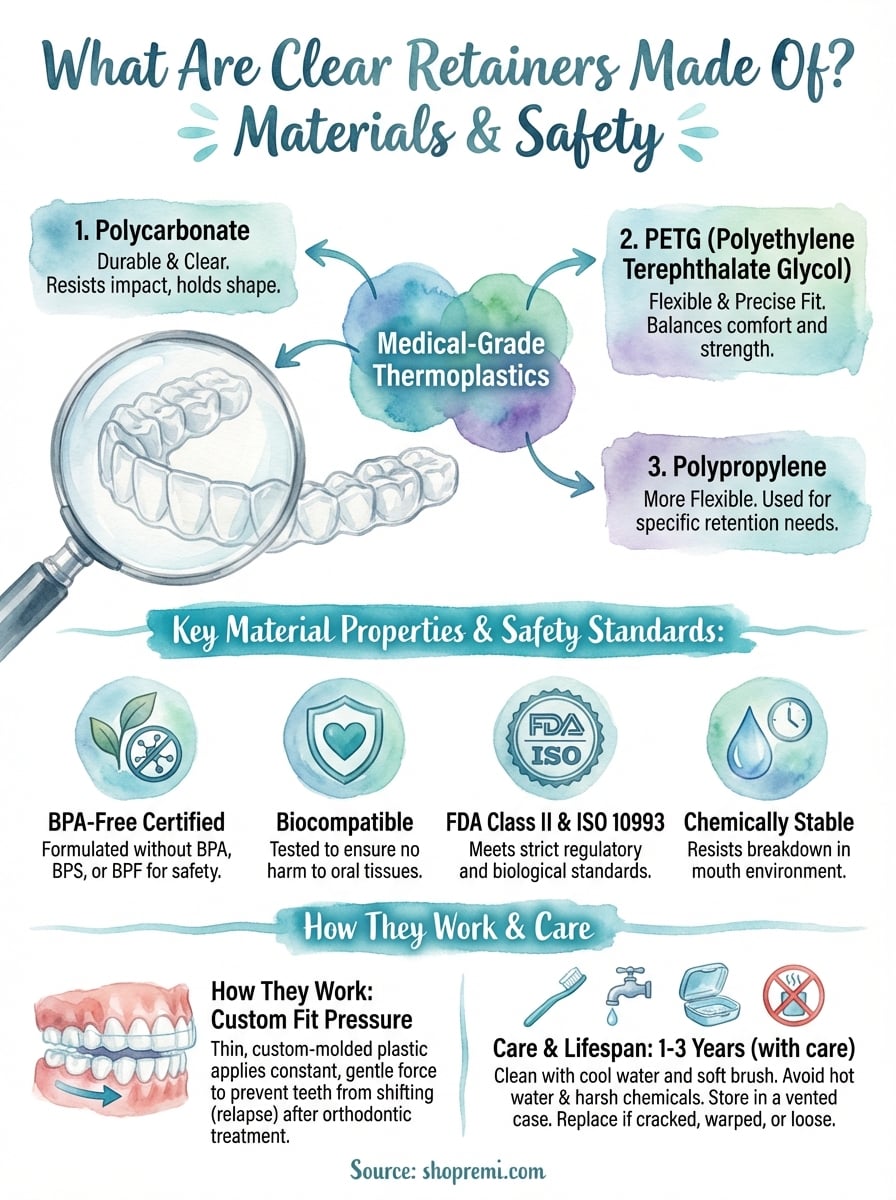
Understanding what are clear retainers made of gives you confidence in the device protecting your orthodontic investment. Medical-grade thermoplastics like polycarbonate, PETG, and polypropylene form the foundation of quality clear retainers, chosen specifically for their biocompatibility, durability, and safety in prolonged oral contact. These materials undergo rigorous FDA testing and meet ISO standards to ensure they won't harm your tissues or release dangerous chemicals. Your retainer works because the plastic maintains its shape under constant stress while remaining comfortable for nightly wear, applying gentle pressure that prevents your teeth from shifting back to their original positions.
Proper care extends your retainer's lifespan to one to three years, though you need to avoid hot water, harsh chemicals, and abrasive cleaning methods that damage the material. When your current retainer shows signs of wear or stops fitting properly, replacement becomes necessary to protect your smile. If you need a custom-fitted clear retainer made from quality materials and designed by dental professionals, check out Remi's custom clear retainers for an affordable, convenient solution delivered directly to your door.

