
 Guards + Retainers
 Custom Night Guard
 Retainer
 Emergency Order

 Whitening
 Whitening Kit
 Teeth Whitening Gel
 Dual-Action Foam
 Cleaning + Care
 Ultrasonic Cleaner Pro
 Water Flosser
 UV Toothbrush Sanitizer
 Deep Clean + Freshening Tablets
 Accessories
 Guard Removal Tool
 Replacement Nozzles
 Bundles

If you've ever stood in a drugstore aisle staring at flossing options, or scrolled through conflicting advice online, you've probably wondered about the real difference between a water flosser vs traditional floss. Both promise cleaner teeth and healthier gums, but they work in fundamentally different ways. Choosing the right one (or using both) depends on your oral health needs, your daily routine, and what you can actually stick with long-term.
At Remi, we design dental care products, from custom night guards to our Cordless Water Flosser, alongside in-house dentists and medical advisors. We've seen firsthand how the right tools make a measurable difference in oral hygiene outcomes, especially when paired with consistent habits.
This article breaks down the pros, cons, and clinical results behind each flossing method so you can decide what actually works for your teeth, not just what sounds good on a label. We'll cover plaque removal effectiveness, ease of use, cost over time, and whether a water flosser can replace string floss entirely.
Why interdental cleaning matters
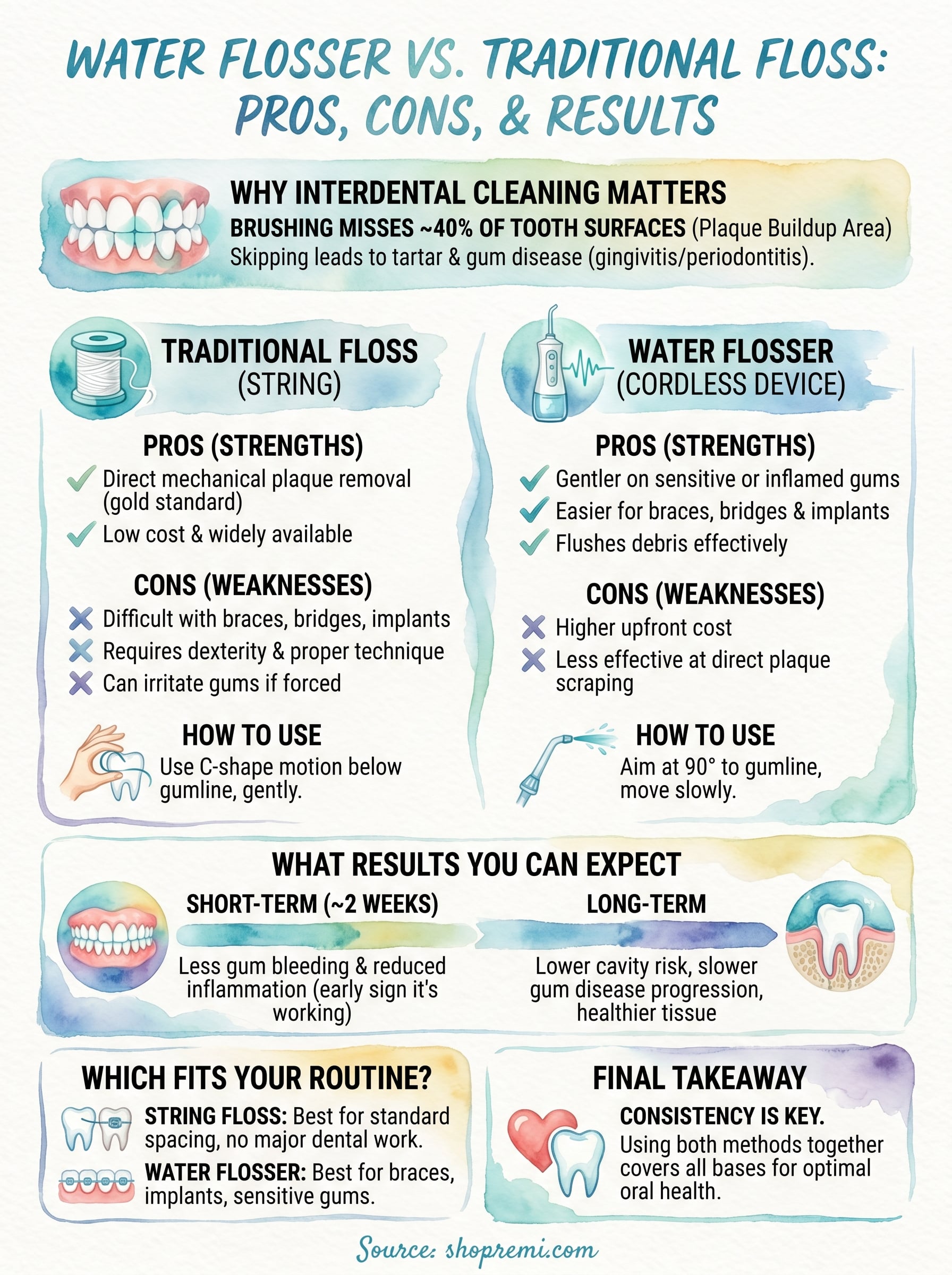
Your toothbrush only reaches about 60% of your tooth surfaces. The remaining 40% lives in the tight contact zones between your teeth and just below the gumline, areas where food particles and bacteria build up into plaque biofilm that hardens into tartar when left undisturbed. No matter how long or how well you brush, those spaces stay dirty without a dedicated interdental cleaning step. That's why dentists treat this part of your routine as non-negotiable, not an add-on.
The science behind plaque buildup
Plaque is a sticky bacterial film that reforms on your teeth within hours of eating. When it sits in the contact zones between teeth, it produces acids that break down enamel and inflame gum tissue. Studies consistently show that people who clean between their teeth have significantly lower rates of gum disease and cavities than those who only brush. The American Dental Association recommends interdental cleaning at least once per day for exactly this reason.
Brushing alone misses nearly half of your total tooth surface, which makes daily interdental cleaning just as essential as brushing itself.
What happens when you skip it
Skipping interdental cleaning allows plaque to calcify into tartar, a substance only a dental professional can remove with specialized tools. Over time, tartar buildup leads to gingivitis, and if that goes untreated, it progresses into periodontitis, a serious infection that destroys the bone supporting your teeth. The CDC estimates that nearly half of adults over 30 in the United States have some form of periodontal disease, and poor interdental hygiene is one of the leading causes. Whether you settle the water flosser vs traditional floss debate one way or the other, the most important thing is that you clean those spaces every day without skipping.
How to use water flossers and string floss
Getting the technique right matters as much as choosing the right tool. Many people use both string floss and water flossers incorrectly, which limits their plaque removal results and can irritate gum tissue over time.
Using string floss correctly
Cut about 18 inches of floss and wind most of it around your middle fingers, leaving a short working section taut between them. Use a C-shape motion around each tooth, curving just below the gumline rather than sawing straight up and down. Here is a simple step sequence to follow:
- Wind floss and hold a 1-2 inch section taut between fingers
- Slide gently between teeth without snapping
- Curve around each tooth in a C-shape and go just below the gumline
- Unwind to a clean section before moving to the next tooth
Proper C-shape technique removes significantly more plaque than a straight up-and-down sawing motion.
Using a water flosser correctly
Fill the reservoir with lukewarm water and start on the lowest pressure setting. Lean over your sink, place the tip just inside your mouth, and aim the stream at a 90-degree angle to your gumline. Move slowly from tooth to tooth, pausing briefly at each gap.
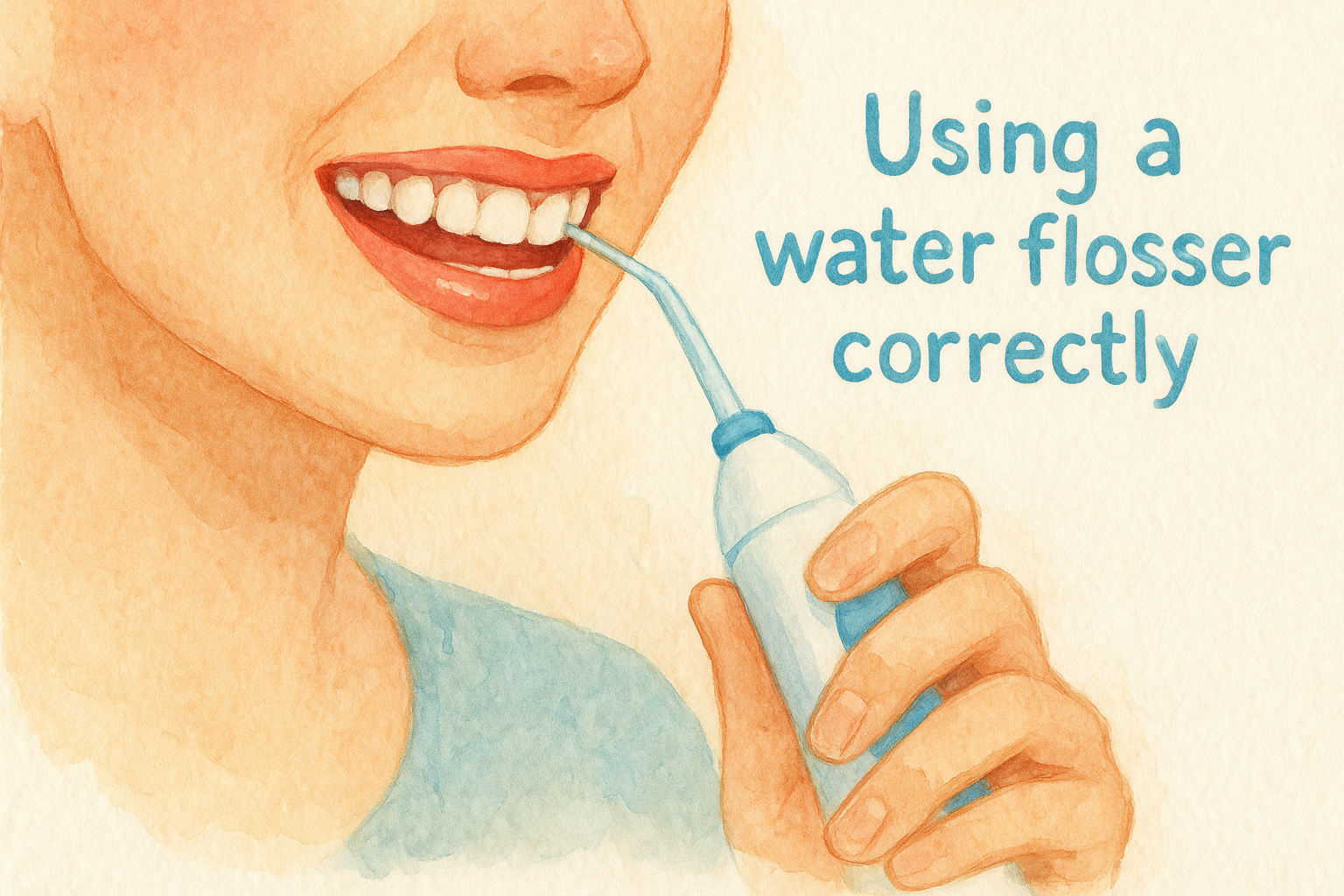
Most models include multiple tip attachments for specific needs. In the water flosser vs traditional floss technique comparison, water flossers typically have a shorter learning curve for new users.
Water flosser vs floss: pros and cons
The water flosser vs traditional floss debate comes down to how each tool handles plaque removal, comfort, and consistency in your daily routine. Neither option is perfect for every mouth, so knowing the specific strengths and weaknesses of each helps you make a smarter choice.
String floss: strengths and weaknesses
String floss gives you direct mechanical contact with tooth surfaces and just below the gumline, which makes it highly effective at physically scraping away plaque biofilm. The drawbacks are real though: it requires decent hand dexterity, can cut into gums if you use too much force, and many people skip it simply because it feels tedious.
- Effective at direct plaque removal through physical contact
- Low cost and widely available anywhere
- Difficult to use with braces, bridges, or implants
- Requires proper technique to avoid gum irritation
Water flossers: strengths and weaknesses
Water flossers are gentler on sensitive or inflamed gums and significantly easier to use around dental appliances like braces or bridges. They flush debris and bacteria from hard-to-reach gaps, but they do not physically scrape plaque deposits the way string floss does.
A water flosser excels at rinsing bacteria from tight pockets but works best when combined with brushing and traditional floss where possible.
- Easier for people with limited dexterity or dental work
- Higher upfront cost compared to string floss
- Less effective at direct mechanical plaque removal
What results you can expect
The results you see from the water flosser vs traditional floss debate depend heavily on consistency, not just which tool you pick. Using either method daily for just two weeks produces measurable improvements in gum inflammation and bleeding, which are the earliest signs that your routine is working.
Short-term improvements
Within the first few weeks of daily interdental cleaning, most people notice their gums bleed less during brushing and flossing. That reduction in bleeding is a direct sign that inflammation is decreasing. Research published in the Journal of Clinical Dentistry found that water flossers reduced gingival bleeding significantly more than string floss alone after just four weeks of consistent use.
Bleeding gums that improve within a few weeks of regular flossing confirm that your technique and consistency are on the right track.
Long-term oral health outcomes
Over months and years, consistent interdental cleaning reduces your risk of cavities forming between teeth and slows the progression of early-stage gum disease. Your dental cleanings also become faster and less uncomfortable because you are not allowing tartar to accumulate unchecked between visits. The long-term payoff is healthier gum tissue, fewer fillings, and lower dental bills overall.
Which option fits your mouth and routine
Choosing between a water flosser vs traditional floss comes down to your specific dental situation and what you will realistically use every single day. The best tool is always the one you actually stick with, regardless of what performs marginally better in a clinical setting.
When string floss makes sense
If your teeth are naturally spaced with no significant bridgework, implants, or orthodontic hardware, string floss gives you the most direct and thorough plaque removal for the lowest cost. It also works well if you have good hand dexterity and do not experience significant gum sensitivity during your routine.
String floss is still the gold standard for direct mechanical plaque removal in uncomplicated mouths with healthy spacing.
When a water flosser is the better fit
A water flosser fits best when you wear braces, bridges, or implants that make threading string floss difficult or time-consuming. It is also a strong choice if you have sensitive or inflamed gums that bleed easily, since the pulsating stream is gentler than string. Many people ultimately use both tools, rotating between them or pairing them in the same session to cover every weakness each method has on its own.
Final takeaways
The water flosser vs traditional floss debate does not have a single winner. String floss gives you direct mechanical plaque removal at a low cost and works well for most adults with standard spacing and no major dental work. Water flossers offer a gentler, easier experience for anyone with braces, implants, bridges, or sensitive gum tissue. Both methods outperform skipping interdental cleaning entirely, and using them together covers every gap that either tool leaves on its own.
Your biggest lever is daily consistency, not which device sits on your bathroom counter. Pick the method that fits your mouth, your schedule, and your comfort level, then actually use it every day. If you want to build a stronger oral care routine from the ground up, the Remi Cordless Water Flosser is a rechargeable, dentist-recommended option designed to make that habit as simple as possible.

