
 Guards + Retainers
 Custom Night Guard
 Retainer
 Emergency Order

 Whitening
 Whitening Kit
 Teeth Whitening Gel
 Dual-Action Foam
 Cleaning + Care
 Ultrasonic Cleaner Pro
 Water Flosser
 UV Toothbrush Sanitizer
 Deep Clean + Freshening Tablets
 Accessories
 Guard Removal Tool
 Replacement Nozzles
 Bundles

If you wore braces or aligners years ago but stopped wearing your retainer, you're not alone. Teeth shift naturally over time, and many adults find themselves looking into a teeth retainer for adults to correct minor movement or prevent further shifting. Others are wrapping up orthodontic treatment later in life and need a retainer for the first time. Either way, the options, and the price differences between them, can be confusing.
The good news is that you don't necessarily need multiple dental appointments or a hefty bill to get a quality retainer. At Remi, we make custom-fitted clear retainers using an at-home impression kit and deliver them directly to your door, all at a fraction of what most dental offices charge. Our retainers are developed alongside in-house dentists and medical advisors, so you get professional-grade results without the traditional markup.
This guide breaks down the main types of adult retainers, what each one costs, how long you should expect to wear them, and where to get them, so you can make a decision that fits both your teeth and your budget.
Why adults still need a retainer
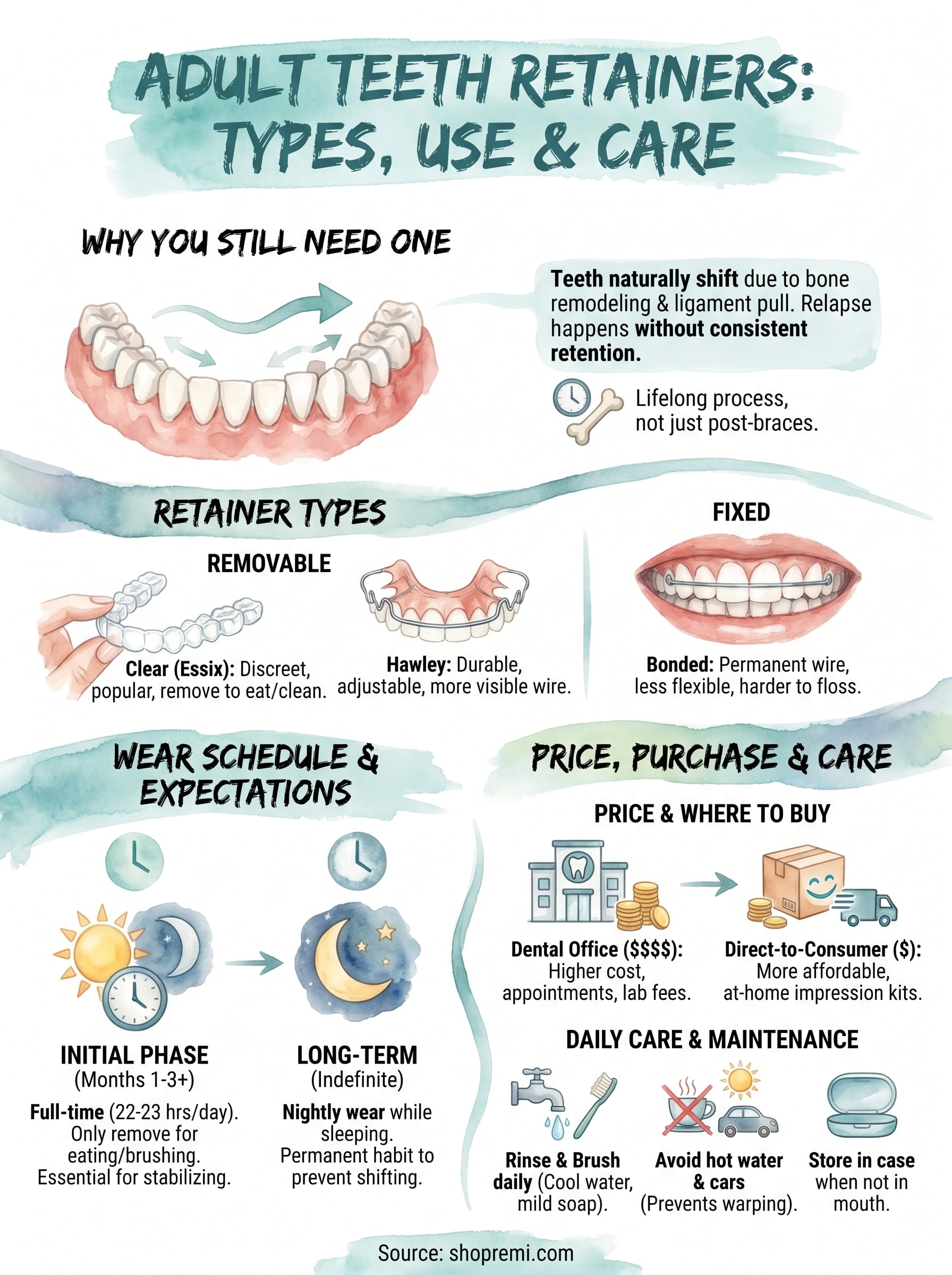
Most people assume retainers are only for teenagers finishing braces, but tooth movement doesn't stop when you hit adulthood. Your teeth are held in place by a network of periodontal ligaments, which are elastic fibers that naturally want to pull your teeth back toward their original positions. That pull doesn't weaken with age, so without a retainer, shifting happens whether you're 25 or 55.
Your teeth never stop moving
The process of tooth movement is tied to bone remodeling, the same biological cycle that continuously breaks down and rebuilds bone tissue throughout your body. Because your jawbone is always in some state of change, your teeth have room to drift. Factors like chewing habits, gum tissue changes, and aging itself add pressure that slowly moves teeth out of alignment over months and years. For adults, this means the results you worked hard for, whether through braces or clear aligners, are never permanently locked in without consistent retention.
Bone remodeling is a lifelong process, so tooth movement is a lifelong reality, not a phase that ends after orthodontic treatment.
What happens when you skip your retainer
If you went through orthodontic treatment and then stopped wearing your retainer, you may already notice small gaps, crowding, or a shift in your bite. This is called orthodontic relapse, and it is one of the most common reasons adults seek out a teeth retainer for adults later in life. In many cases, the shifting is minor enough that a new retainer can hold your teeth in their current position and prevent further movement. More significant relapse may require additional treatment before a retainer alone will help.
Even adults who never had braces can benefit from wearing a retainer. If you grind your teeth at night, the repeated pressure can push teeth out of alignment over time, and a retainer keeps that drift in check. Jaw clenching, tongue posture habits, and even natural wear on tooth surfaces all contribute to gradual shifting that a retainer helps counteract.
Types of teeth retainers for adults
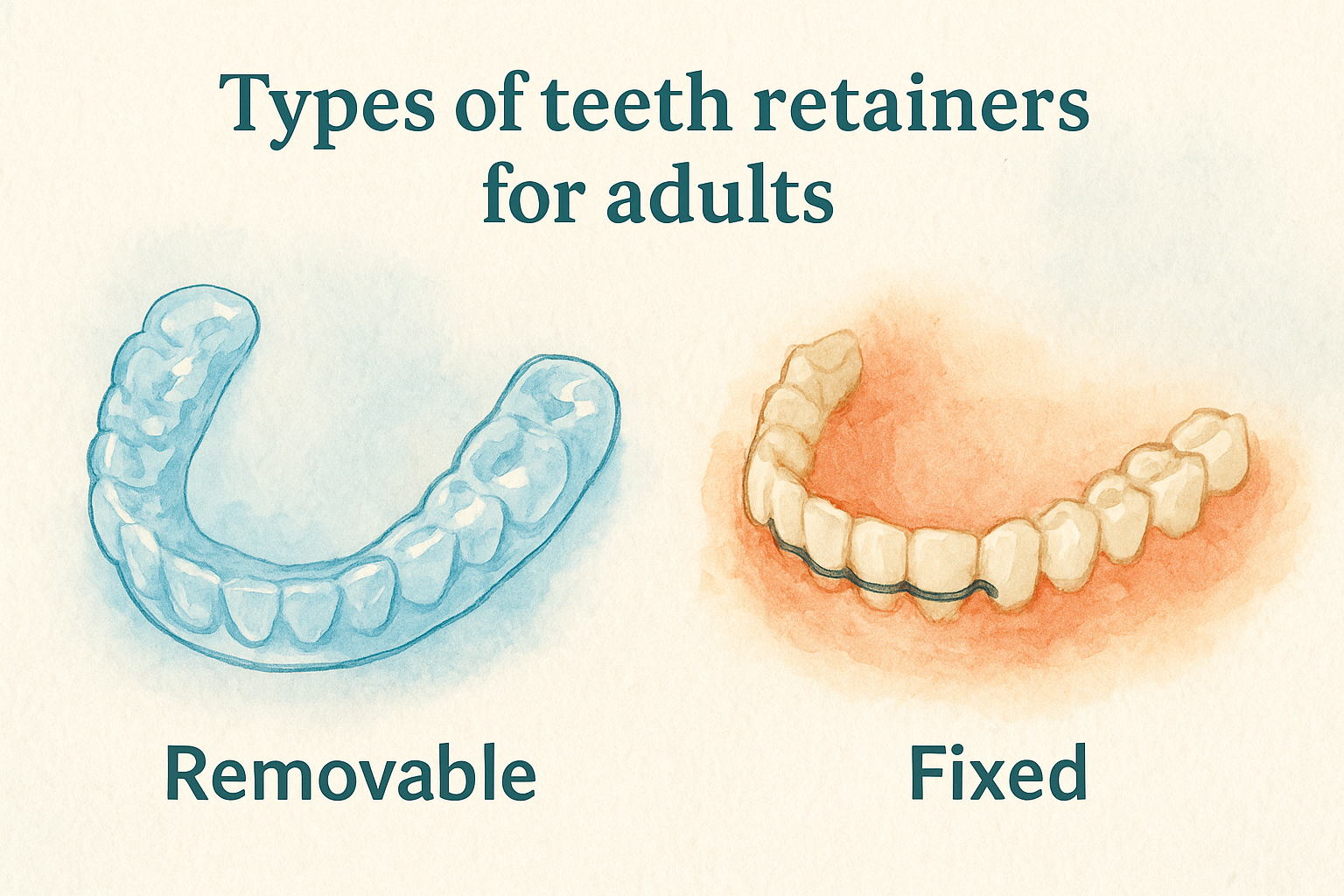
When you shop for a teeth retainer for adults, you'll find two main categories: removable and fixed. Each type works differently, and the right choice depends on your lifestyle and what your dentist or orthodontist recommends.
Removable retainers
Clear retainers, sometimes called Essix retainers, are thin plastic trays molded to fit your teeth exactly. They're nearly invisible, easy to take out for meals and brushing, and the most popular style for adults. At-home impression kits from direct-to-consumer providers make this style far more affordable than getting one through a dental office.
Hawley retainers use a wire-and-acrylic design that is older but still widely used. A wire sits across your front teeth and connects to an acrylic plate that rests against your palate. They're more durable and adjustable than clear trays but more visible when you smile.
Clear retainers are the most popular removable option for adults today because they stay discreet and fit comfortably.
Fixed retainers
A bonded retainer is a thin wire cemented to the back of your front teeth, usually the lower set. Since it never comes out, you don't have to remember to wear it. The downside is cleaning around the wire, which requires floss threaders or a water flosser.
You also cannot remove a bonded retainer yourself, so any repairs or adjustments always require a dentist visit. This makes it a less flexible option compared to removable styles, even though the no-removal routine appeals to many adults.
Adult retainer wear schedule and what to expect
When you first get a teeth retainer for adults, expect to wear it full-time for the first few months. This phase is the most critical because your teeth are still settling and the surrounding bone is stabilizing around their new positions.
The full-time phase
Full-time wear means keeping your retainer in for 22 to 23 hours a day, taking it out only to eat, drink (other than water), and brush. Most adults adjust within the first two weeks. Mild soreness and slight speech changes are normal at first and typically resolve on their own within a few days.
The full-time phase is not permanent, but skipping it raises your risk of relapse before your teeth have a chance to stabilize.
What to remove your retainer for during this phase:
- Eating any food or drink other than water
- Brushing and flossing
- Cleaning the retainer itself
Long-term nighttime wear
After the full-time phase, most providers shift you to nighttime-only wear, which means wearing your retainer while you sleep. For the majority of adults, this routine continues indefinitely, so think of it as a permanent habit rather than a temporary fix.
Signs you need to get back on a consistent schedule:
- Your retainer feels tighter than usual when you put it in
- You notice visible gaps or crowding that were not there before
- Your bite feels different when you chew
Teeth retainer prices and where to buy one
Price is one of the biggest factors adults consider when looking for a teeth retainer for adults. Your total cost depends on the type of retainer you choose and whether you buy through a dental office or a direct-to-consumer service.
Dental office vs. direct-to-consumer
Getting a retainer through a dentist means paying for in-office fitting appointments, lab fees, and overhead costs. Clear retainers from a dental office typically run $300 to $600 per arch, and Hawley retainers fall in a similar range. Fixed bonded retainers add another $250 to $500 per arch, plus a separate appointment for placement and any future repairs.
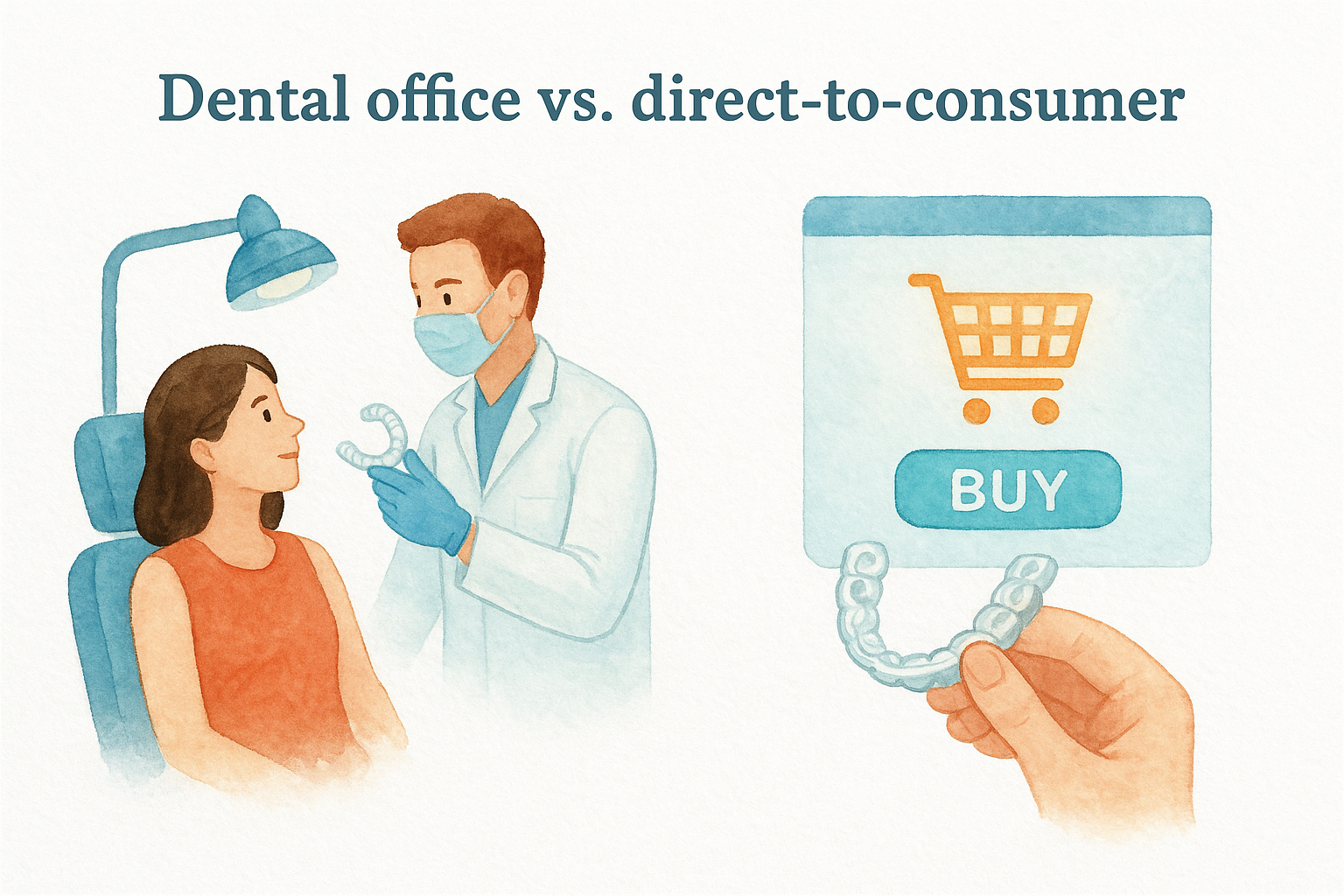
Direct-to-consumer services remove the in-office steps entirely, which cuts costs without cutting the custom fit.
At Remi, custom clear retainers are made from an at-home impression kit you complete yourself, then mail back. No office visits, no lab markups passed through a provider, and no hidden fees. The result is a professionally crafted retainer at a price that reflects the direct model.
What affects the price
Several factors shift the final number: the material used, how many arches you need covered (upper, lower, or both), and whether you are ordering a replacement. Replacements are a common expense adults overlook when budgeting, and ordering through a direct-to-consumer provider typically makes replacements far more affordable than going back to a dental office each time.
Cleaning, maintenance, and common problems
A teeth retainer for adults needs consistent daily care to stay effective and odor-free. Bacteria and plaque build up on retainer surfaces just as they do on your teeth, and neglecting that buildup leads to discoloration, bad breath, and potential oral health issues over time.
Daily cleaning routine
Rinse your retainer with cool water every time you remove it, then brush it gently with a soft-bristled toothbrush and mild soap. Avoid hot water, which warps the plastic and ruins the fit.
Simple daily habits that protect your retainer:
- Rinse immediately after removal
- Brush with a soft toothbrush and mild soap
- Store it in its case when it is not in your mouth
- Deep clean with cleaning tablets or an ultrasonic cleaner a few times per week
Cleaning your retainer takes under two minutes a day and adds months to its lifespan.
Common problems and when to act
Warping from heat exposure is the most frequent issue with clear retainers. Leaving yours in a hot car or rinsing with hot water are the two most common causes, and both are easy to avoid with a little habit adjustment.
If your retainer no longer fits snugly or feels unusually tight, order a replacement before your teeth shift further. Cracks or broken wires on Hawley retainers need a dentist's attention promptly, since continuing to wear a damaged retainer can cause discomfort and uneven pressure on your teeth.
Next steps
You now have a clear picture of what a teeth retainer for adults involves, from the types and wear schedules to what you should expect to pay. The biggest takeaway is simple: your teeth will shift without consistent retention, and the earlier you act, the easier it is to stay ahead of that movement.
If you finished orthodontic treatment recently, commit to your full-time wear phase and transition into nightly use before relapse becomes an issue. If you stopped wearing your retainer years ago and notice some shifting, a new retainer can still hold your teeth where they are now and stop things from getting worse. Either way, you do not need to overpay at a dental office to get a quality fit. Remi makes the process straightforward with an at-home impression kit and professional-grade results delivered to your door. Order your custom clear retainer and protect your smile today.

