
 Guards + Retainers
 Custom Night Guard
 Retainer
 Emergency Order

 Whitening
 Whitening Kit
 Teeth Whitening Gel
 Dual-Action Foam
 Cleaning + Care
 Ultrasonic Cleaner Pro
 Water Flosser
 UV Toothbrush Sanitizer
 Deep Clean + Freshening Tablets
 Accessories
 Guard Removal Tool
 Replacement Nozzles
 Bundles

You just left the dentist's office, and the bill hits harder than the Novocain. A single crown runs $1,000+. A custom night guard? Somewhere between $300 and $800. It's enough to make anyone wonder why dental care is so expensive in the first place. You're not imagining it, dental costs have outpaced general inflation for decades, and millions of Americans delay or skip treatment because of it.
The reasons behind those prices aren't always obvious. It's not just about the procedure itself, there's a web of factors from education debt to equipment costs that inflate every line item on your bill. Understanding what drives these prices can help you make smarter decisions about where to spend and where to save.
That's exactly why we started Remi. We saw how much people were overpaying for things like custom night guards and retainers through traditional dental offices, so we built a direct-to-consumer model that cuts out the middlemen. But before we get into solutions, let's break down the five biggest reasons dental care costs what it does, and what you can actually do about it.
1. Dental office overhead and extra visits add up fast
Running a dental practice costs a significant amount of money before a single patient walks through the door. Dentists pay for commercial lease space, malpractice insurance, practice management software, utilities, and consumable supplies every single month. Those fixed costs don't go away on slow weeks, so they get built into the price of every appointment you book.
What drives the cost
Dental offices in major cities often pay $5,000 to $20,000 per month in rent alone. Add payroll for front desk staff, dental assistants, office managers, and billing coordinators, and you're looking at the largest recurring expense in the entire practice budget. Unlike most businesses, a dental office cannot operate lean; it needs a fully staffed team present just to perform basic procedures safely and within regulatory requirements.
A single fully equipped operatory chair can cost more than $30,000 to set up, and most offices run several chairs simultaneously to stay profitable.
How it shows up for patients
When you book a routine cleaning, you're not just paying for the hygienist's 45 minutes of work. Every appointment covers a share of the office's monthly overhead, the cost of disposable supplies used during your visit, and the administrative hours staff spend on insurance verification and billing before and after you arrive. Practices that split a single treatment across multiple appointments, such as separate visits for impressions, fittings, and adjustments on a custom appliance, pass those overhead costs to you each time you return.
Your bill reflects the full operational cost of keeping the office running that day, not just the clinical work performed on your teeth.
How to reduce the impact
Recognizing why dental care is so expensive often starts with this overhead structure, and some of those costs are genuinely avoidable. Direct-to-consumer dental products like custom night guards or retainers made with at-home impression kits cut out multiple office visits entirely. You skip the chair fees, administrative markups, and per-visit overhead charges. For protective dental appliances that don't require an in-office clinical procedure to produce, ordering direct is one of the most practical ways to lower your spending without lowering your standards.
2. Dental training and student debt influence pricing
Dentists spend 8 to 10 years in post-secondary education before they treat their first paying patient. That investment is substantial, and it doesn't come cheap. The average dental school graduate carries over $290,000 in student loan debt, according to the American Dental Education Association. That debt load shapes every pricing decision a dentist makes from day one of practice.
What drives the cost
Dental school is expensive for several reasons. Programs require specialized faculty, clinical simulation labs, and hands-on patient training facilities that cost far more to operate than a standard university classroom. Tuition at private dental schools can exceed $100,000 per year, and students spend four years completing the program after an undergraduate degree. When they graduate, most dentists face monthly loan payments that rival a mortgage.
The average dental school graduate enters practice with more student debt than most medical specialties outside of orthopedics and neurosurgery.
How it shows up for patients
Those loan repayments become part of the practice's operating reality. Dentists set fees high enough to cover debt service alongside all other costs. This is a core reason why dental care is so expensive: the pricing reflects a decade of education investment that patients help repay through every appointment.
How to reduce the impact
Choosing direct-to-consumer dental products for non-clinical needs keeps money out of that overhead cycle. When you order a custom night guard at home, you pay for the product itself, not the education debt baked into an office visit fee.
3. Equipment, labs, and materials cost more than you think
Beyond the office lease and education debt, dental equipment and lab fees add another significant layer to your bill. Most people never see this side of the cost, but it's a major reason why dental care is so expensive across the U.S.
What drives the cost
Modern dental offices run on expensive, specialized equipment that requires regular maintenance and eventual replacement. Digital X-ray systems, intraoral cameras, and CAD/CAM milling machines each cost tens of thousands of dollars. On top of hardware, external dental labs charge substantial fees to fabricate crowns, bridges, and custom appliances like night guards. Lab fees for a single crown can reach $200 to $500 before the dentist adds their markup.
The materials used in dental work, from ceramic and zirconia to medical-grade resins, carry premium price tags that most patients never see itemized on their bill.
How it shows up for patients
When your dentist sends an impression to an external lab, you typically wait one to two weeks and return for a second appointment. That second visit adds another round of chair time and overhead charges to your total cost.
Each return trip also means more administrative processing, which inflates the per-treatment price well beyond what the clinical work alone justifies.
How to reduce the impact
For protective appliances like night guards and retainers, you can skip the lab middleman entirely. Direct-to-consumer options use the same professional-grade materials without routing your order through an office that marks up every step of the process.
4. Sterilization, safety rules, and staffing raise per-visit costs
Dental offices operate under strict federal and state health regulations that require specific sterilization protocols, protective equipment, and staff training for every single appointment. These compliance costs aren't optional, and they don't scale down based on how simple your procedure is.
What drives the cost
Every instrument a dental team uses must go through a multi-step sterilization process using autoclaves and chemical disinfectants that cost thousands of dollars to purchase and maintain. The CDC and OSHA set the infection control standards that every practice must meet, which means purchasing single-use barriers, gloves, masks, and disposable tool covers for each patient. Training staff to maintain compliance adds another recurring expense to the practice budget.
The CDC's infection control guidelines for dental settings require practices to maintain sterilization monitoring logs, biological indicator testing, and documented staff training cycles, none of which is free.
How it shows up for patients
These compliance costs get folded into your per-visit charge whether you're there for a cleaning or a complex procedure. Because every appointment triggers the same full sterilization cycle, even a short follow-up visit carries the entire weight of compliance overhead built into the fee.
How to reduce the impact
This overhead is one core reason why dental care is so expensive for routine appliances that don't require chairside work. When you order a custom night guard or retainer through a direct-to-consumer model, you skip the clinical visit entirely, which means none of these per-visit compliance costs appear on your bill.
5. Dental insurance limits and admin costs push costs to you
Dental insurance sounds like a safety net, but most plans are structured to limit what they pay, not to cover what you actually need. Annual maximums typically cap out at $1,000 to $2,000 per year, a threshold that hasn't kept pace with rising dental fees for decades. Once you hit that ceiling, every remaining cost lands directly on you.
What drives the cost
Dental practices dedicate significant staff hours to insurance billing, prior authorization requests, claim submissions, and appeals. That administrative labor doesn't pay for itself. Practices hire dedicated billing coordinators specifically to manage the back-and-forth with insurance companies, and those salaries get factored into every procedure fee on your bill.
The American Dental Association has reported that administrative costs consume a growing share of dental practice revenue each year, directly driving up fees for patients.
How it shows up for patients
When insurance denies or underpays a claim, the remaining balance shifts to you through a process called balance billing. You also pay indirectly through inflated procedure fees that practices set higher to offset the percentage of claims that insurers routinely reject or reimburse at reduced rates.
How to reduce the impact
This is another core reason why dental care is so expensive: the insurance and admin layer adds cost without adding clinical value. For custom appliances like night guards or retainers, bypassing the insurance system entirely through a direct-to-consumer model keeps your out-of-pocket cost simple and significantly lower.
Next steps to pay less for dental care
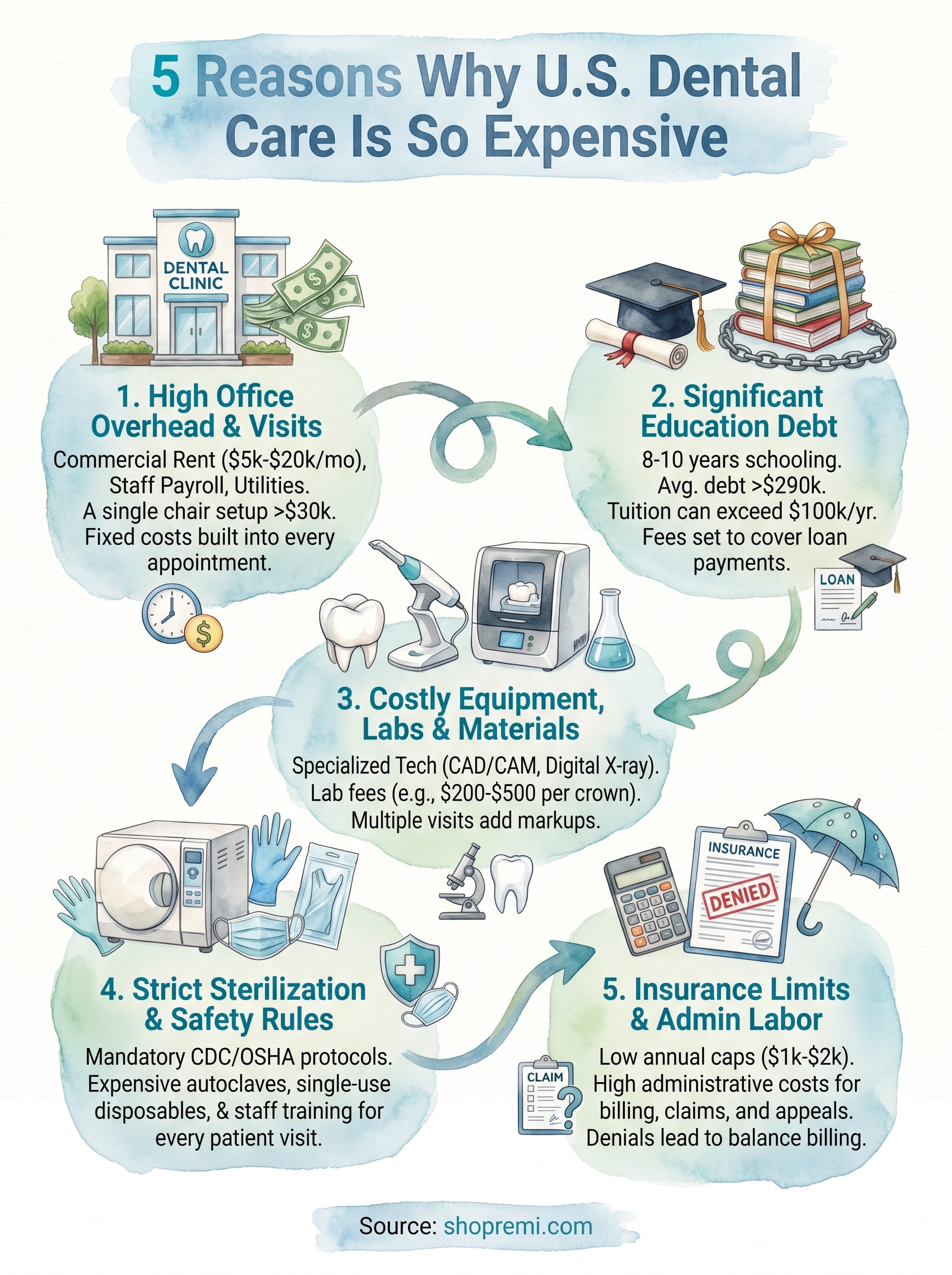
Now that you understand why dental care is so expensive, you can make smarter choices about where your money goes. The five factors above, overhead, education debt, lab costs, compliance requirements, and insurance admin, all compound on top of each other, which is why a single appliance from a traditional dental office can cost hundreds more than it should.
The most direct way to reduce that spending is to cut out the office visits for products that don't require in-person clinical work. Custom night guards and retainers are the clearest example. You get the same professional-grade fit and materials without paying for the chair time, the lab markup, or the administrative overhead built into every appointment.
If you grind your teeth or need to maintain your alignment, start there. Check out Remi's custom night guard and see how much you can save without compromising on quality.

