
 Guards + Retainers
 Custom Night Guard
 Retainer
 Emergency Order

 Whitening
 Whitening Kit
 Teeth Whitening Gel
 Dual-Action Foam
 Cleaning + Care
 Ultrasonic Cleaner Pro
 Water Flosser
 UV Toothbrush Sanitizer
 Deep Clean + Freshening Tablets
 Accessories
 Guard Removal Tool
 Replacement Nozzles
 Bundles

If you work in a dental lab or fabricate custom oral appliances, you've almost certainly come across proform mouthguard material, one of the most widely used thermoplastic sheets for vacuum-formed mouthguards, splints, and retainers. But with multiple thicknesses, laminate options, and competing suppliers on the market, picking the right product for the right application takes more than a quick glance at a catalog.
This article breaks down the EVA (ethylene-vinyl acetate) specs behind Pro-Form sheets, covers their primary clinical and athletic uses, and offers practical buying tips so you get the best value. At Remi, we work with professional-grade materials every day to produce custom-fitted night guards and retainers delivered directly to customers at a fraction of typical dental office prices, so material quality is something we take seriously. Whether you're a dental professional sourcing supplies or simply curious about what goes into a well-made mouthguard, you'll find the details you need below.
Why ProForm mouthguard material matters
The material you choose for a mouthguard directly affects how well it protects teeth and how long it holds up under repeated stress. Not all thermoplastic sheets perform equally, and proform mouthguard material has become a benchmark in professional dental labs because it combines consistency, clarity, and reliable thermoforming behavior. If the sheet warps unevenly or tears during fabrication, the finished appliance won't fit precisely, which means the patient won't wear it.
A poorly fitted mouthguard often ends up in a drawer rather than in a patient's mouth, which delivers zero protection.
The clinical stakes of material choice
When a dental professional selects a thermoplastic sheet, they're making a decision that affects bite alignment, cushioning, and long-term durability all at once. Thinner, low-grade materials may deform under normal occlusal pressure within weeks, forcing remakes that cost both time and money. Choosing a laminate with consistent thickness tolerances reduces chair time, patient complaints, and lab waste.
Your material choice also shapes patient compliance. Appliances made from clear, smooth-finishing sheets feel more comfortable and look less obtrusive, which increases the chance a patient actually uses the device every night rather than skipping it.
Why labs and clinicians keep coming back to Pro-Form
Labs that have standardized on Pro-Form sheets report fewer defective pulls and more predictable adaptation across different vacuum-forming machines. The material's EVA-based composition adapts well to complex arch shapes without developing thin spots or stress fractures along the margins. That consistency matters most when you're producing high volumes of appliances and cannot afford variation batch to batch.
What ProForm material is made of
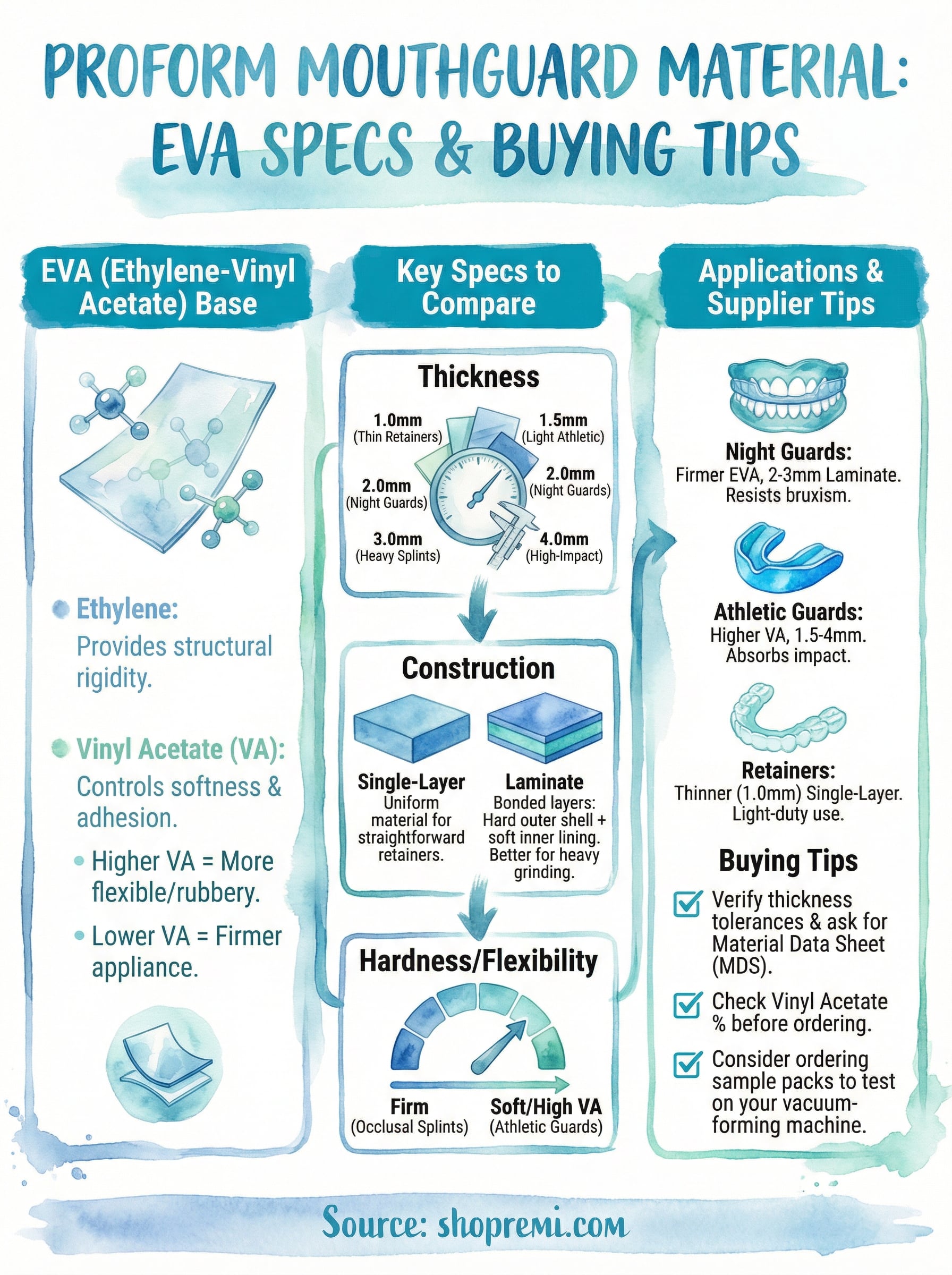
ProForm mouthguard material is built on an ethylene-vinyl acetate (EVA) base, a copolymer that combines flexibility with enough firmness to absorb impact without cracking. EVA gives the finished appliance its characteristic feel: slightly cushioning against bite pressure but stable enough to hold its shape through months of nightly wear. Some ProForm sheets use a single-layer EVA formulation, while others feature laminated constructions that bond a softer inner layer to a harder outer shell.
What EVA brings to the formula
The ethylene component provides structural rigidity and resistance to deformation, while the vinyl acetate content controls softness and adhesion during thermoforming. A higher vinyl acetate percentage generally produces a more flexible, rubbery sheet, while a lower percentage results in a firmer appliance.
The vinyl acetate percentage is one of the most practical specs to check before ordering a new batch of sheets.
Lab technicians adjust their material selection based on the intended use: athletic mouthguards typically call for higher vinyl acetate content, whereas occlusal splints and night guards benefit from a firmer formulation that resists repeated grinding forces over time. If you order sheets without checking this spec, you risk getting a material that is either too soft to protect against bruxism or too rigid to thermoform cleanly.
Key specs and options to compare
When you shop for proform mouthguard material, three specs drive the decision: thickness, layer construction, and hardness rating. Getting any one of these wrong for your application means remaking appliances and wasting material costs.
Thickness ranges
Sheet thickness determines how much cushioning and rigidity the finished appliance provides. Most suppliers offer ProForm sheets in the following standard sizes:
| Thickness | Common Use |
|---|---|
| 1.0 mm | Thin retainers, soft splints |
| 1.5 mm | Light-duty athletic guards |
| 2.0 mm | Night guards, moderate bruxism |
| 3.0 mm | Heavy-duty occlusal splints |
| 4.0 mm | High-impact athletic protection |
Matching the thickness to the patient's bite force is the single most important step before ordering a new supply.
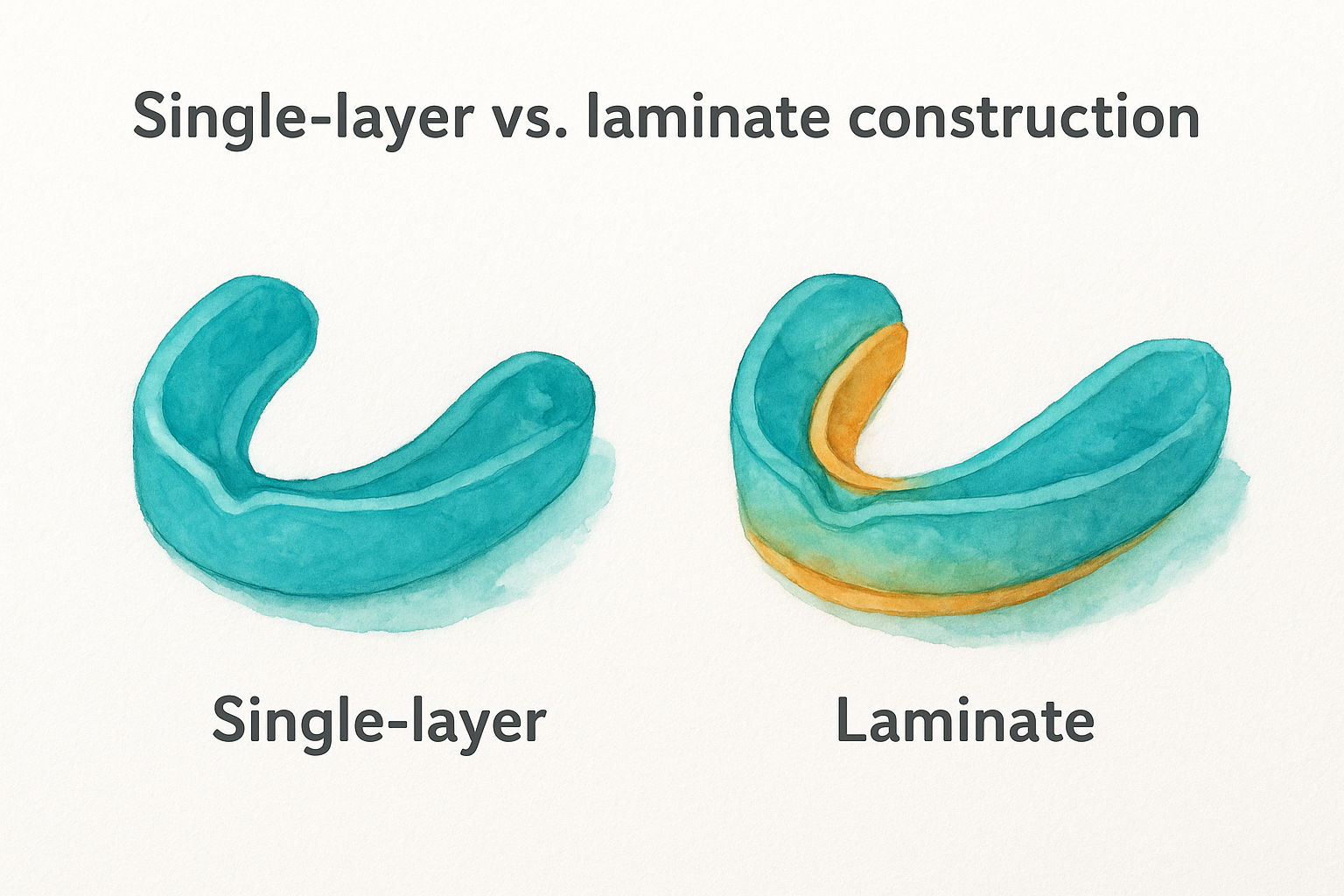
Single-layer vs. laminate construction
Single-layer sheets give you uniform material throughout, which works well for straightforward retainers and light guards. Laminate sheets bond two or more materials together, typically a softer inner layer for comfort against soft tissue and a harder outer layer to absorb occlusal load. For patients with heavy grinding habits, a dual-laminate construction holds up significantly longer than a single-layer equivalent at the same thickness.
How labs thermoform ProForm laminates
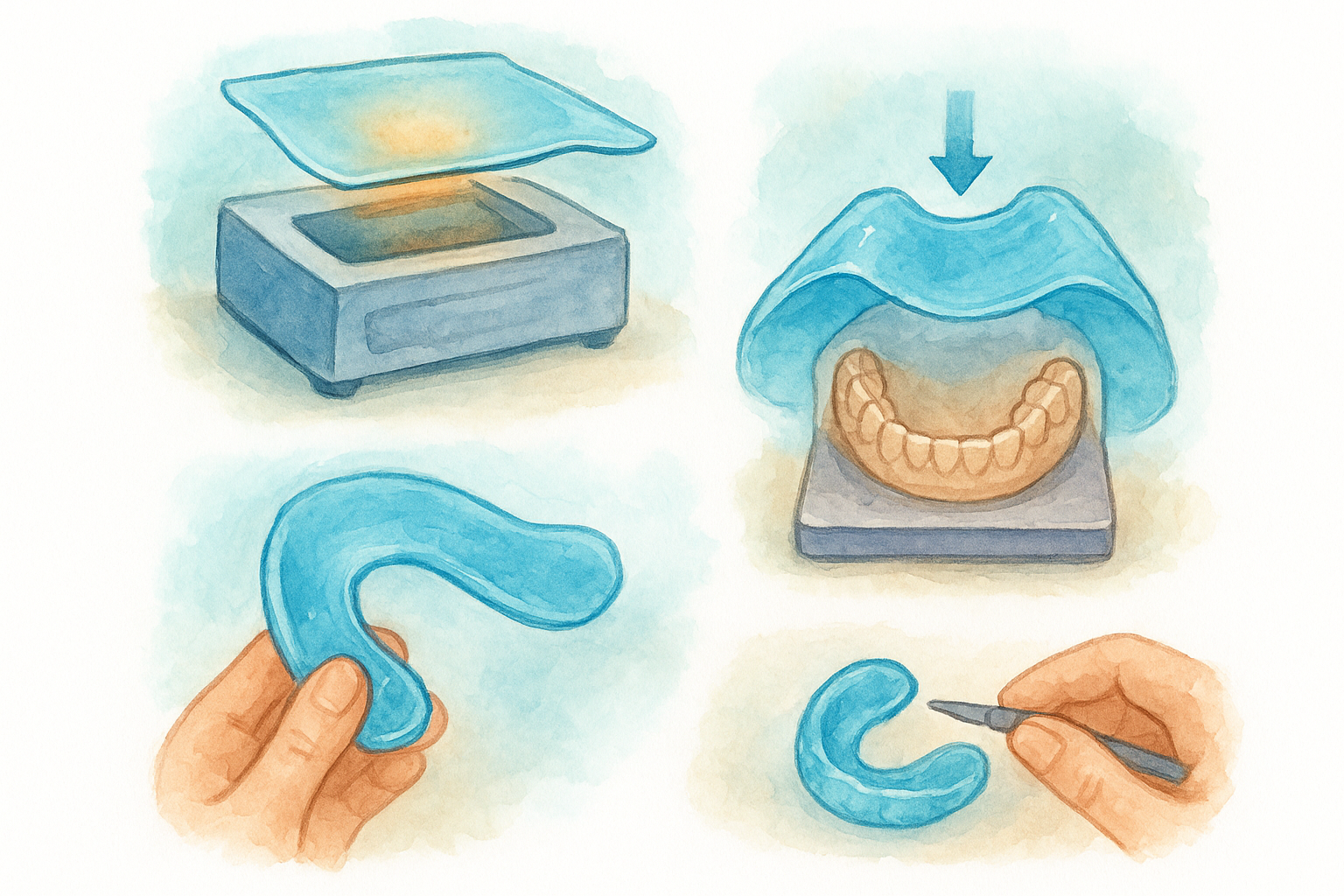
Thermoforming proform mouthguard material follows a precise sequence that leaves no room for guesswork. You heat the sheet to the correct softening temperature, seat it over a stone model on the vacuum-forming machine, and draw it down with negative pressure until the material conforms tightly to every surface. Rushing any step produces thin margins, air pockets, or uneven thickness that compromises the finished appliance.
Dialing in temperature and timing
EVA-based sheets respond poorly to overheating. When you push the temperature too high, the material loses its structural memory and over-stretches across the occlusal surfaces, leaving the margins too thin to protect adequately. Most lab technicians heat ProForm sheets until the material sags slightly in the frame, roughly 1 to 2 inches of drape, then immediately seat it over the model.
Consistent drape depth before seating is the clearest indicator that your heating time is calibrated correctly.
Trimming and finishing the appliance
Once the vacuum-formed appliance cools completely on the model, you trim the margins with a sharp carbide bur or scissors designed for thermoplastic material. Smooth margins prevent soft tissue irritation and improve patient compliance. Finishing with a flame or heat gun to polish the edges removes any rough spots left from trimming.
How to choose and buy the right sheets
Before you place an order, nail down the intended application and your patient's bite force profile. A sheet sized for a light retainer will fail fast under a heavy bruxer's occlusal load, so let clinical need drive your selection rather than price alone.
Match the material to the application
For night guards targeting bruxism, choose a firmer EVA sheet in the 2.0 mm to 3.0 mm range with dual-laminate construction. Athletic mouthguards call for a higher vinyl acetate content that absorbs impact instead of resisting it.
Ordering a sample pack before committing to a full case lets you test how a specific sheet behaves on your vacuum-forming machine.
Matching thickness and hardness to the use case cuts remakes significantly. If you fabricate multiple appliance types, stock two or three different sheet weights so you always have the right material ready.
What to look for in a supplier
When buying proform mouthguard material, verify that the supplier provides thickness tolerances and a material data sheet for every SKU. Skip vendors who list only a generic product name without technical specs.
Look for these details before committing to a supplier:
- Vinyl acetate percentage per product
- Shelf life and storage conditions
- Minimum order quantities and sample availability
What to do next
Now that you understand what goes into proform mouthguard material, from EVA composition and vinyl acetate percentages to thickness tolerances and laminate construction, you can make sourcing decisions based on actual specs rather than generic catalog descriptions. Whether you're a lab technician standardizing your fabrication workflow or a dental professional evaluating materials for a specific patient case, matching the right sheet to the right application cuts remakes, reduces waste, and improves long-term outcomes for everyone involved.
For patients who want a custom-fitted night guard without multiple dental appointments or high office fees, Remi builds professional-grade appliances using dental-quality materials and delivers them directly to your door. The process starts with a simple at-home impression kit, and the result is an appliance that fits the way a properly lab-fabricated guard should, without the markup. Check out Remi's custom night guard to see exactly how the process works and get started today.

