
 Guards + Retainers
 Custom Night Guard
 Retainer
 Emergency Order

 Whitening
 Whitening Kit
 Teeth Whitening Gel
 Dual-Action Foam
 Cleaning + Care
 Ultrasonic Cleaner Pro
 Water Flosser
 UV Toothbrush Sanitizer
 Deep Clean + Freshening Tablets
 Accessories
 Guard Removal Tool
 Replacement Nozzles
 Bundles

If you've ever woken up with a sore jaw, dull headache, or sensitive teeth, you're probably already searching for how to stop teeth grinding while sleeping. You're not alone, the American Sleep Association estimates that bruxism affects roughly 10% of adults, and many more go undiagnosed because it happens while they're unconscious.
Left unchecked, nightly grinding wears down enamel, strains your jaw joints, and can lead to cracked or chipped teeth over time. The good news? You don't need an expensive dental office visit to start protecting yourself. At Remi, we've worked alongside dentists and medical advisors to help over 350,000 customers tackle bruxism with custom-fitted night guards, delivered straight to their doors at a fraction of the traditional cost.
Below, you'll find nine practical tips you can put to work tonight, from stress management techniques and sleep hygiene adjustments to professional-grade dental solutions that keep grinding from doing real damage. Let's get into it.
What teeth grinding at night is
Bruxism is the clinical term for grinding, clenching, or gnashing your teeth. Sleep bruxism specifically happens while you're unconscious, which makes it tricky to catch early. You often rely on a partner noticing the sound, or a dentist spotting wear patterns on your molars during a routine checkup. Understanding exactly what's happening in your mouth is the first step toward figuring out how to stop teeth grinding while sleeping for good.
The two types of bruxism
Dentists split bruxism into two categories based on when it happens. Sleep bruxism is classified as a sleep-related movement disorder, meaning your brain triggers muscle activity in your jaw during certain sleep stages. Awake bruxism, by contrast, happens during the day and is usually tied to concentration or stress. Most people who grind at night aren't aware they're doing it at all.
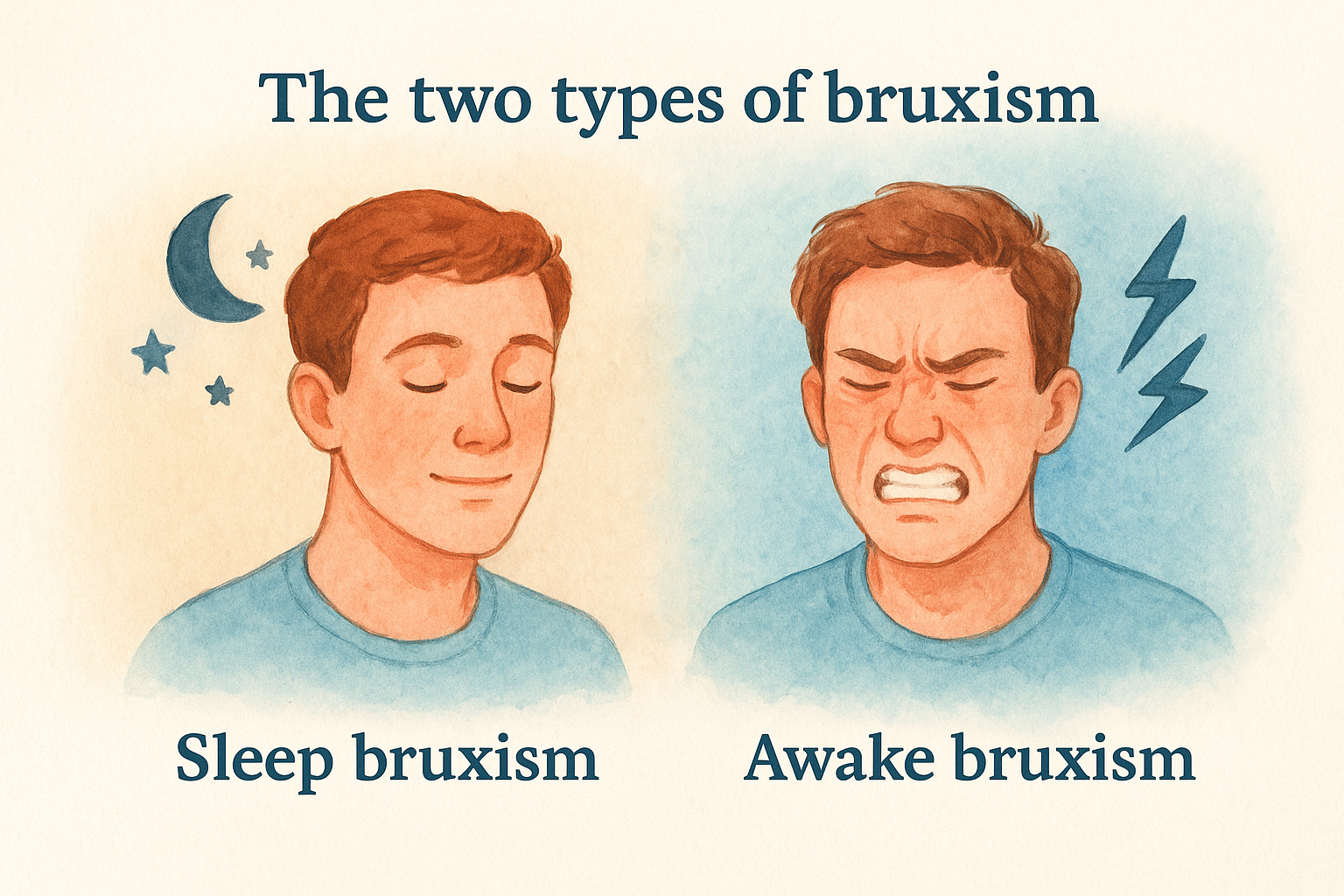
Sleep bruxism is considered a movement disorder of sleep, which is why standard willpower or conscious effort alone cannot stop it from happening.
The two types can overlap, but nighttime grinding tends to produce stronger muscle contractions. During sleep, your body loses the feedback mechanism that would normally signal you to ease up, so the force applied to your teeth is often much higher than anything you'd do while awake.
How grinding damages your teeth over time
Repeated nightly grinding puts an enormous amount of pressure on your teeth, jaw muscles, and temporomandibular joints (TMJ). Over months and years, that friction strips away tooth enamel, which your body cannot regenerate. You might notice your teeth looking shorter or more translucent at the edges, or you might feel increased sensitivity to hot and cold foods.
Beyond enamel loss, sustained clenching strains the muscles around your jaw and temples, contributing to chronic headaches, facial pain, and earaches. In more advanced cases, the constant pressure can crack teeth or damage dental restorations like crowns and fillings. Catching bruxism early and putting protective measures in place is far easier than repairing the damage after the fact.
What triggers teeth grinding while you sleep
Knowing what sets off bruxism gives you a real advantage when figuring out how to stop teeth grinding while sleeping. The triggers vary from person to person, but they generally fall into two overlapping categories: physical and neurological factors, and lifestyle habits that raise your baseline tension before bed.
Physical and neurological factors
Your brain plays a central role in sleep bruxism. Research shows that dopamine dysregulation and disruptions in the central nervous system can trigger the jaw muscle activity that causes grinding during sleep. Certain medications, especially selective serotonin reuptake inhibitors (SSRIs) used to treat anxiety and depression, are also linked to increased bruxism episodes as a side effect.
Sleep disorders compound the problem significantly. If you have obstructive sleep apnea, your airway partially closes during sleep, which causes your jaw to tense up as your body tries to reopen it. Treating the underlying sleep disorder often reduces grinding frequency on its own.
If you take an SSRI or have been diagnosed with a sleep disorder, talk to your doctor before assuming stress is the only cause of your grinding.
Lifestyle and environmental triggers
Stress and anxiety are the most commonly reported triggers, and the connection is straightforward: tension you carry through the day doesn't automatically switch off when you close your eyes. High caffeine or alcohol intake in the hours before bed also raises muscle activity during sleep, making grinding more likely and more intense.
Tip 1–3: Reset your sleep and evening habits
Your evening routine directly shapes how tense your jaw muscles are when you fall asleep. Small, consistent changes in the two hours before bed can meaningfully reduce grinding episodes and give every other strategy in this guide more room to work.
Tip 1: Cut caffeine and alcohol after 2 PM
Caffeine keeps your nervous system elevated well into the night, and alcohol fragments your sleep cycles, both of which increase jaw muscle activity while you sleep. Cut these out in the afternoon and swap them for water or herbal tea instead. Common culprits to eliminate after 2 PM:
- Coffee and espresso drinks
- Energy drinks and pre-workouts
- Beer, wine, and spirits
- Caffeinated sodas
The earlier you cut caffeine, the less stimulation your nervous system carries into sleep.
Tip 2: Add a 10-minute wind-down habit
A consistent wind-down routine signals your nervous system to lower tension before sleep. Try 10 minutes of light stretching or reading in dim light rather than scrolling on your phone, which keeps arousal levels high and makes grinding more likely.
Pick one habit and repeat it at the same time each night. Consistency beats variety when it comes to building a pre-sleep signal your body actually responds to.
Tip 3: Sleep on your back
Side sleeping pushes direct pressure onto your jaw and actively encourages clenching through the night. Switching to back sleeping removes that mechanical pressure entirely, making it one of the simplest physical adjustments you can apply when learning how to stop teeth grinding while sleeping.
Tip 4–6: Relax your jaw and nervous system
Grinding often reflects accumulated physical tension that your jaw muscles carry into sleep. These three tips target that tension directly, giving your jaw and nervous system a real chance to downshift before you close your eyes.
Tip 4: Do a jaw stretch before bed
A quick jaw stretch routine trains your muscles to release held tension rather than carry it overnight. This straightforward movement helps reset muscle memory and is one of the most underused tools when learning how to stop teeth grinding while sleeping. Follow these steps each night:
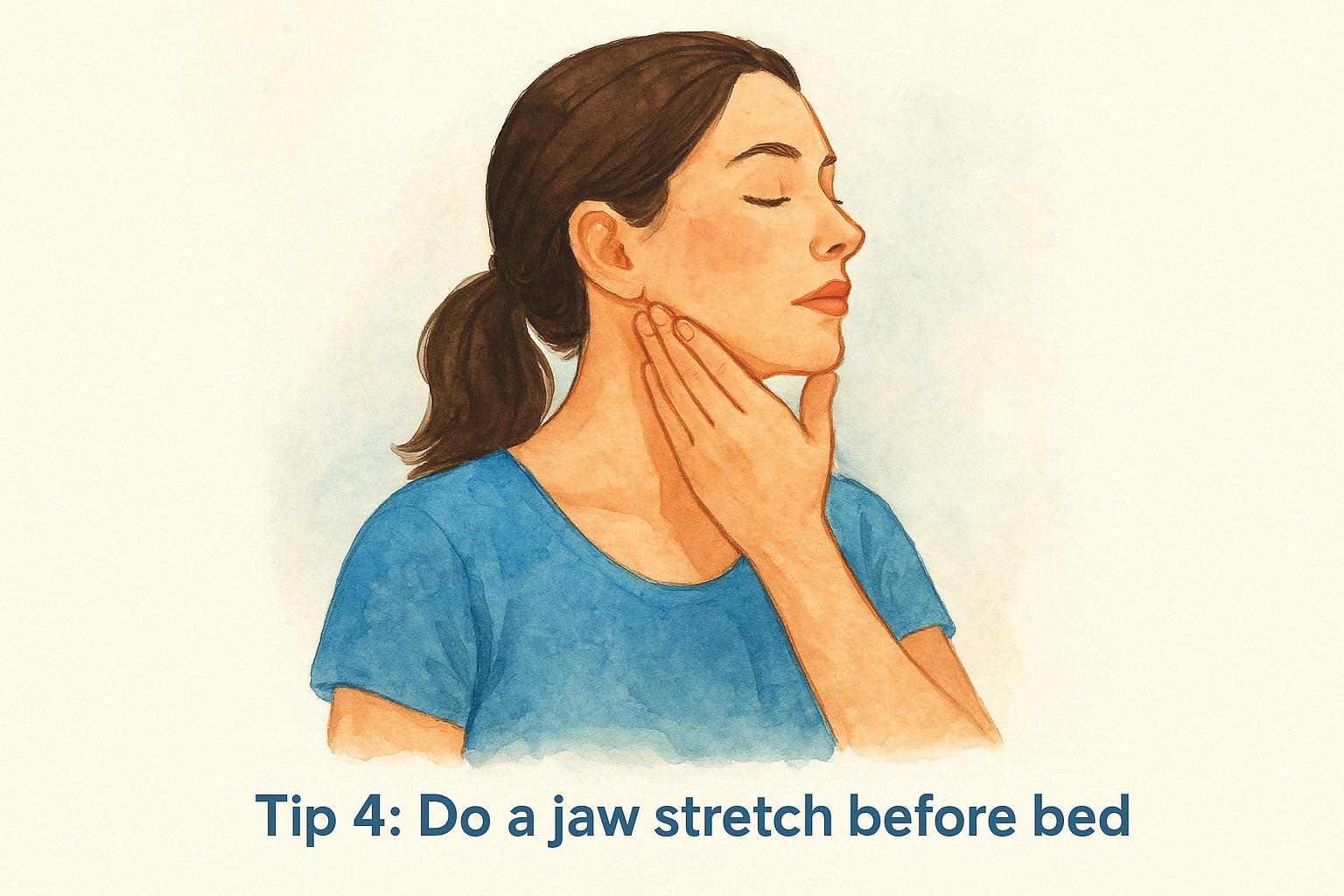
- Place your tongue flat against the roof of your mouth
- Let your lower jaw drop open slowly
- Hold for five seconds, then close gently
- Repeat five times
Tip 5: Apply a warm compress to your jaw
Heat loosens tight muscles more effectively than most people realize. Press a warm, damp cloth against your jaw for 10 minutes before bed. The warmth increases blood flow to your masseter muscles, reducing the baseline tension that drives clenching overnight.
Pair this with light jaw circles, slowly rotating your lower jaw five times in each direction while the compress is in place. Combining heat and gentle movement gives you a faster release than either approach alone.
Apply the compress at the same point in your nightly routine so your body starts associating the warmth with settling down for sleep.
Tip 6: Practice diaphragmatic breathing
Slow, deep breathing activates your parasympathetic nervous system, which directly lowers muscle tension throughout your body. Try inhaling for four seconds, holding for four, then exhaling for six. Repeat this cycle for five minutes immediately after your warm compress.
Tip 7–9: Protect teeth and treat root causes
The first six tips reduce grinding triggers, but some nights your jaw will still clench. Tips 7 through 9 shift focus from prevention to active protection, targeting both the physical damage bruxism causes and the underlying conditions that drive it.
Tip 7: Wear a custom-fitted night guard
A custom night guard sits between your upper and lower teeth, absorbing force before it reaches your enamel. Unlike bulky pharmacy trays, a properly fitted guard matches your exact bite and stays comfortable all night. Remi's at-home impression kit lets you get a lab-quality guard at a fraction of the dental office price, making this the most direct way to stop teeth grinding while sleeping from doing real damage.
A custom-fitted guard is not a cure, but it is your strongest line of defense against enamel loss while you address the root causes.
Tip 8: Ask your doctor about medication side effects
SSRIs and stimulant medications are well-documented bruxism triggers. If your grinding started after a new prescription, bring it up with your doctor. Common culprits include:
- Fluoxetine, sertraline, and paroxetine (SSRIs)
- Amphetamines and methylphenidate (stimulants)
A dosage adjustment or medication switch often reduces episodes without stopping treatment.
Tip 9: Get screened for sleep apnea
Obstructive sleep apnea drives jaw tension during sleep as your body works to reopen a partially closed airway. Ask your doctor about a sleep study if you snore, wake frequently, or feel unrested after a full night in bed.
Treating sleep apnea often reduces grinding frequency significantly on its own.
Next steps
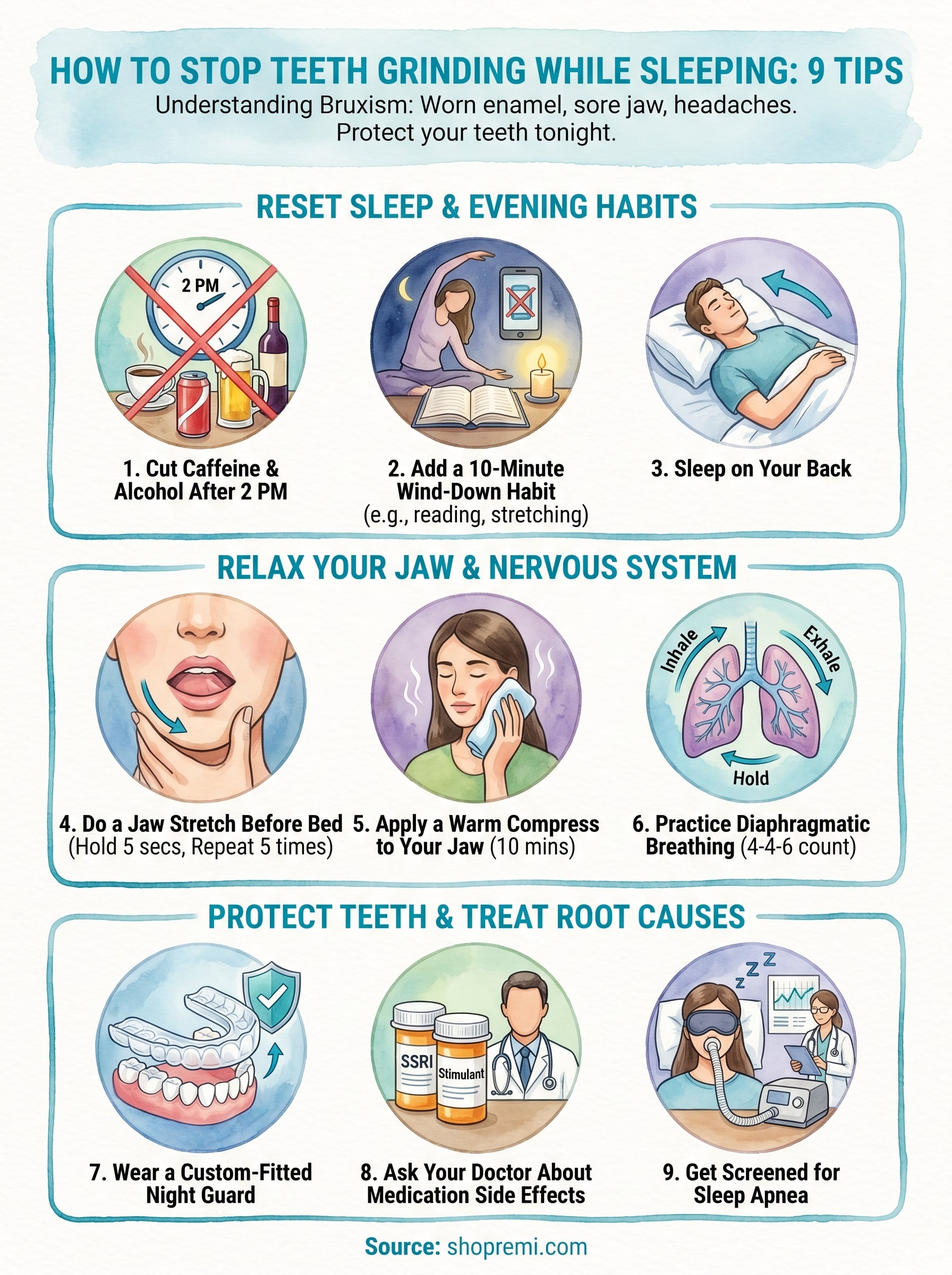
The nine tips above give you a clear path for how to stop teeth grinding while sleeping, but knowing the steps and acting on them are two different things. Start with one or two changes tonight: cut caffeine after 2 PM, add a jaw stretch before bed, or apply a warm compress to your jaw. Your body responds to repetition, so prioritize consistency over perfection as you build these habits. Small, repeated wins build the momentum that makes the bigger adjustments stick long term.
Your teeth also need physical protection while you work through the lifestyle and medical changes. A custom-fitted night guard is the most direct way to stop enamel damage in its tracks, and you do not need a dental office appointment to get one. Remi's custom night guard comes with an at-home impression kit, ships directly to your door, and costs 80% less than the dentist without sacrificing fit or quality. Order yours today and start protecting your teeth tonight.

