


You finished orthodontic treatment, got your clear retainer, and were told to wear it. But has anyone actually explained how do clear retainers work, what's happening at a biological level when that thin piece of plastic sits over your teeth? Most people just snap them in and trust the process, which is fine. But understanding the science behind retention can change how seriously you treat this phase of your dental care.
Here's the short answer: your teeth aren't cemented into your jawbone like posts in concrete. After braces or aligners move them, the bone and soft tissue need time to stabilize around each tooth's new position. A clear retainer acts as a passive hold, preventing your teeth from drifting back while that remodeling process completes. Skip it, and your teeth will shift, sometimes within weeks.
At Remi, we make custom-fitted clear retainers using an at-home impression kit and professional dental lab fabrication, at a fraction of what a dental office charges. So we think about this stuff constantly. This article breaks down the actual mechanics of how clear retainers keep your teeth in place, what's happening inside your jaw while you wear one, and why fit and consistency matter more than most people realize.
Why teeth shift after braces and aligners
Your teeth aren't fused directly to your jawbone. Each tooth sits in a socket and connects to the surrounding bone through thousands of tiny elastic fibers called the periodontal ligament (PDL). This ligament is what makes orthodontic treatment possible in the first place: apply consistent, controlled pressure, and the PDL responds by signaling the bone to break down on one side of the tooth and rebuild on the other, allowing the tooth to move. That same mechanism is also what makes retention so critical when treatment ends.
The periodontal ligament: your teeth's built-in suspension system
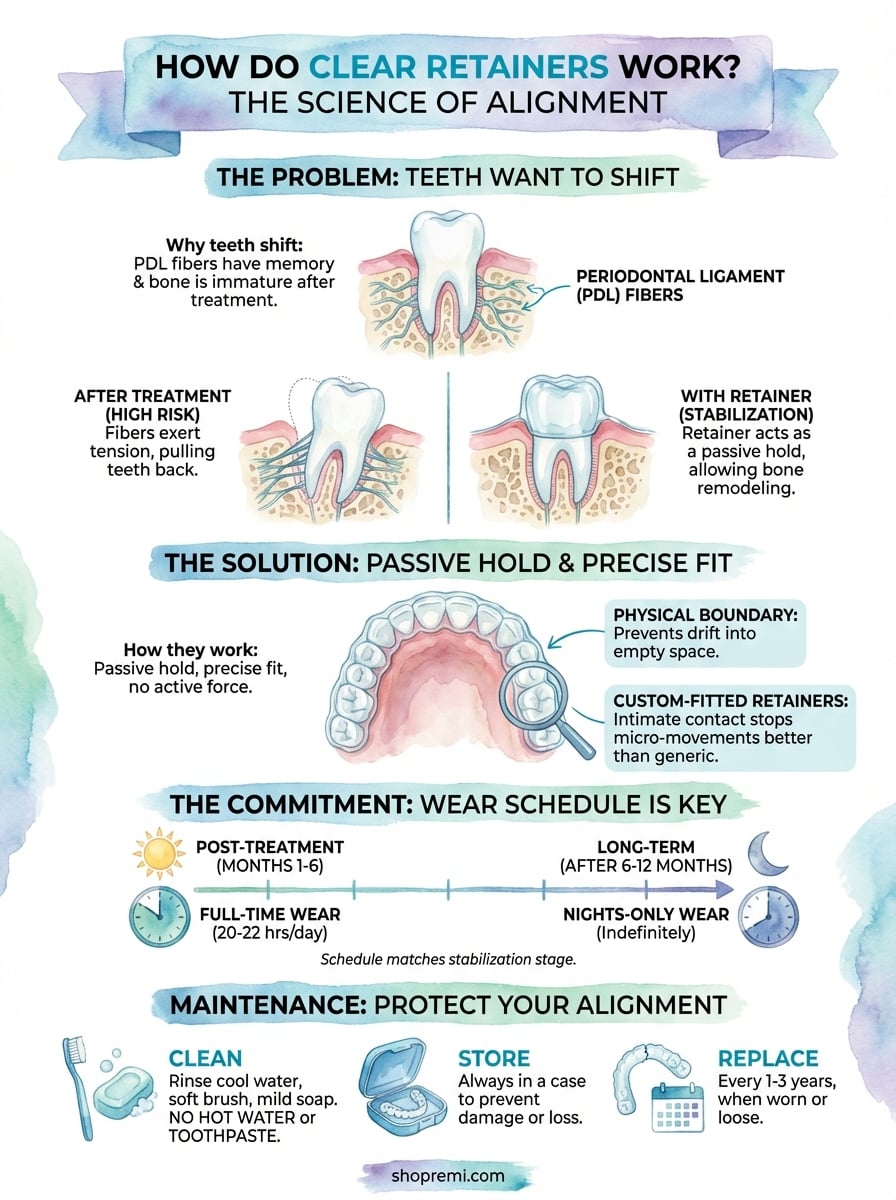
The PDL has memory. Before your braces or aligners moved your teeth, those fibers were arranged around a specific tooth position. Once orthodontic pressure shifts a tooth to a new location, the PDL fibers get stretched and reoriented, but they don't immediately accept the new position as permanent. For months after treatment ends, those fibers exert tension on the tooth, pulling it back toward where it used to be. Without something holding the tooth in place during this period, it will drift. This is the primary driver of short-term relapse, and it's exactly why your orthodontist tells you to wear your retainer full-time right after finishing treatment.
The PDL can begin pulling a tooth back toward its original position within days of removing orthodontic appliances, which is why immediate retention is non-negotiable.
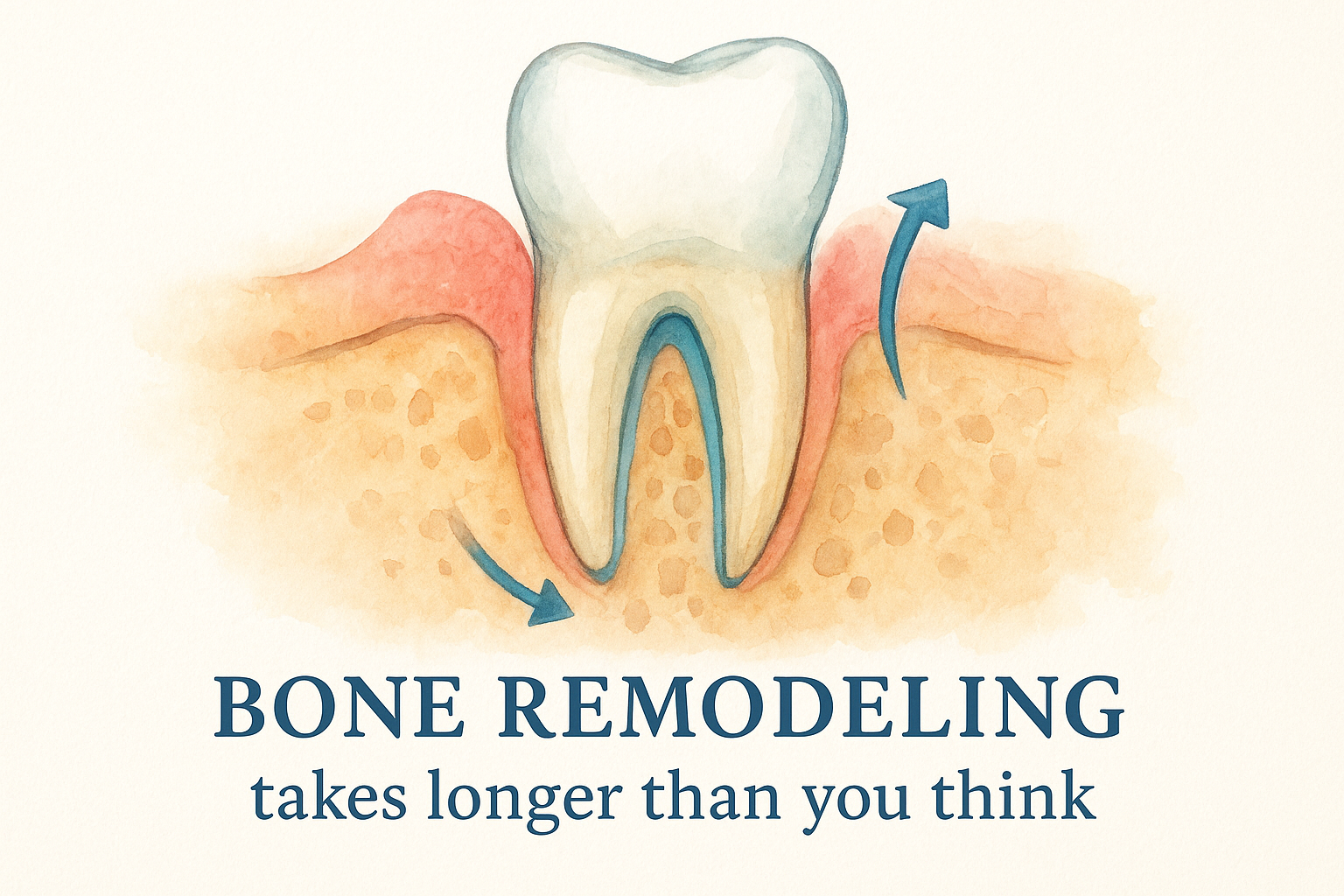
Bone remodeling takes longer than you think
Moving a tooth requires bone resorption on the pressure side and new bone deposition on the tension side. Once active treatment ends, the new bone surrounding your tooth's current position is still immature and hasn't fully mineralized yet. Immature bone is softer and less stable, meaning the tooth has less structural support locking it in place. This remodeling process can take anywhere from several months to over a year to complete, depending on your age, bone density, and how far your teeth moved during treatment.
Your age plays a real role here. Younger patients tend to have more metabolically active bone, which means faster remodeling but also faster relapse if the retainer gets skipped. Older patients may have denser bone that takes longer to remodel, but that doesn't reduce the risk of shifting. Understanding how do clear retainers work begins with recognizing that retention isn't a formality you can rush through. It's the phase where your jaw actually locks in the result of all that orthodontic work, and no amount of effort during active treatment compensates for skipping this step afterward.
How clear retainers hold teeth in place
Once you understand what's pulling your teeth back, the mechanics of how clear retainers work become straightforward. A clear retainer is a thin, rigid plastic shell molded to the exact contours of your teeth in their corrected position. It doesn't apply force to move anything. Its job is simpler: occupy the space your teeth would drift into if left unchecked, so they have no room to go anywhere.
The physical fit does the work
The retainer achieves this through precise surface contact. When the appliance sits over your teeth, the walls of the plastic press lightly against the outer and inner surfaces of each tooth. This contact creates a mechanical boundary. If a tooth begins to shift even slightly, it immediately meets resistance from the retainer wall, which pushes it back into alignment. The tighter and more accurate the fit, the more effectively it blocks movement.
This is why custom-fitted retainers outperform generic boil-and-bite options. A retainer made from a precise impression of your teeth has intimate contact at every surface. A generic option has gaps and inconsistencies that allow micro-movements to accumulate over time. Those small shifts compound quickly, which is why understanding how do clear retainers work also means understanding why fit quality is not a detail to cut corners on.
Passive force vs active pressure
Unlike braces or aligners, a well-fitting retainer applies no active orthodontic force. It isn't designed to move teeth. This distinction matters because it explains what happens when the fit degrades. If you stop wearing your retainer for a period and your teeth shift, putting the retainer back in will feel tight. At that point, the retainer is no longer just retaining.
Wearing a tight retainer to "push teeth back" after skipping it for weeks can stress the PDL and surrounding bone in ways a proper appliance isn't designed to handle.
How long to wear clear retainers for best results
Wear time is where most people lose the results they worked hard to get. The biology of bone remodeling and PDL stabilization doesn't follow a fixed clock, which means there's no single date when your teeth are permanently locked in. Your wear schedule needs to match the stage of stabilization your jaw is in, and that schedule changes significantly over the first year after treatment ends.
Full-time wear right after treatment
For the first several months after finishing braces or aligners, your orthodontist will typically tell you to wear your retainer 20 to 22 hours per day. This covers the highest-risk window, when your PDL fibers are still pulling toward the original tooth positions and the surrounding bone hasn't fully mineralized. Removing the retainer only to eat and brush gives your teeth almost no unguarded time to drift. Understanding how do clear retainers work during this phase means recognizing that even a few days of skipping can allow measurable movement in recently treated teeth.
The first three to six months after orthodontic treatment carry the highest relapse risk, making consistent full-time wear non-negotiable during that window.
Shifting to nights-only wear
Once your orthodontist confirms that your teeth have stabilized, most patients transition to wearing their retainer only at night. This typically happens somewhere between six months and one year post-treatment, though it varies by individual. Nights-only wear is not the end of retention. It's a long-term commitment, and most dental professionals recommend indefinite nightly wear to prevent gradual shifting that accumulates over years. Your teeth respond to the pressures of chewing, speaking, and even resting jaw position throughout your lifetime, so the retainer remains your primary defense against those forces even decades after treatment ends.
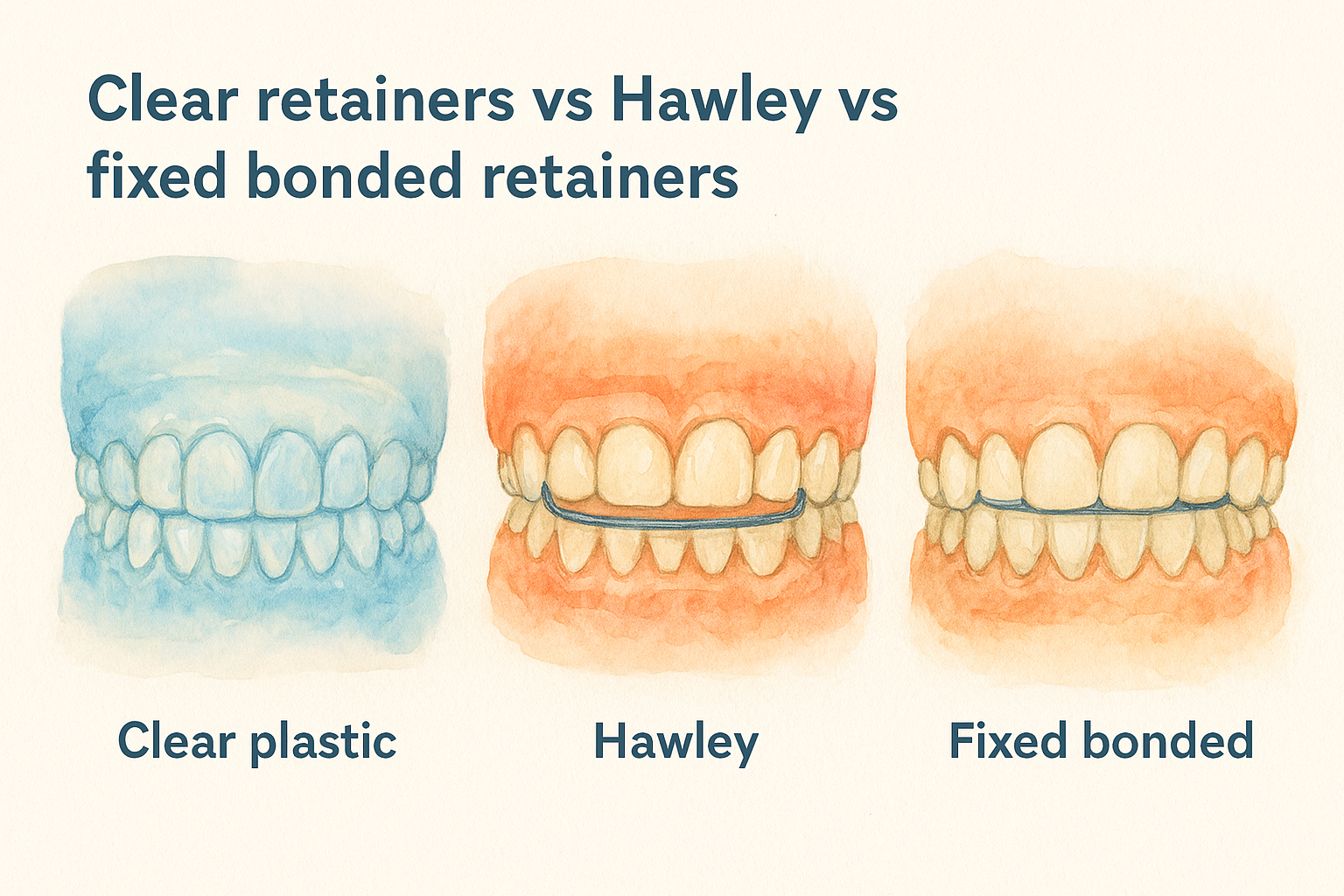
Clear retainers vs Hawley vs fixed bonded retainers
Not all retainers work the same way, and knowing the differences helps you understand why your orthodontist recommended a specific type and what tradeoffs come with each option. Three main retainer categories exist: clear plastic (Essix), Hawley, and fixed bonded. Understanding how do clear retainers work compared to these alternatives clarifies what you're actually getting with each approach.
Hawley retainers
A Hawley retainer uses a wire that runs across the front of your teeth combined with an acrylic plate that sits against the roof of your mouth or along the inside of your lower teeth. The wire does the holding work by applying contact pressure against the tooth surfaces. Hawley retainers are durable and adjustable if minor corrections are needed, and they allow your upper and lower teeth to contact naturally when biting. The tradeoff is visibility since the wire shows when you smile, and some people find the acrylic bulk uncomfortable at first.
Fixed bonded retainers
Bonded retainers take a completely different approach: a thin wire cemented directly to the back surfaces of your front teeth, typically the lower incisors. You cannot remove it, which eliminates the compliance problem entirely since it works continuously without any action on your part. This makes it highly effective for long-term stability in the front teeth specifically.
Fixed retainers do not protect your full arch the way a removable retainer does, so many orthodontists use both types together.
Cleaning around a bonded wire requires more deliberate effort, and if the wire breaks or a bond fails, you need a dental appointment to repair it. Clear retainers cover your entire arch, are removable, and are straightforward to replace when they wear out, which makes them the preferred option for most patients who want full arch coverage with daily flexibility.
How to clean, store, and replace clear retainers
Understanding how do clear retainers work means nothing if the appliance is dirty, warped, or worn through. A degraded retainer loses the precise fit that makes it effective, so maintaining it properly directly protects the alignment results you worked to achieve.
Cleaning your clear retainer
Rinse your retainer with cool water every time you remove it, before bacteria and saliva dry onto the surface. For a deeper clean, use a soft-bristled toothbrush and mild dish soap to scrub all surfaces gently. Avoid hot water entirely since heat warps the plastic and permanently distorts the fit. Toothpaste feels like a logical choice, but most formulas are mildly abrasive and will scratch the plastic, creating grooves where bacteria accumulate.
Scratched retainers harbor more bacteria and lose optical clarity faster, both of which signal it's time for a replacement.
For a more thorough approach, ultrasonic cleaners use high-frequency sound waves to dislodge debris from hard-to-reach surfaces without abrasive contact, preserving the retainer's surface integrity.
Storing and replacing your retainer
Always keep your retainer in its hard-sided case when you're not wearing it. Leaving it on a table or wrapped in a napkin exposes it to bacteria, physical damage, and accidental disposal, which is one of the most common ways retainers get thrown away.
Clear retainers don't last forever. Most wear through in one to three years depending on how frequently you wear them and whether you grind at night. Signs you need a replacement include visible cracks, a noticeably looser fit, or persistent discoloration that cleaning won't resolve. Replacing your retainer on schedule keeps your protective coverage consistent and closes the gap in retention that allows teeth to begin shifting again.
Keep your teeth aligned for the long run
Understanding how do clear retainers work puts you in a better position to actually protect your results. The biology is straightforward: your PDL fibers and bone need time to stabilize around your teeth's corrected positions, and a well-fitted clear retainer is the only thing standing between your current smile and gradual relapse. No shortcut replaces consistent wear, proper cleaning, and timely replacement when the plastic degrades.
Your retainer is a long-term tool, not a temporary inconvenience. Wearing it nightly, keeping it clean, and replacing it on schedule adds up to years of maintained alignment that your orthodontic treatment earned. If your current retainer is worn out, ill-fitting, or lost, the gap in protection matters immediately. Getting a replacement quickly is the move that actually preserves your investment. Order a custom clear retainer from Remi and get a precise, professional-grade fit without the dental office price tag.

