


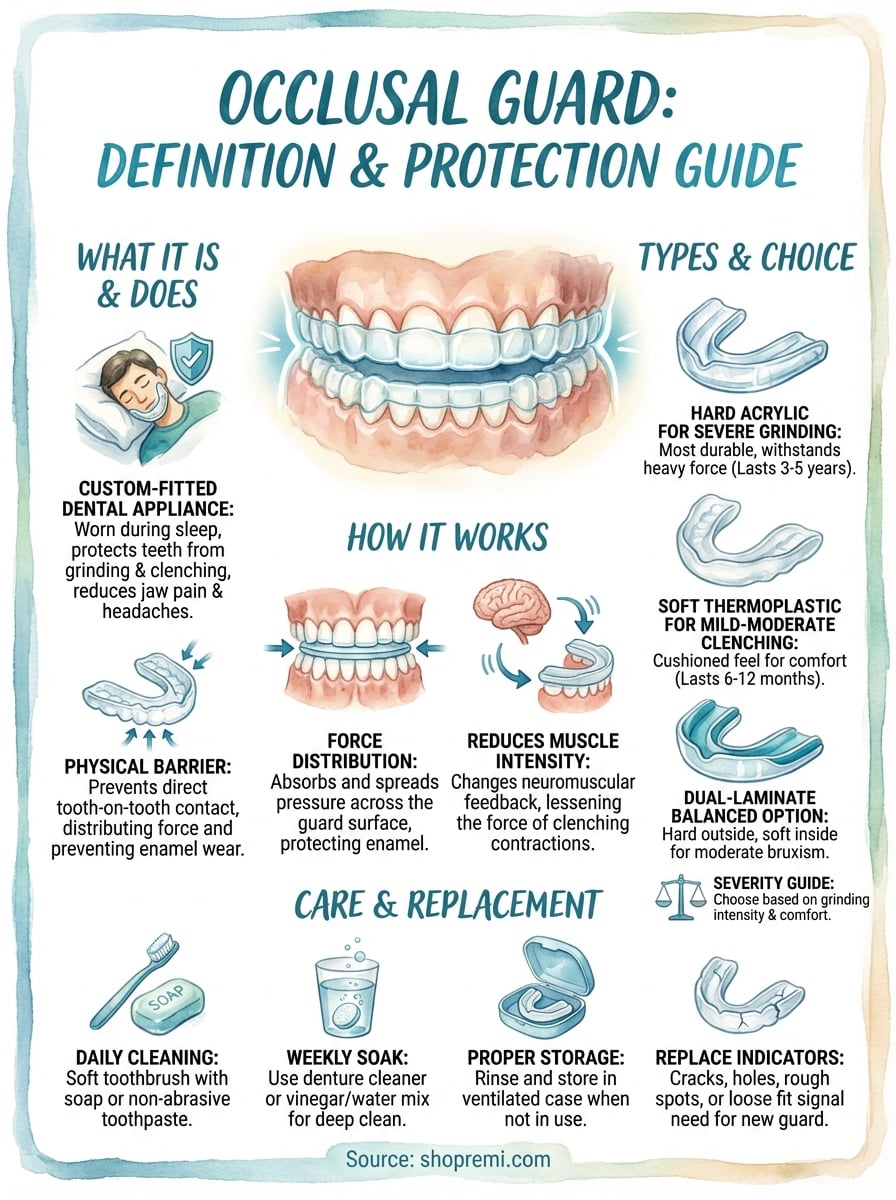
If your dentist mentioned an occlusal guard or you've stumbled across the term while researching teeth grinding solutions, you're probably wondering what it actually means. The occlusal guard definition is straightforward: it's a custom-fitted dental appliance designed to protect your teeth from grinding and clenching, typically worn during sleep.
These guards act as a barrier between your upper and lower teeth, absorbing the pressure that would otherwise wear down enamel, crack fillings, or strain your jaw muscles. For the millions of Americans dealing with bruxism, an occlusal guard can be the difference between waking up with jaw pain and getting restful, damage-free sleep.
At Remi, we specialize in creating professional-grade custom occlusal guards (also called night guards) at a fraction of dental office prices. This guide breaks down exactly how these devices work, who needs one, and what sets them apart from other oral appliances like retainers or sports mouthguards.
What an occlusal guard is and is not
Understanding the occlusal guard definition means knowing exactly what this device does and what it doesn't do. An occlusal guard is a protective dental appliance made from durable materials like acrylic or soft thermoplastic that covers either your upper or lower teeth. The primary purpose is to prevent direct tooth-on-tooth contact when you grind or clench, distributing the force across the guard's surface instead of concentrating it on individual teeth.
What qualifies as an occlusal guard
You'll find occlusal guards under several names: night guards, bite guards, or bruxism splints. These terms all describe the same basic device, though the specific design may vary based on your needs. A true occlusal guard must be custom-fitted to your mouth or at minimum offer some level of moldability to ensure it stays in place and provides proper coverage.
Professional occlusal guards come in three main materials: hard acrylic (most durable), dual-laminate (hard outside, soft inside), and soft thermoplastic (cushioned feel). Each material serves the same protective function but offers different levels of comfort and durability based on the severity of your grinding.
"An occlusal guard works by creating a physical barrier that absorbs grinding forces, protecting your natural teeth from wear and your jaw from strain."
What an occlusal guard is not
Your occlusal guard is not a sports mouthguard, even though they look similar. Sports guards are designed to absorb sudden impact forces from external trauma, while occlusal guards address internal grinding forces that occur during sleep. The materials and thickness differ significantly between the two.
An occlusal guard also isn't a retainer. Retainers hold your teeth in specific positions to maintain orthodontic results, while occlusal guards simply protect against grinding without moving teeth. Using a retainer as a night guard can damage the retainer and won't provide adequate protection for bruxism. Similarly, whitening trays and athletic mouthpieces lack the durability and structural design needed for nighttime grinding protection.
Why occlusal guards matter for teeth and jaw health
Your teeth and jaw face significant stress when you grind or clench during sleep. Without protection, this repetitive force causes measurable damage that accumulates over months and years. Understanding the occlusal guard definition helps you see why dentists recommend this device; it serves as your first line of defense against bruxism complications that affect both your dental structure and jaw function.
Protection against permanent dental damage
Grinding wears down your tooth enamel at a rate that can't be reversed. You risk cracking fillings, chipping teeth, and exposing the softer dentin layer underneath once enamel erodes completely. These issues don't just affect appearance; they create pathways for decay and infection that require expensive restorative work.
"Untreated bruxism can wear down teeth by several millimeters over time, changing your bite and facial structure."
An occlusal guard absorbs the grinding forces instead of your teeth, preserving your natural dental structure. The guard material takes the wear while your enamel stays intact, preventing the need for crowns, veneers, or extensive dental repairs down the road.
Relief from jaw pain and headaches
Clenching puts extreme pressure on your temporomandibular joint (TMJ) and the muscles that control jaw movement. This tension radiates outward, causing morning headaches, facial soreness, and even neck pain that interferes with your daily activities.
Wearing an occlusal guard reduces the intensity of muscle contractions during sleep. Your jaw muscles can't clench as forcefully when the guard creates space between your teeth, which means less strain on joints and surrounding tissues.
How an occlusal guard works during clenching and grinding
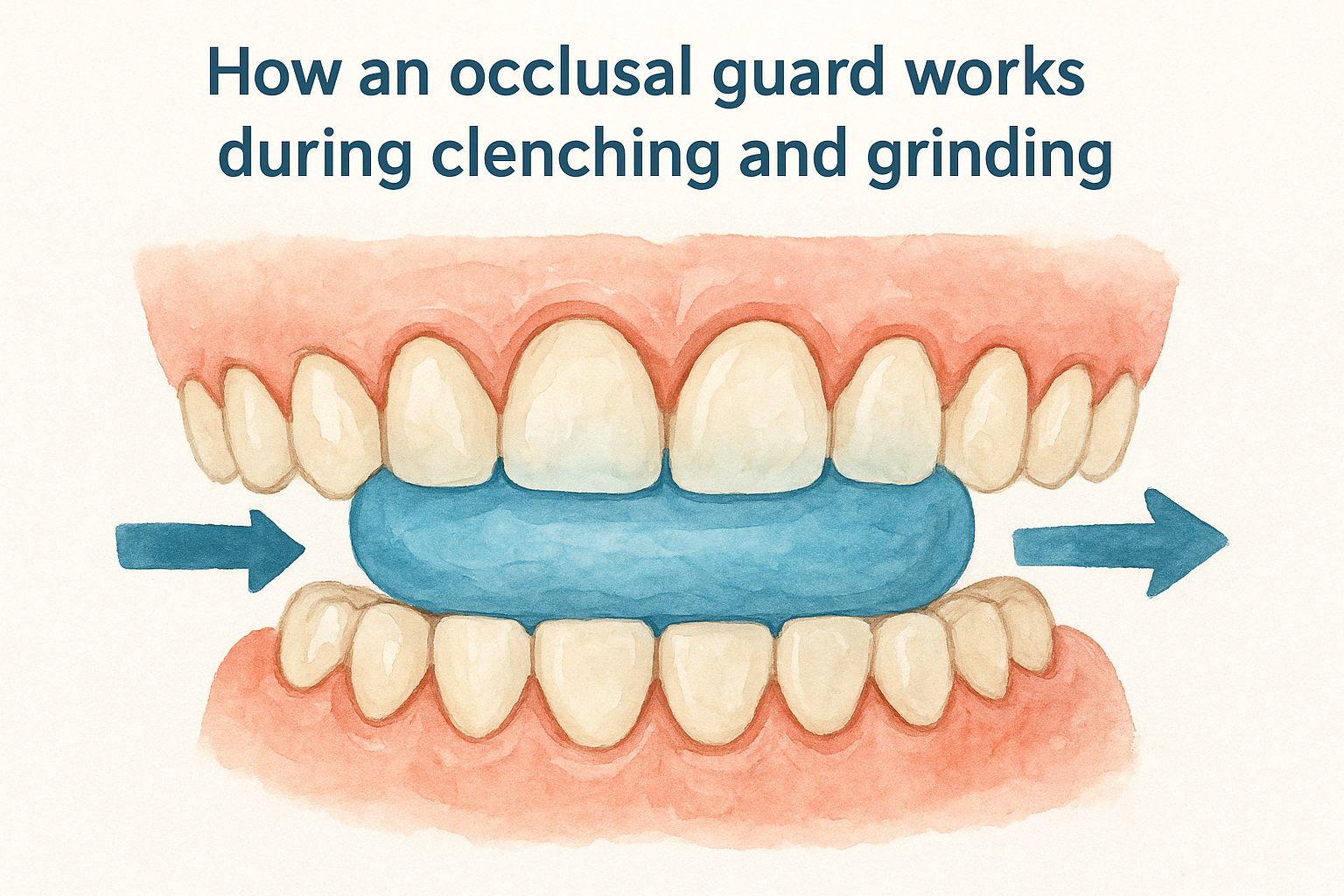
The mechanical process behind the occlusal guard definition centers on force distribution and barrier protection. When you clench or grind your teeth during sleep, your jaw muscles generate forces that can exceed 250 pounds per square inch. An occlusal guard intercepts these forces before they reach your natural teeth, spreading the pressure across a larger surface area instead of concentrating it on vulnerable enamel edges and tooth cusps.
Creating physical separation between teeth
Your occlusal guard maintains a small but critical space between your upper and lower dental arches. This separation prevents the direct contact that causes enamel wear and fractures. When you attempt to grind, your teeth meet the smooth guard surface instead of grinding against opposing teeth with their irregular edges and points.
"The guard acts like a shock absorber for your teeth, converting destructive grinding motion into distributed pressure that the appliance absorbs."
The guard material itself deforms slightly under pressure, which dissipates grinding energy that would otherwise transfer directly into your tooth structure. You'll notice wear marks on your guard over time, visual proof that the device is taking damage instead of your teeth.
Reducing muscle contraction intensity
Wearing an occlusal guard changes your neuromuscular feedback loop during sleep. Your brain receives signals that something foreign sits between your teeth, which typically reduces the intensity of jaw muscle contractions by 30-50%. You may still clench, but the force decreases because your jaw can't achieve the same tight closure it would without the guard in place.
Types of occlusal guards and how to choose one
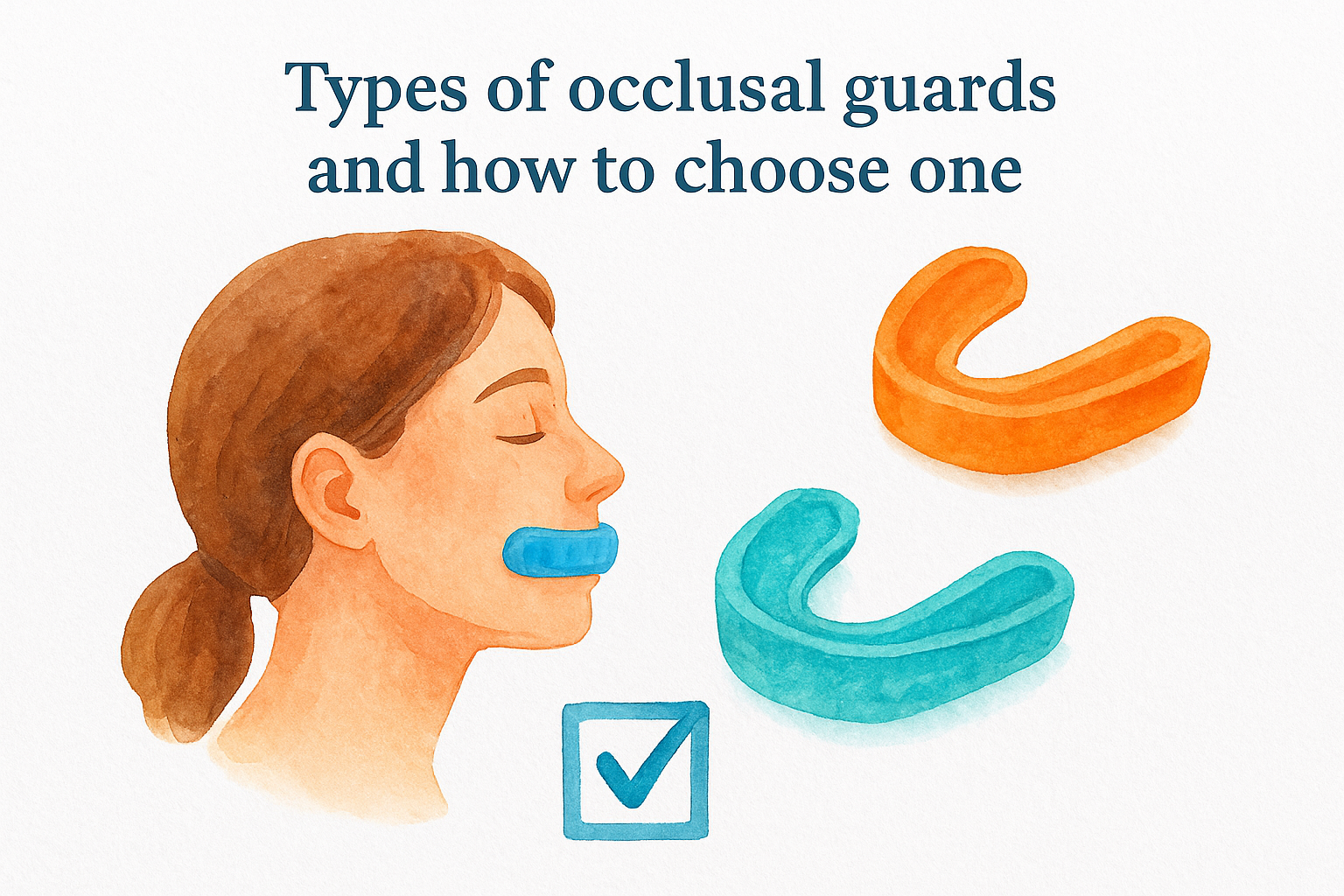
Understanding the complete occlusal guard definition means recognizing that these devices come in three distinct material types, each designed for different grinding intensities and comfort preferences. Your choice depends on whether you're a heavy grinder or light clencher, your sensitivity to foreign objects in your mouth, and how long you want the guard to last before replacement.
Hard acrylic guards for severe grinding
Hard acclusal guards use rigid acrylic material that withstands the most aggressive grinding patterns. These guards last 3-5 years with proper care and provide the strongest protection against tooth wear. Dentists typically recommend hard guards for patients who grind through softer materials within months.
The rigid surface prevents your teeth from achieving the grinding motion they naturally want, which can reduce the frequency of grinding episodes over time. You'll need a few nights to adjust to the firmness, but the durability makes this material the most cost-effective long-term option.
Soft guards for mild to moderate clenching
Soft thermoplastic guards offer a cushioned feel that many first-time wearers prefer. These guards work well if you primarily clench rather than grind side-to-side, providing comfortable protection for occasional bruxism. The flexible material adapts to slight bite changes without needing adjustments.
"Soft guards typically need replacement every 6-12 months because the material compresses and tears more easily than hard acrylic."
Choosing based on your grinding severity
Your dentist can assess grinding severity by examining wear patterns on your teeth, but you can also self-evaluate. If you wake with jaw soreness and headaches multiple times per week, you likely need a hard guard. Occasional tension without visible tooth damage suggests a soft guard will suffice.
How to wear, clean, and replace an occlusal guard
Proper care extends the life of your occlusal guard and ensures it continues protecting your teeth effectively. The occlusal guard definition centers on protection, but that protection only works when you wear the device consistently and maintain it according to dental standards. Your nightly routine and cleaning habits directly impact how well the guard performs.
Wearing your guard properly each night
Insert your occlusal guard right before bed, making sure it seats completely over your teeth without gaps along the gumline. You should feel even pressure across all covered teeth when you bite down gently. The guard stays in place through suction and fit rather than through conscious effort, so you won't need to hold it with your jaw muscles.
"Consistent nightly wear is essential because skipping even a few nights allows grinding damage to accumulate on your natural teeth."
Remove the guard immediately upon waking and rinse it with cool water before storing it in its ventilated case. Never sleep with the guard during daytime naps unless your dentist specifically recommends it for severe bruxism.
Daily cleaning and replacement schedule
Clean your guard each morning using a soft toothbrush and antibacterial soap or non-abrasive toothpaste. Avoid hot water, which warps the material and compromises the fit. Deep clean your guard weekly by soaking it in a denture cleaner or a mixture of equal parts white vinegar and cool water for 15-20 minutes.
Replace your occlusal guard based on visible wear indicators: cracks, holes, rough spots, or a loose fit signal the need for a new guard. Hard guards typically last 3-5 years, while soft guards need replacement every 6-12 months.
Conclusion section
The occlusal guard definition extends beyond a simple protective device to represent your primary defense against long-term dental damage from grinding and clenching. These custom-fitted appliances preserve your enamel, reduce jaw strain, and prevent the expensive restorative procedures that untreated bruxism eventually requires. Whether you choose a hard acrylic guard for severe grinding or a soft guard for occasional clenching, consistent nightly wear transforms your dental health trajectory.
Your teeth absorb hundreds of pounds of force during grinding episodes, and that pressure accumulates into visible damage over time. An occlusal guard interrupts this destructive cycle by creating a protective barrier that takes the wear instead of your natural tooth structure. Combined with proper cleaning and timely replacement, these guards deliver professional-level protection without the typical dental office price tag.
Ready to protect your smile? Get your custom night guard from Remi at 80% less than dental office costs, with the same professional-grade quality and a perfect fit guaranteed.

