
 Guards + Retainers
 Custom Night Guard
 Retainer
 Emergency Order

 Whitening
 Whitening Kit
 Teeth Whitening Gel
 Dual-Action Foam
 Cleaning + Care
 Ultrasonic Cleaner Pro
 Water Flosser
 UV Toothbrush Sanitizer
 Deep Clean + Freshening Tablets
 Accessories
 Guard Removal Tool
 Replacement Nozzles
 Bundles

You went to the doctor expecting an ear infection diagnosis, but your ears checked out fine. The pain is still there, a dull ache, sometimes sharp, radiating from deep inside your ear. If this sounds familiar, the real culprit might not be your ears at all. Jaw clenching ear pain is one of the most commonly misidentified symptoms, and it often traces back to your temporomandibular joint (TMJ) rather than an ear problem.
The TMJ sits just millimeters from your ear canal, and when you clench your jaw, especially during sleep, the pressure and muscle tension can radiate directly into your ear. This creates pain that genuinely feels like an infection but doesn't respond to antibiotics or ear drops because the source is entirely mechanical.
At Remi, we work with people dealing with bruxism and jaw clenching every day, providing custom-fitted night guards designed to reduce the grinding and clenching that trigger these exact symptoms. In this article, we'll break down why jaw clenching causes ear pain, how to tell it apart from an actual ear infection, the key TMJ warning signs to watch for, and practical relief strategies you can start using right away.
Why jaw clenching can cause ear pain
Your temporomandibular joint (TMJ) is the hinge that connects your lower jaw to your skull, and it sits directly in front of your ear canal on both sides of your head. When you clench your jaw repeatedly, especially during sleep, you put significant mechanical stress on this joint and the surrounding muscles. That stress doesn't stay isolated to your jaw. It spreads outward, and because the ear sits so close, it becomes a primary target for referred pain.
The anatomy behind the connection
The TMJ shares a wall with your external ear canal, and the two structures are separated by only a thin layer of tissue. The joint capsule, the disc inside the joint, and the surrounding ligaments all sit within millimeters of your eardrum. When the joint swells or becomes irritated from chronic clenching, that inflammation can press directly against ear tissue and trigger pain signals that your brain interprets as coming from inside your ear. This is why so many people spend months treating what they assume is an ear problem while the actual source is their jaw.
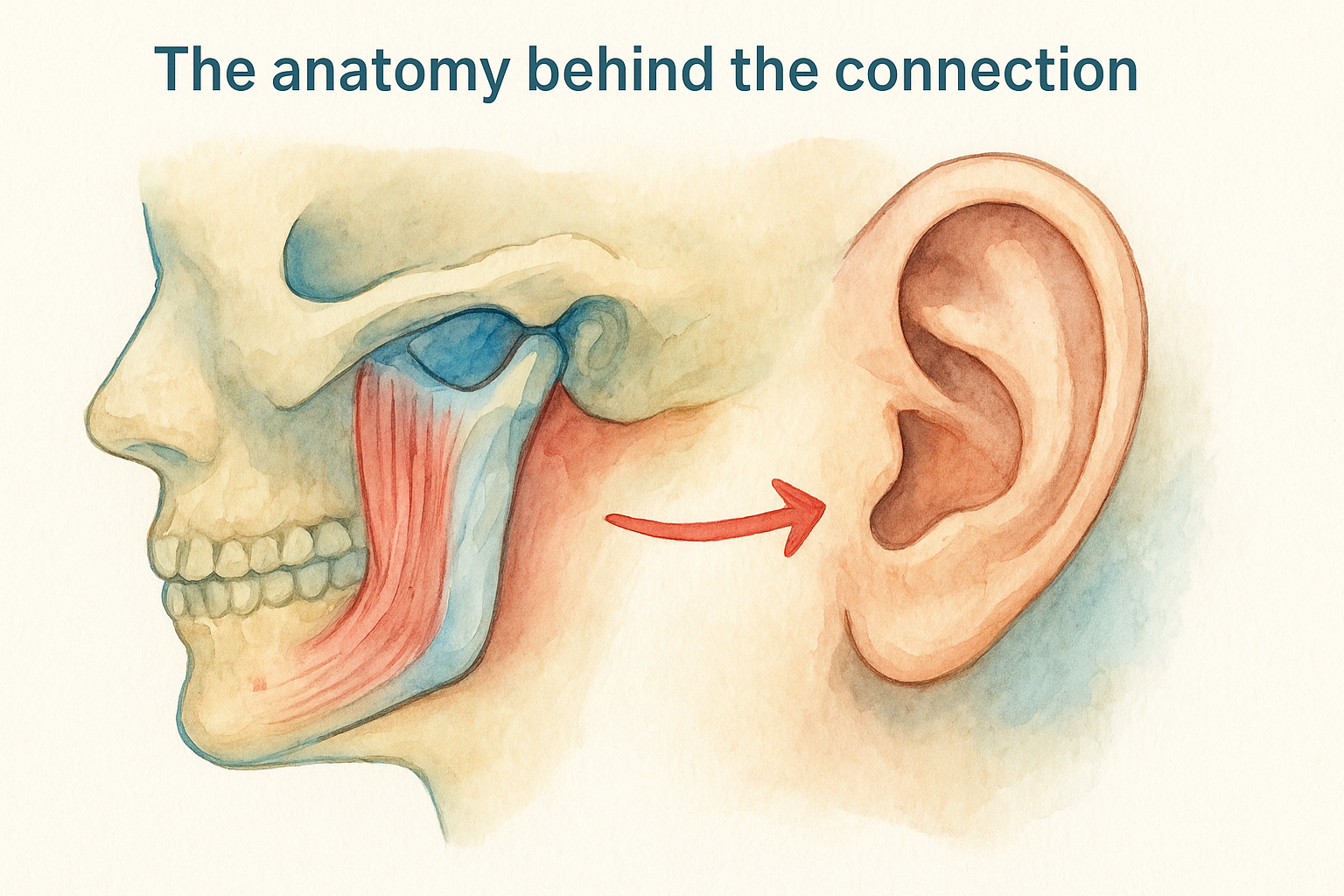
Running directly through this area, the auriculotemporal nerve branches off the trigeminal nerve and passes right alongside the TMJ before reaching your ear. Clenching compresses and irritates this nerve, and when that happens, the pain travels along the nerve's path into your ear canal, your eardrum, and even your outer ear. Your brain struggles to pinpoint the exact origin, which is why jaw clenching ear pain can feel indistinguishable from an infection.
The auriculotemporal nerve connects the jaw joint and the ear so directly that irritation in one almost always creates sensation in the other.
How muscle tension creates referred pain
Clenching engages a group of powerful muscles, primarily the masseter (running along your cheek and jaw) and the temporalis (spreading up the side of your skull). Both muscles work overtime when you clench, and sustained tension in them builds pressure that radiates outward. The temporalis muscle runs right alongside your ear, so when it tightens and stays contracted for hours, it generates deep, throbbing pain that settles directly into your ear region.
Myofascial referred pain is the clinical term for what happens when trigger points in these muscles send pain to areas seemingly unrelated to the actual source of tension. Research in pain science shows that trigger points in the masseter and temporalis are among the most common sources of referred ear pain in adults. When you combine constant nighttime clenching with already-tight jaw muscles, the result is a consistent pain pattern that mimics ear conditions without involving your ears at all.
TMJ signs that often show up with ear pain
Jaw clenching ear pain rarely travels alone. When your TMJ is under chronic stress from clenching, your body sends several other warning signals that point directly to the joint as the source. Recognizing these signs early gives you a clearer picture of what's actually happening and helps you avoid months of chasing the wrong diagnosis.
Clicking, popping, and jaw stiffness
One of the most telling TMJ signs is a clicking or popping sound when you open or close your mouth. This happens because the disc inside your joint has shifted out of its normal position, causing the bones to catch and release as your jaw moves. You might also notice morning stiffness in your jaw, especially if you clench heavily during sleep, making it difficult to open your mouth wide right after waking up.
If you hear a consistent click every time you open your jaw, that's your joint signaling that the disc alignment is off.
Headaches, facial tension, and jaw soreness
Tension headaches that start at your temples and wrap around toward your ears are a classic companion to TMJ dysfunction. The temporalis muscle, already strained from clenching, pulls tight across your skull and generates pain that feels like a band squeezing your head. You may also notice soreness along your jaw, cheeks, and neck, particularly in the morning or after chewing a tough meal.
Some people experience a sensation of fullness or pressure deep inside the ear, along with occasional ringing (tinnitus) or mild dizziness. Both of those symptoms trace back to the TMJ's close proximity to the structures that regulate ear pressure and balance, making them reliable indicators that your jaw, not your ear, is the problem.
How to tell TMJ ear pain from an ear infection
Separating jaw clenching ear pain from a true ear infection is something many people struggle with, and for good reason. Both conditions produce deep ear ache and pressure, and neither feels pleasant. The key difference lies in the surrounding symptoms and how the pain behaves. An ear infection typically comes with fever, fluid drainage, and pain that worsens when you pull on your ear. TMJ-related ear pain almost never produces those signs, which gives you a useful filter for telling one from the other.
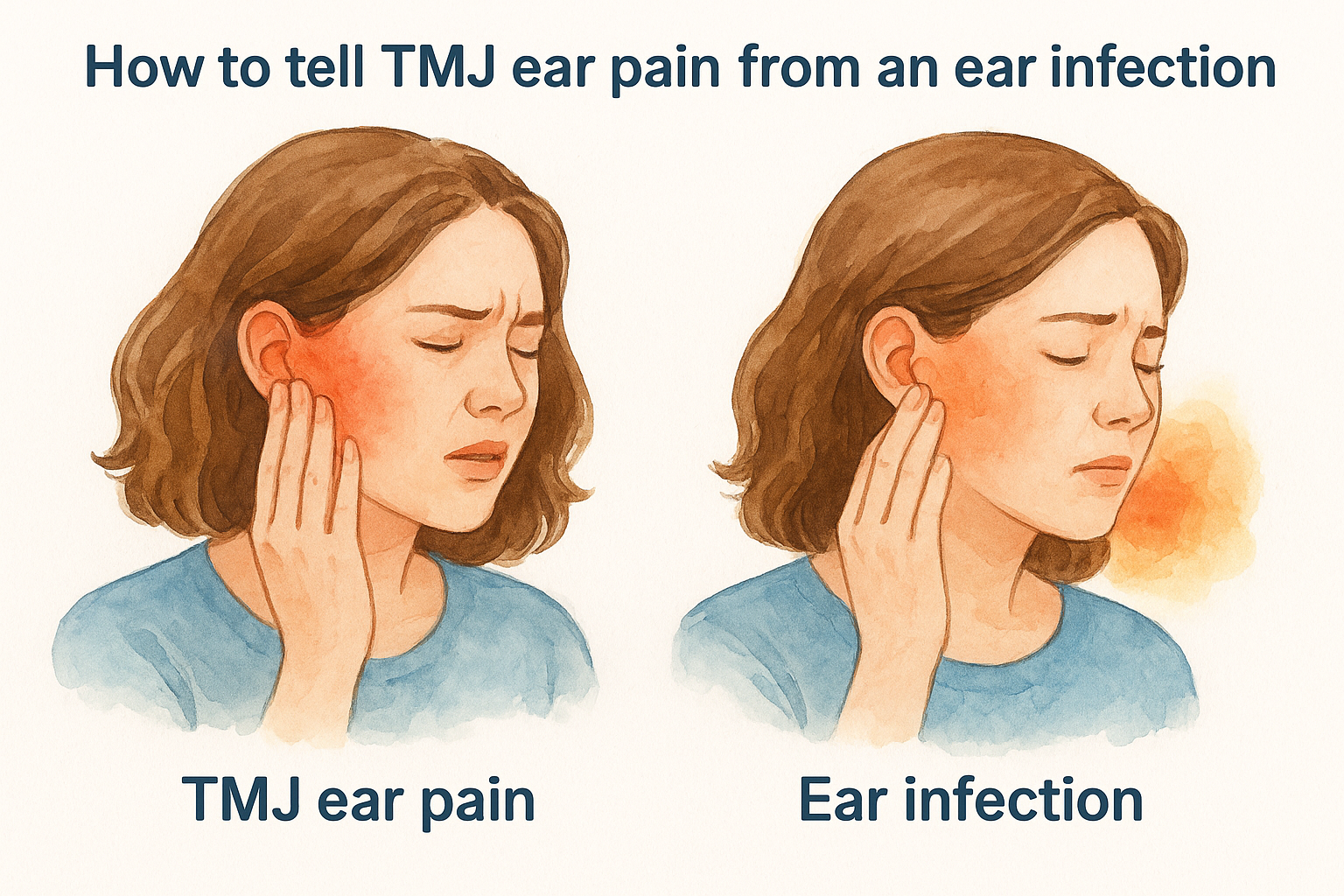
Symptoms that point to your jaw
TMJ ear pain follows predictable patterns tied directly to jaw movement and muscle activity. You'll notice the pain intensifies after eating, talking for extended periods, or waking up from sleep, all situations where your jaw muscles have been working hard or sitting under tension overnight. The pain often spreads into your temples, cheeks, or neck, areas an ear infection never reaches. You may also hear clicking in your jaw or feel stiffness when opening your mouth wide, two signs that point squarely at your joint rather than an infection.
If your ear pain gets worse when you chew or clench your teeth, your jaw is almost certainly the source, not your ear.
Symptoms that point to your ear
A genuine ear infection produces a different set of signals. Fever, muffled hearing, and discharge from the ear canal are the hallmarks that distinguish a true infection from a TMJ problem. You might also notice the pain spikes when you press on your tragus (the small cartilage flap at the front of your ear canal) or tug on your earlobe. Neither of those actions involves your jaw, so if that movement triggers pain, your ear itself needs attention and a visit to a doctor is the right call.
How to relieve jaw clenching ear pain at home
You don't have to wait for a dental appointment to start feeling better. Several at-home strategies can reduce the muscle tension and joint pressure that drive jaw clenching ear pain, giving you meaningful relief while you work on a longer-term plan.
Apply heat or cold to the jaw
Moist heat is one of the fastest ways to loosen the masseter and temporalis muscles responsible for your ear pain. Press a warm, damp cloth against your jaw for 15 to 20 minutes, several times per day. If your jaw feels acutely swollen, use a cold pack wrapped in a towel for the first 48 hours to reduce inflammation before switching to heat.
Applying heat to your jaw rather than your ear targets the actual source of the pain and produces faster relief.
Try jaw relaxation exercises
Simple stretching exercises can break the cycle of chronic muscle tension that keeps your ear aching. Place your tongue on the roof of your mouth and let your teeth separate slightly, then slowly open and close your jaw 10 times without forcing the movement. Repeating this two to three times daily trains your muscles to carry less tension throughout the day.
Many people also clench during stressful daytime activities without realizing it. Setting a reminder to check your jaw position every hour and consciously relaxing it can cut down on the cumulative muscle load that eventually feeds into ear pain by evening.
Protect your jaw overnight
Nighttime clenching is the hardest habit to stop because you're asleep when it happens. Wearing a custom-fitted night guard creates a physical barrier between your upper and lower teeth, distributing bite force evenly and reducing the joint stress that causes ear pain.
A custom appliance shaped to your exact bite stays in place better than a drugstore boil-and-bite option and delivers more consistent protection night after night. The at-home impression process makes getting a custom guard straightforward without requiring a dental office visit.
Treatment options and when to get medical help
At-home relief helps in the short term, but persistent jaw clenching ear pain often needs professional care to resolve fully. If your symptoms have lasted more than a few weeks or are disrupting your sleep and daily routine, it's worth seeing a professional who can assess the joint directly and build a structured treatment plan around your specific situation.
Professional dental treatments
Your dentist or an oral medicine specialist can offer several targeted interventions that go well beyond what you can manage at home. Occlusal splint therapy involves wearing a professionally calibrated appliance that repositions your bite and reduces joint load, delivering more precision than a standard over-the-counter option. For muscle tension that won't release on its own, trigger point injections or Botox injections into the masseter muscle can interrupt the clenching cycle by limiting the force your jaw generates. Physical therapy focused on jaw mechanics also produces strong results, retraining your bite pattern and reducing the chronic tightening that feeds into ear pain over time.
A professionally fitted appliance calibrated to your specific bite targets the mechanical root of your symptoms in a way that generic products cannot replicate.
When to see a doctor
Certain symptoms signal that you need prompt medical evaluation rather than continued self-management. Seek care right away if you experience severe ear pain accompanied by fever, sudden hearing loss, or visible swelling around your jaw or neck, since those signs may indicate an infection or structural joint damage that requires imaging or prescription medication. You should also consult a professional if your jaw locks open or closed at any point. That symptom points to significant disc displacement inside the joint that stretching and heat alone will not fix, and early intervention consistently leads to better outcomes than waiting it out.
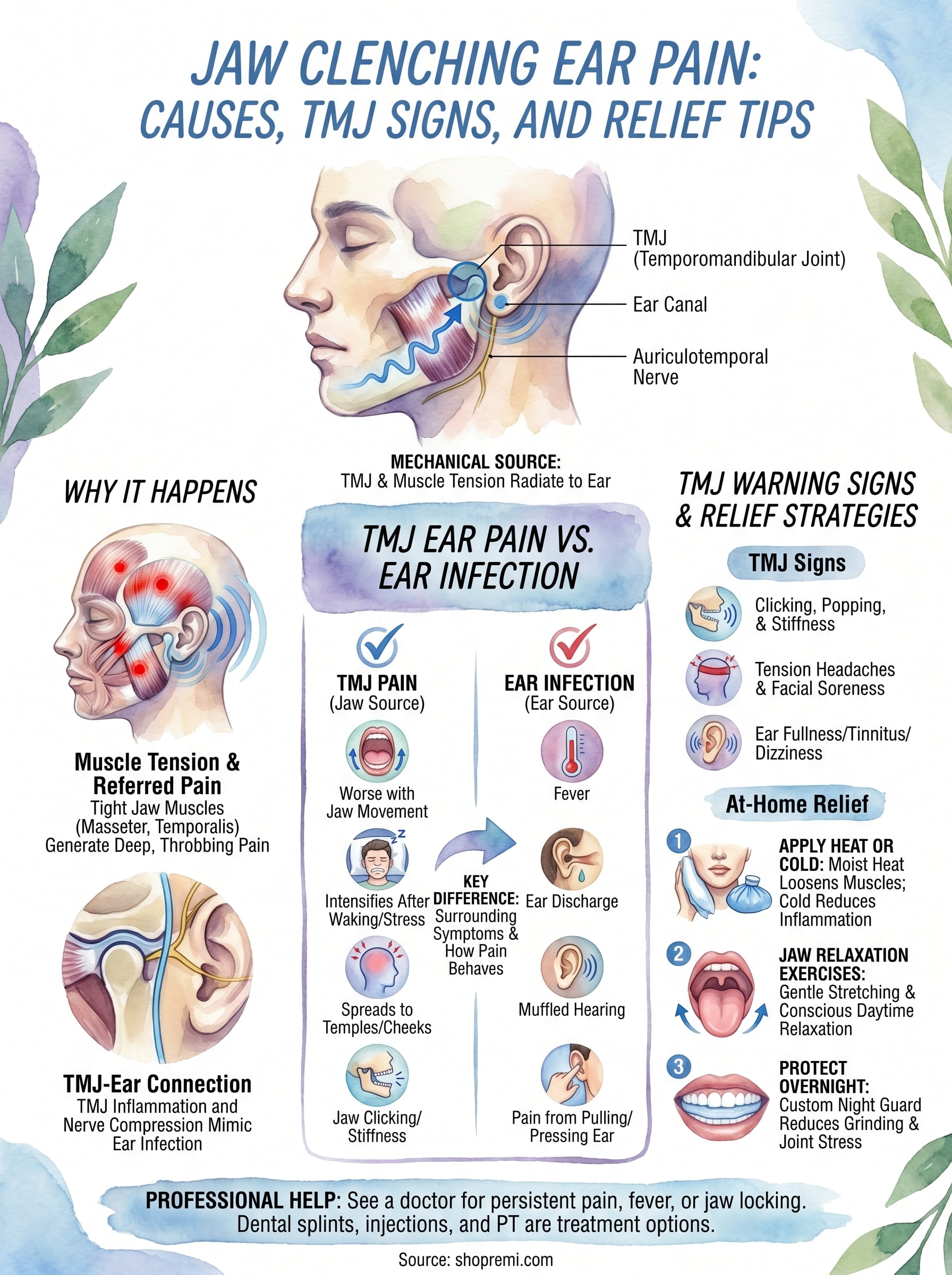
Next steps for relief
Jaw clenching ear pain is a real and treatable problem, and the path forward starts with recognizing that your jaw, not your ear, is driving your symptoms. The strategies in this article give you a solid foundation, from heat therapy and stretching to understanding the difference between TMJ pain and an infection. Applying these consistently will reduce your discomfort over time.
The most important step you can take right now is protecting your jaw while you sleep. Nighttime clenching undoes every bit of daytime relief you build up, and stopping it requires a physical barrier between your teeth. A custom-fitted night guard shaped to your exact bite delivers that protection without the bulk or poor fit of a generic store-bought option. If you're ready to address the source of your symptoms directly, explore Remi's custom night guard and take the first step toward pain-free mornings.

