
 Guards + Retainers
 Custom Night Guard
 Retainer
 Emergency Order

 Whitening
 Whitening Kit
 Teeth Whitening Gel
 Dual-Action Foam
 Cleaning + Care
 Ultrasonic Cleaner Pro
 Water Flosser
 UV Toothbrush Sanitizer
 Accessories
 Guard Removal Tool
 Replacement Nozzles

If you've finished Invisalign treatment, you've probably been told you need a retainer to keep your teeth in place. But what exactly is that retainer made of? Understanding Invisalign retainer material matters more than you might think, especially when it comes to safety, comfort, and how long your retainer will actually last.
Invisalign's Vivera retainers use a proprietary thermoplastic material that's different from their aligner trays and distinct from standard Essix or Hawley retainers. Questions about BPA content, durability, and whether these materials are safe for daily wear are valid concerns that deserve clear answers.
At Remi, we make custom clear retainers designed to maintain your smile at a fraction of dental office prices. Whether you're comparing options or simply want to know what's going into your mouth every night, this guide breaks down everything you need to know about retainer materials, from technical composition to real-world performance.
Why retainer material matters
The plastic that touches your teeth every night isn't just a detail. Your retainer sits in your mouth for 8 to 12 hours daily, which means the material needs to be safe, durable, and comfortable enough that you'll actually wear it consistently.
Safety and daily contact
You put your retainer directly on your teeth and gums, where it stays for hours at a time. Materials that contain harmful chemicals like BPA (bisphenol A) can leach into your saliva and enter your body over months or years of use. Medical-grade thermoplastics designed for oral applications undergo testing to ensure they won't break down into toxic compounds with regular exposure to moisture, bacteria, and temperature changes in your mouth.
The material your retainer is made from determines both its safety profile and how it performs over time.
Cost and replacement frequency
Different retainer materials wear out at different rates. Softer plastics may need replacement every 6 to 12 months, while more durable options can last 2 to 3 years or longer with proper care. Understanding invisalign retainer material composition helps you predict costs and plan for replacements before your teeth start shifting.
Comfort and compliance
Material thickness, flexibility, and edge smoothness all affect whether you can tolerate wearing your retainer night after night. Rigid materials may cause pressure points on sensitive gums, while overly flexible plastics might not provide enough retention force to keep your teeth stable. The right material balance means you'll wear your retainer consistently, which is the only way it can do its job.
What Invisalign Vivera retainers are made of
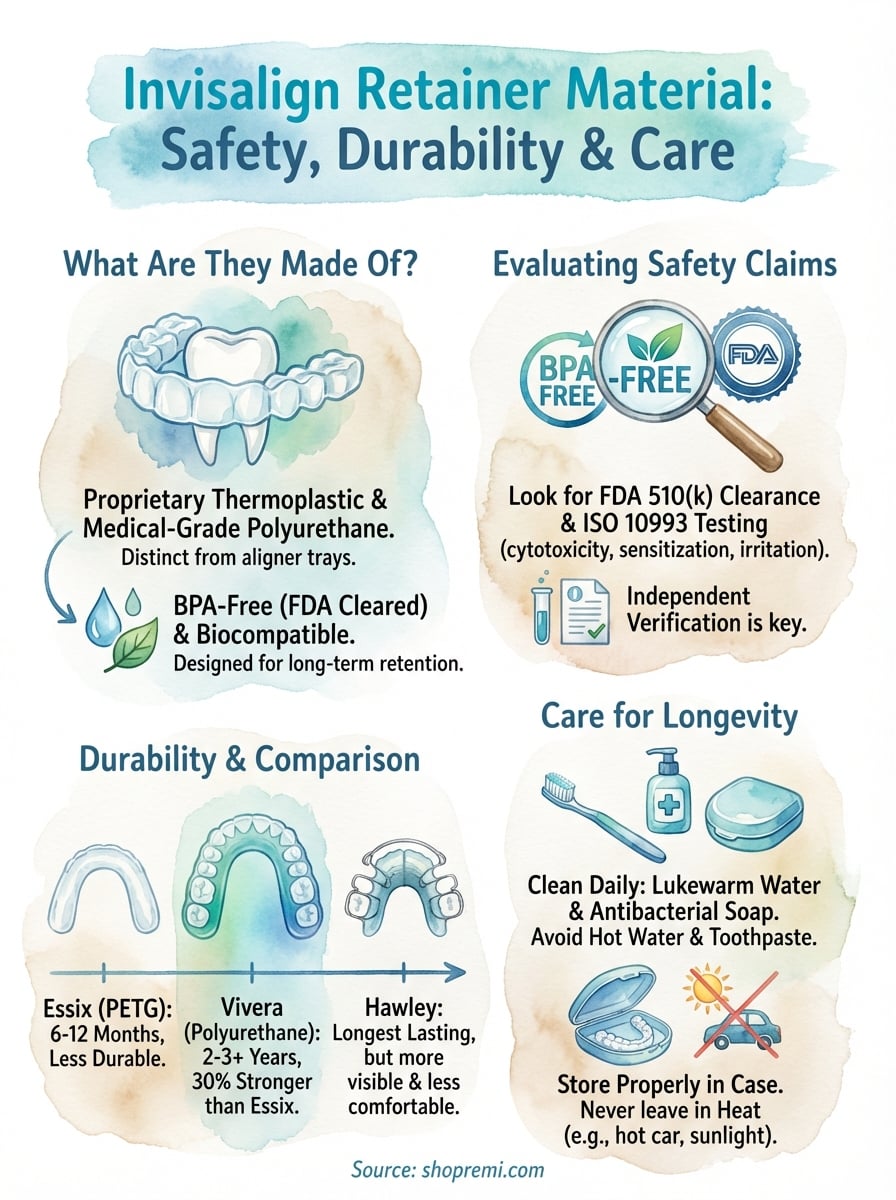
Invisalign Vivera retainers use a proprietary thermoplastic material that the company doesn't fully disclose to the public, but it's distinct from the SmartTrack material used in Invisalign aligners. Vivera retainers are made from a medical-grade polyurethane-based plastic designed specifically for long-term retention rather than tooth movement. This invisalign retainer material is engineered to be more rigid and durable than standard aligner trays because retainers need to maintain their shape over months or years of nightly wear.
SmartTrack versus Vivera material
Invisalign aligners use SmartTrack material, which is a multi-layer thermoplastic with elastic properties that allow for controlled tooth movement. Vivera retainers, however, use a different formulation that prioritizes strength and dimensional stability over flexibility. The Vivera material is 30% stronger than standard Essix retainer materials according to Align Technology's own testing, which translates to longer replacement intervals and better shape retention.
Vivera retainers are engineered for durability, not tooth movement, which is why they use a different material than Invisalign aligners.
BPA-free certification
Align Technology confirms that Vivera retainers are completely BPA-free and meet FDA clearance standards for oral medical devices. The material undergoes biocompatibility testing to ensure it won't leach harmful chemicals during normal use.
How Vivera compares to Essix and Hawley retainers
You have three main retainer options after orthodontic treatment, and each uses different materials with distinct trade-offs. Vivera retainers compete directly with Essix clear retainers and traditional Hawley wire retainers, but the invisalign retainer material stands apart in both composition and performance.
Material strength and durability
Vivera retainers use a proprietary polyurethane-based thermoplastic that's significantly thicker and more rigid than standard Essix retainers, which are typically made from basic PETG (polyethylene terephthalate glycol) plastic. Clinical testing shows Vivera material is 30% more durable than traditional Essix plastics, which means you'll replace them less frequently. Hawley retainers use acrylic and metal wire, making them the most durable option overall but also the most visible and least comfortable for many patients.
Vivera retainers bridge the gap between basic Essix affordability and Hawley durability.
Cost and availability
You'll pay $400 to $800 for Vivera retainers through your orthodontist, while Essix retainers typically cost $200 to $400, and Hawley retainers run $300 to $600. Remi offers custom clear retainers made from medical-grade thermoplastic at a fraction of these prices, delivering comparable quality without the dental office markup.
How to evaluate safety and BPA-free claims
You can't just take a manufacturer's word when it comes to what goes in your mouth every night. Independent verification and transparent testing protocols separate legitimate safety claims from marketing spin, especially when evaluating invisalign retainer material and other clear retainer options.
Check for FDA clearance
Your retainer should have FDA 510(k) clearance, which means the material has been evaluated for safety as a medical device. You can verify this by asking your provider for the clearance number or searching the FDA's database directly. Companies that hide this information or use vague language like "dental-grade plastic" without specifics are red flags.
FDA clearance doesn't guarantee perfection, but it means the material has passed basic biocompatibility testing for oral use.
Look for third-party testing
ISO 10993 biocompatibility testing is the international standard for materials that contact human tissue. Retainer manufacturers should provide documentation showing their material passed cytotoxicity, sensitization, and irritation tests conducted by independent labs. BPA-free claims specifically require chemical analysis proving bisphenol A levels are below detectable limits, not just manufacturer statements.
How to make retainers last longer
Your retainer's lifespan depends less on the invisalign retainer material itself and more on how you care for it daily. Even the most durable thermoplastic will break down faster if you expose it to hot water, harsh chemicals, or constant stress from improper handling. Small changes in your routine can add months or years to your retainer's usable life.
Clean with the right products
You need to clean your retainer every morning using lukewarm water and antibacterial soap or a dedicated retainer cleaner. Never use hot water, which warps thermoplastic materials, or toothpaste, which is abrasive enough to scratch the surface and create bacteria traps. A soft-bristle toothbrush works perfectly for gentle scrubbing without damaging the material.
Daily cleaning with the right products prevents bacterial buildup that degrades thermoplastic faster than normal wear.
Store properly when not wearing
Always keep your retainer in its protective case when you're not wearing it, never wrapped in a napkin or left on a counter. Heat exposure is the biggest threat to retainer materials, so never leave your case in a hot car, near a stove, or in direct sunlight. This simple habit prevents warping and extends replacement intervals significantly.
What to do next
You now understand how invisalign retainer material differs from standard clear retainer plastics and what makes certain materials safer and more durable than others. This knowledge helps you make informed decisions about which retainer option fits your budget, safety standards, and long-term maintenance preferences.
Your teeth will shift without consistent retainer wear, regardless of which material you choose. The best retainer is the one you'll actually wear every night, which means finding the right balance between cost, comfort, and quality that works for your specific situation.
Remi makes this decision simpler by offering custom clear retainers made from medical-grade thermoplastic at a fraction of dental office prices. You get the same professional quality materials and custom fit through an at-home impression process, with retainers delivered directly to your door. Start your order today to protect your smile without the markup.

