
 Guards + Retainers
 Custom Night Guard
 Retainer
 Emergency Order

 Whitening
 Whitening Kit
 Teeth Whitening Gel
 Dual-Action Foam
 Cleaning + Care
 Ultrasonic Cleaner Pro
 Water Flosser
 UV Toothbrush Sanitizer
 Deep Clean + Freshening Tablets
 Accessories
 Guard Removal Tool
 Replacement Nozzles
 Bundles

Most brands struggle to break through the noise when selling directly to consumers. You pour money into ads that seem to work for everyone else. You launch products that should resonate but fall flat. The problem is not your product or your budget. You are missing a cohesive strategy that connects every piece of your marketing to your customers.
A direct to consumer marketing strategy gives you that framework. It maps out exactly how you will reach your audience, what message will resonate with them, and which channels will drive the most sales. When you build this foundation first, every dollar you spend works harder and every campaign builds on the last.
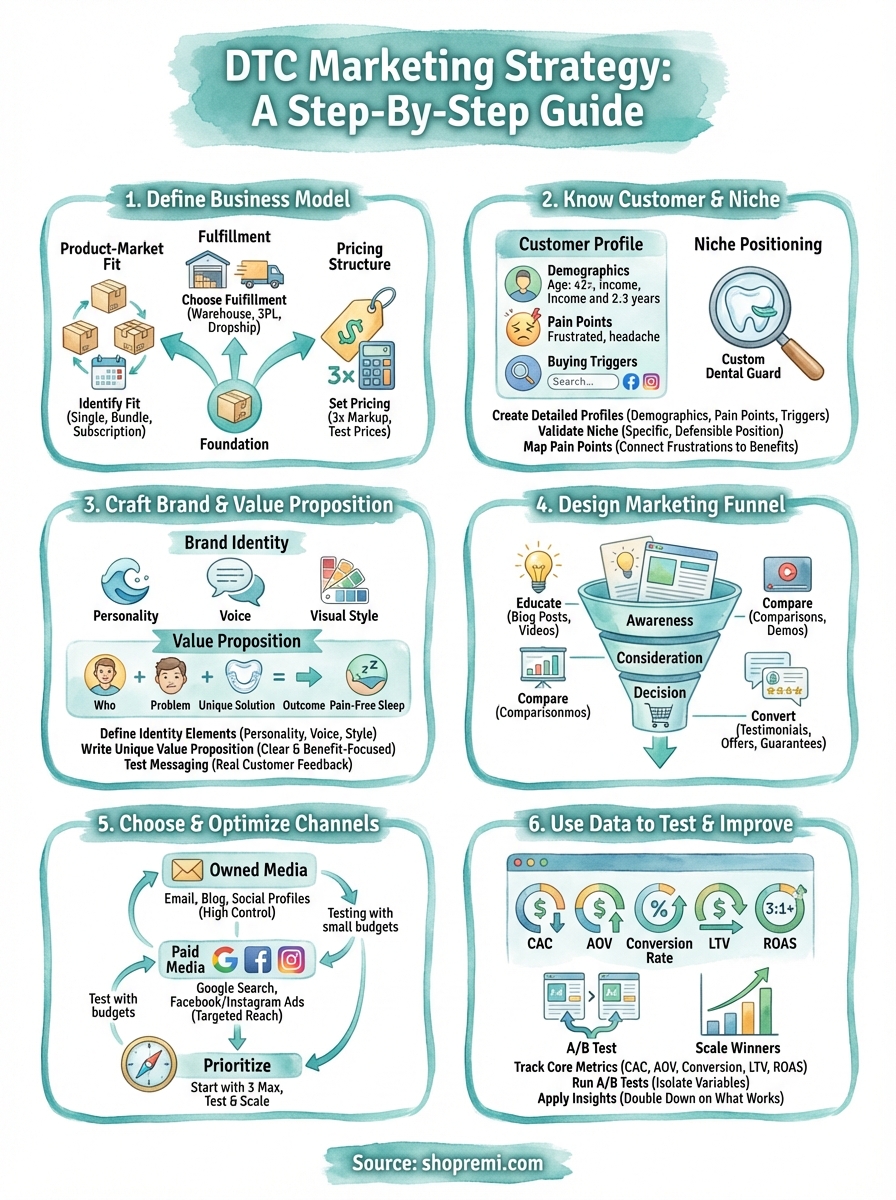
This guide walks you through creating your own DTC marketing strategy from scratch. You will learn how to define your business model, identify your ideal customer, craft a compelling brand position, design your marketing funnel, choose the right channels, and use data to improve. By the end, you will have a clear roadmap to grow your DTC brand profitably.
Why you need a direct to consumer strategy
You cannot afford to wing it when selling directly to consumers. Without a clear strategy, you waste money on channels that do not convert, confuse customers with inconsistent messaging, and compete on price alone because you have not built a strong brand. A direct to consumer marketing strategy gives you a competitive advantage by creating a repeatable system for acquiring and retaining customers profitably.
You gain control over your margins and customer experience
Traditional retail models force you to give up 30% to 60% of your revenue to distributors and retailers. When you sell directly, you keep those margins and reinvest them into product development, customer service, and marketing that actually works. You also control every touchpoint in the customer journey, from the first ad they see to the unboxing experience. This control lets you create a brand experience that builds loyalty instead of treating customers as one-time transactions.
The brands winning in DTC are not just selling products. They are building relationships that turn first-time buyers into repeat customers.
You own the data that drives growth
Retail partners rarely share customer data with you. You never learn who bought your product, why they chose it, or what would make them buy again. Direct relationships with customers give you access to purchase history, browsing behavior, email engagement, and feedback that tells you exactly what is working. This data becomes your competitive moat because you can test new products faster, personalize marketing at scale, and predict customer lifetime value with accuracy. When you know your customers better than anyone else, you make smarter decisions about where to invest your time and money.
You build a sustainable business model
Relying on retail partners or marketplaces puts your business at risk. Algorithm changes, fee increases, or retailer bankruptcies can destroy your revenue overnight. Your own channels protect you from these external shocks because you control the distribution. A solid strategy also helps you plan for long-term profitability instead of chasing short-term sales that drain your cash flow. You build systems for customer retention, referral programs, and content marketing that compound over time instead of starting from zero with every campaign.
Step 1. Define your DTC business model
Your business model determines how you create, deliver, and capture value from customers. You need to make three fundamental decisions before you build your direct to consumer marketing strategy: what you sell, how you fulfill orders, and how you price your products. These choices shape everything from your messaging to your channel selection, so getting them right now saves you from costly pivots later. Start by writing down your answers to each of the following components, because vague ideas lead to inconsistent execution.
Identify your product-market fit
You must decide whether you will sell single products, product bundles, or subscriptions. Single products work best when you have high-margin items that solve a specific problem, like custom night guards or specialty cleaning devices. Bundles increase average order value by pairing complementary products together, such as a night guard with cleaning foam. Subscriptions create predictable revenue when customers need regular replenishment, like whitening foam refills or replacement brush heads. Choose the model that matches how your customers naturally buy. If they need your product monthly, force-fitting a one-time purchase model will cost you revenue.
The best business model matches how customers want to buy, not how you want to sell.
Choose your fulfillment approach
Your fulfillment strategy impacts your margins and customer experience. Warehousing your own inventory gives you complete control over shipping speed and packaging but requires upfront capital and storage space. Using a third-party logistics provider (3PL) reduces your overhead but adds per-unit costs and surrenders some quality control. Dropshipping eliminates inventory risk entirely but offers the lowest margins and longest shipping times. For custom products like dental guards, you likely need direct relationships with manufacturers who can fulfill individual orders. Map out your entire supply chain on paper before you commit, including production time, shipping costs, and quality checkpoints.
Set your pricing structure
Your pricing must cover production costs, marketing expenses, and still leave room for profit. Calculate your unit economics by adding product cost, shipping, payment processing fees, and customer acquisition cost, then compare that to your selling price. Most successful DTC brands target a 3x markup on product costs to stay profitable while investing in growth. Test different price points with small ad campaigns before you scale. Start with competitor prices as a reference, then adjust based on your unique value proposition. If you offer custom fit products instead of one-size-fits-all alternatives, you can command premium pricing that reflects the personalization.
Step 2. Know your customer and niche
You cannot build a successful direct to consumer marketing strategy without knowing exactly who you serve and why they need your solution. Generic messaging that tries to appeal to everyone ends up converting no one because it fails to address specific problems your ideal customers face. Your competitors probably make this mistake, which creates an opportunity for you to dominate by speaking directly to a well-defined audience. Spend time now documenting your customer profiles and niche position because every marketing decision you make later depends on this foundation.
Create detailed customer profiles
Start by identifying your primary customer segment with demographic and psychographic details that go beyond basic age and income data. Document their daily routines, the specific problems they experience, where they spend time online, and who influences their buying decisions. For a dental protection brand, your primary segment might be working professionals aged 28 to 45 who grind their teeth due to stress, browse health content on Instagram and Reddit, trust recommendations from dentists or health bloggers, and prioritize sleep quality. Write out complete profiles for your top two or three customer segments using this template:
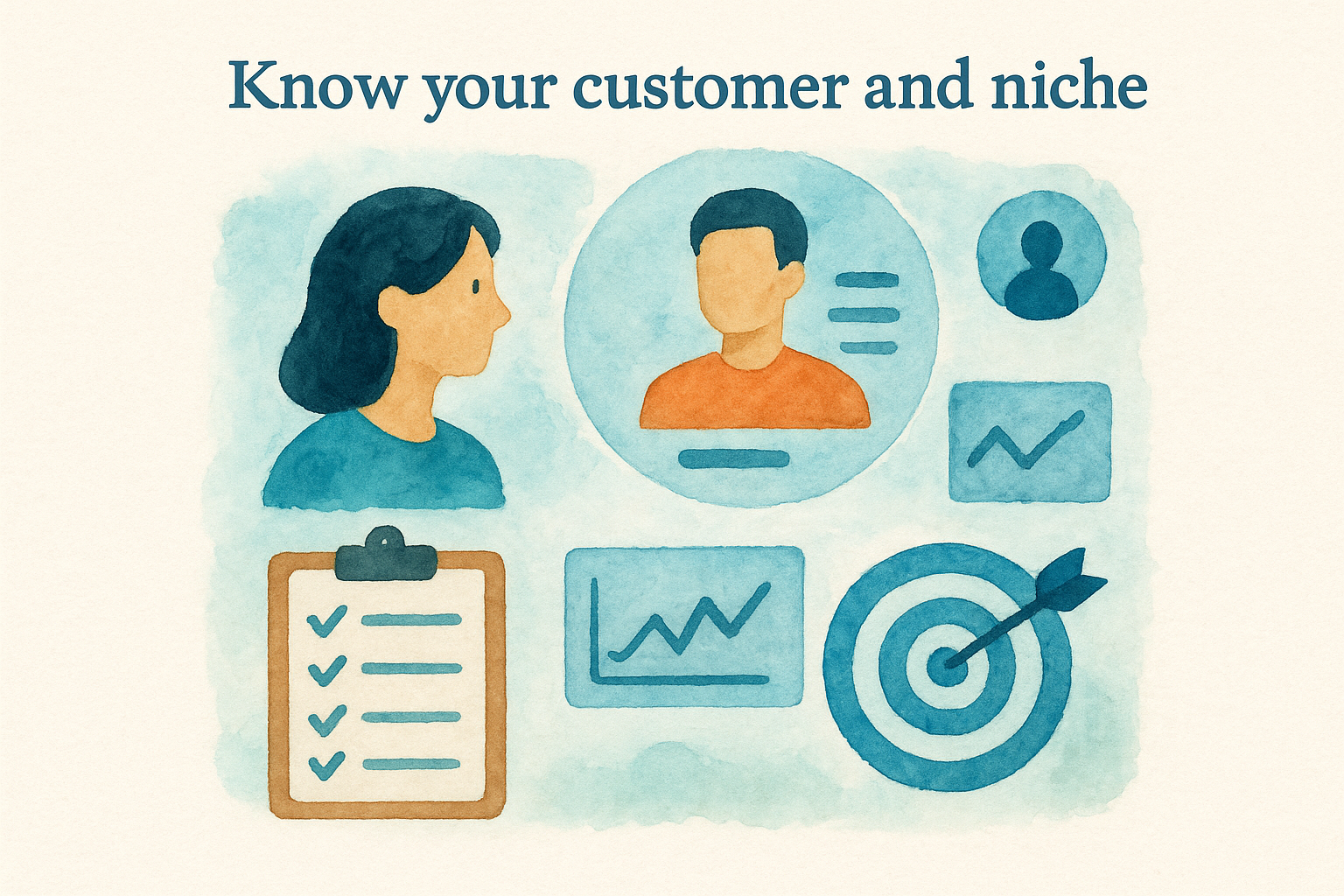
Customer Profile Template:
- Demographics: Age range, income level, location, occupation
- Pain points: Specific problems they experience daily
- Current solutions: What they use now and why it fails them
- Buying triggers: What makes them search for alternatives
- Content consumption: Where they spend time and who they follow
- Decision factors: Price sensitivity, quality requirements, convenience needs
Validate your niche positioning
Your niche defines the specific market segment where you can win against larger competitors. Choosing "dental products" as your niche is too broad because you will compete with established brands on every front. Instead, focus on "custom-fitted dental protection for teeth grinders" to own a defensible position that addresses a specific need. Test your niche by searching for your main keywords and analyzing who ranks in the top positions. If you see only general dental sites or pharmacy brands, you have found a gap. Research Reddit threads, Amazon reviews of competitor products, and dental forums to confirm that enough people struggle with this problem and express frustration with existing solutions.
When you own a specific niche, customers remember you as the solution for their exact problem instead of just another option.
Map customer pain points and motivations
List every frustration your customers experience with current solutions and match each one to a benefit your product delivers. Someone dealing with teeth grinding might struggle with expensive dental office visits ($500+ for custom guards), uncomfortable drugstore guards that do not fit properly, or multiple appointments that waste time. Your direct response addresses high costs with affordable custom fitting, poor fit with professional-grade materials and at-home impressions, and wasted time with direct-to-door delivery. Create a two-column table that connects each pain point to your solution, then use this document to write all your marketing copy. This exercise also reveals which benefits matter most, helping you prioritize your messaging across different channels.
Step 3. Craft your brand and value proposition
Your brand identity and value proposition separate you from competitors who sell similar products at similar prices. Strong branding creates an emotional connection that makes customers choose you even when cheaper alternatives exist, while a clear value proposition instantly communicates why your solution deserves attention. Most DTC brands skip this step and jump straight into running ads, then wonder why their cost per acquisition stays high and customer loyalty remains low. Building these elements now gives every piece of content, every ad, and every customer interaction a consistent foundation that compounds over time.
Define your brand identity elements
You need to establish five core elements that shape how customers perceive your brand: personality, voice, visual style, mission, and values. Your personality describes how you communicate, whether professional and trustworthy or casual and approachable. Voice determines your word choice and sentence structure, like using contractions and direct language versus formal terminology. Visual style encompasses your color palette, typography, imagery approach, and logo design that customers recognize instantly. Document these decisions in a brand guide that anyone creating content can reference. For a dental protection brand, you might choose a personality that balances medical credibility with accessible wellness, a voice that explains dental concepts without jargon, and a clean visual style using calming blues and whites that suggest professionalism without clinical coldness.
Your brand identity should feel authentic to your mission while appealing to the specific emotions your target customers value most.
Write your unique value proposition
Your value proposition answers three questions in one clear sentence: who you serve, what problem you solve, and why your solution beats alternatives. Use this formula to draft yours: "We help [target customer] solve [specific problem] through [unique approach] so they can [desired outcome]." A weak value proposition lists features like "custom dental guards with fast shipping," while a strong one addresses outcomes: "We help stressed professionals protect their teeth from grinding with custom-fitted guards made at home, so they wake up pain-free without expensive dental visits." Test your value proposition by reading it to someone unfamiliar with your business. If they immediately understand what you do and who benefits, you have crafted something clear. If they need clarification, simplify your language and make the benefit more specific.
Test your messaging with real customers
Write three variations of your core marketing message and show them to at least ten people who match your target customer profile. Ask which version makes them most likely to buy and why, then listen for the exact words they use to describe your benefit. These phrases often become your best marketing copy because they reflect how customers naturally talk about their problems. Run small Facebook or Google ad tests with different headlines based on your variations, spending $50 to $100 per message to see which drives the lowest cost per click. Real data from customer responses and ad performance reveals which aspects of your direct to consumer marketing strategy resonate most, letting you invest in messaging that converts instead of guessing what might work.
Step 4. Design your marketing funnel
Your marketing funnel maps the path customers take from discovering your brand to making their first purchase and beyond. Without a structured funnel, you waste money attracting visitors who never convert because you have not planned the right content and offers for each stage of their decision process. Most DTC brands focus only on the bottom of the funnel with conversion-focused ads, then wonder why their cost per acquisition remains high. You need to build trust at every stage by delivering value before asking for the sale, which requires different content and tactics as customers move from awareness to consideration to decision.
Map the three funnel stages
You must identify what actions customers take at each stage and what information they need to move forward. The awareness stage begins when potential customers first recognize they have a problem, like teeth grinding causing jaw pain or disturbed sleep. They search for general information about symptoms and solutions but are not ready to buy yet. Your goal here is to capture attention and build credibility through educational content that positions your brand as helpful rather than sales-focused. The consideration stage starts when they understand their problem and actively research different solutions, comparing custom dental guards versus pharmacy options versus doing nothing. Decision stage customers know what type of solution they want and now evaluate specific brands based on price, quality, reviews, and guarantees. Document each stage using this framework:
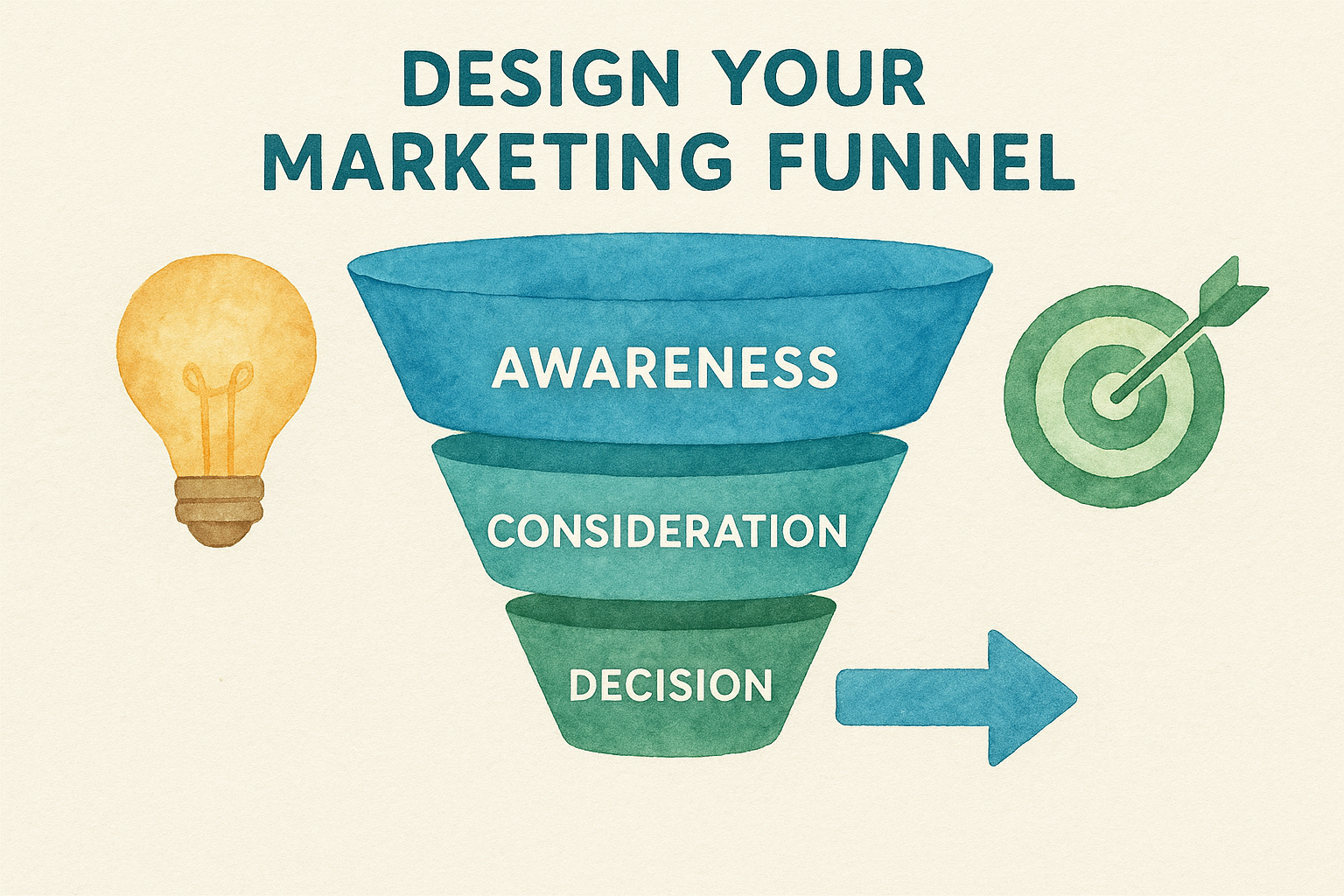
Funnel Stage Framework:
- Stage name: Awareness / Consideration / Decision
- Customer mindset: What they think and feel at this stage
- Questions they ask: Information they search for
- Content types: Blog posts, videos, comparisons, testimonials
- Calls to action: Next step you want them to take
Create stage-specific content and offers
Each funnel stage requires different messaging that matches customer intent instead of pushing for a purchase before they are ready. Awareness content educates without selling, like "5 Signs You Grind Your Teeth at Night" or "How Teeth Grinding Affects Your Sleep Quality." Consideration content compares options objectively, such as "Custom vs. Drugstore Night Guards: Which Works Better?" or video demonstrations showing the impression kit process. Decision content removes final objections with customer testimonials, guarantee details, and special offers that create urgency. Build a simple content map that connects each stage to specific pieces you will create, focusing first on decision stage content that converts warm traffic, then working backward to awareness content that feeds your funnel. Your direct to consumer marketing strategy depends on having the right content ready when customers need it.
Customers buy when they have enough information to feel confident, not when you pressure them before they are ready.
Set conversion goals and metrics
Define measurable targets for moving customers from one stage to the next so you can identify which parts of your funnel leak prospects. Track awareness-to-consideration conversion by monitoring how many blog readers click through to product pages or sign up for your email list. Consideration-to-decision conversion measures how many product page visitors add items to cart, and decision-to-purchase tracks cart-to-checkout completion. Use this metrics table to establish baselines:
| Funnel Stage | Key Metric | Target Benchmark | How to Improve |
|---|---|---|---|
| Awareness | Click-through rate from content | 2-5% | Better headlines, stronger hooks |
| Consideration | Add-to-cart rate | 8-12% | Clearer benefits, social proof |
| Decision | Checkout completion | 60-70% | Reduce friction, offer guarantees |
Review these numbers weekly during your first 90 days to spot problems quickly and test solutions before small leaks become major revenue losses.
Step 5. Choose and optimize your channels
You cannot succeed in every marketing channel at once, so you must prioritize the platforms where your target customers spend time and where you can acquire them profitably. Your direct to consumer marketing strategy succeeds or fails based on channel selection because spreading your budget too thin produces mediocre results everywhere instead of excellence in a few key areas. Start with three channels maximum during your first six months, master those, then expand to others once you understand what drives conversions and can scale profitably.
Evaluate channels by audience and ROI
You need to match your customer research from Step 2 with channels that deliver measurable returns. Review where your target audience actually spends time rather than assuming they use every platform. If your customers are professionals aged 28 to 45 dealing with teeth grinding, they likely browse Facebook and Instagram for health content, search Google when pain becomes urgent, and trust email recommendations from brands they know. Map each channel to your funnel stages from Step 4, since some platforms work better for awareness while others excel at conversion.
| Channel Type | Best For | Average CAC | Time to Results |
|---|---|---|---|
| Google Search Ads | Decision stage, high intent | $30-80 | 2-4 weeks |
| Facebook/Instagram Ads | Awareness and consideration | $25-60 | 4-8 weeks |
| Email Marketing | Retention and repeat purchase | $5-15 | Ongoing |
| Content/SEO | Awareness, long-term | $15-40 | 3-6 months |
Calculate your maximum allowable CAC by multiplying your average order value by your target profit margin, then test channels that historically deliver within that range for similar products.
Focus your budget on channels where you can afford to acquire customers profitably, not where competitors happen to advertise.
Build owned media first
Your owned channels cost nothing per impression and give you complete control over messaging without algorithm changes destroying your reach overnight. Email marketing delivers the highest ROI of any channel because you own the list and can reach subscribers whenever you want. Build your email list from day one by offering a discount code, free educational content, or early access to new products in exchange for addresses. Create a simple blog on your site that targets Google searches related to your niche, like "how to stop grinding teeth at night" or "custom night guard vs dentist," which attracts organic traffic that converts better than cold ads.
Social media profiles on platforms your customers use give you free distribution when you post consistently valuable content. Post three times per week mixing educational content, customer testimonials, and product benefits rather than constant promotional messages that drive followers away.
Test paid channels systematically
You must test paid advertising with small budgets first to validate which channels and messages produce profitable customer acquisition before scaling spend. Start with $500 to $1,000 per channel over two weeks, running three different ad variations that test your core value propositions from Step 3. Track every dollar to cost per click, conversion rate, and cost per acquisition so you identify winners quickly. Google Search ads work best when you target bottom-funnel keywords like "buy custom night guard" or "affordable dental guard online," while Facebook and Instagram ads excel at interrupting users with compelling visuals and educational hooks that match awareness and consideration stages. Use this testing framework:
Paid Channel Testing Process:
- Set daily budget at $25-50 per channel
- Create 3 ad variations testing different hooks
- Run for 7-14 days to gather data
- Kill ads with CAC above your maximum allowable
- Double budget on winning combinations
- Repeat weekly until you hit target volume
Step 6. Use data to test and improve
Your direct to consumer marketing strategy only succeeds when you measure performance and make decisions based on real data instead of assumptions. Most DTC brands waste money running the same campaigns month after month without testing variations or analyzing what actually drives profitable customer acquisition. You need to establish a systematic approach to tracking key metrics, running controlled experiments, and applying insights to improve every part of your funnel. Data tells you which headlines convert, which channels deliver the lowest cost per acquisition, and which customers become your most valuable long-term buyers.
Track your core metrics weekly
You must monitor five essential metrics that directly impact your profitability and growth trajectory. Customer acquisition cost (CAC) reveals how much you spend to gain each new customer across all channels. Average order value (AOV) shows the typical purchase size and helps you identify opportunities for upsells or bundles. Conversion rate at each funnel stage from Step 4 pinpoints where prospects drop off so you can fix specific problems. Customer lifetime value (LTV) projects total revenue from each customer over their relationship with your brand, while return on ad spend (ROAS) measures revenue generated per dollar spent on advertising.
| Metric | Formula | Target Benchmark | Review Frequency |
|---|---|---|---|
| CAC | Total marketing spend ÷ new customers | Under 1/3 of LTV | Weekly |
| AOV | Total revenue ÷ number of orders | $80-150 for dental products | Weekly |
| Conversion Rate | Purchases ÷ site visitors × 100 | 2-4% for e-commerce | Daily |
| LTV | AOV × purchase frequency × customer lifespan | 3x CAC minimum | Monthly |
| ROAS | Revenue from ads ÷ ad spend | 3:1 or higher | Weekly |
Set up Google Analytics to track these automatically and review your dashboard every Monday morning to catch problems before they drain your budget.
Run structured A/B tests
You improve results by testing one variable at a time against a control version to isolate what actually drives better performance. Test your product page headline by creating two versions with identical layouts but different copy, then split traffic evenly between them for at least 100 conversions per variation. Try these tests first in order of potential impact: checkout page design and copy, product image selection and order, value proposition headlines, call-to-action button text and color, and pricing display formats. Document every test with a hypothesis like "Adding customer testimonials above the fold will increase conversion rate by 15%" before you run it, then compare actual results to your prediction.
The brands that grow fastest test relentlessly and kill what does not work instead of defending underperforming campaigns.
Apply insights to scale winners
You maximize return by doubling down on what works and cutting what fails based on your test results and metric trends. When you identify an ad variation that delivers 30% lower CAC than your control, shift more budget to that creative immediately while testing new variations against it. Scale successful channels by increasing daily spend by 20% weekly until performance degrades, then stabilize at the highest profitable level. Use your data to inform product development by analyzing which features customers mention most in reviews and support conversations, then build those insights into your next iteration.
Examples and practical templates
You need concrete frameworks to implement your direct to consumer marketing strategy instead of starting with a blank page. Real templates and examples from successful DTC brands show you exactly what to create and how to structure your campaigns. These tools eliminate guesswork and let you launch faster while avoiding common mistakes that waste time and money.
Launch your first 90-day campaign
Your initial campaign should focus on validating your channel selection and testing your core messaging before you scale spending. Start with a structured 90-day plan that allocates budget across awareness, consideration, and decision content while tracking performance weekly. Use this template to outline your launch campaign:
90-Day DTC Launch Template:
Month 1: Foundation and Testing
- Week 1-2: Set up Google Analytics, Facebook Pixel, email platform
- Week 3-4: Launch 3 ad variations across 2 channels at $50/day each
- Content: Create 4 blog posts, 12 social posts, welcome email sequence
- Goal: Achieve 100 website visitors per day, 50 email subscribers
Month 2: Optimization
- Week 5-6: Kill underperforming ads, double budget on winners to $100/day
- Week 7-8: Launch retargeting campaigns for site visitors
- Content: Add 3 comparison guides, 8 customer testimonial posts
- Goal: Reach 2% conversion rate, reduce CAC by 20%
Month 3: Scale
- Week 9-10: Increase winning channel spend to $200/day
- Week 11-12: Test one new channel with $50/day budget
- Content: Launch email nurture sequence, add FAQ page
- Goal: Generate 100+ customers, achieve 3:1 ROAS
Map your customer journey with precision
You convert more customers when you document every touchpoint from first contact to repeat purchase. This example shows how a dental protection brand maps the complete journey with specific actions at each stage:
| Stage | Customer Action | Your Response | Content Needed |
|---|---|---|---|
| Awareness | Searches "jaw pain morning" | Google ad → blog post on teeth grinding | Educational article, symptom guide |
| Consideration | Reads 3 blog posts, visits product page | Email capture with discount code | Product comparison, video demo |
| Decision | Adds to cart, abandons | Cart recovery email at 1 hour, 24 hours | Testimonials, guarantee details |
| Purchase | Completes checkout | Order confirmation, impression kit instructions | Thank you email, how-to video |
| Retention | Product arrives | Follow-up at 7 days, 30 days, 90 days | Care tips, reorder reminders |
Adapt this framework by replacing each touchpoint with actions your specific customers take and the content that moves them forward.
Templates only work when you customize them to match your unique customers, products, and brand voice.
Create your email welcome sequence
Your welcome sequence converts new subscribers into customers by delivering value immediately and building trust before asking for the sale. Use this proven five-email structure:
Email 1 (Sent immediately): Deliver promised discount code, introduce brand story in 2-3 sentences, link to bestseller products
Email 2 (Day 2): Share educational content that addresses main pain point, include customer testimonial, no direct sales pitch
Email 3 (Day 4): Explain your unique process (custom fitting, at-home impressions), use photos or video, highlight convenience benefit
Email 4 (Day 7): Present limited-time offer with urgency (expires in 48 hours), showcase guarantee and return policy, clear call to action
Email 5 (Day 10): Final reminder of special offer, address common objections, provide customer support contact
Bringing your DTC plan to life
Your direct to consumer marketing strategy succeeds when you execute consistently rather than waiting for perfect conditions. You now have the framework to define your business model, understand your customers, craft compelling messaging, design your funnel, choose profitable channels, and use data to improve. The next step is to pick your starting point and launch your first campaign this week instead of planning indefinitely.
Begin with one channel where your target customers spend time and test three message variations with a small budget. Track your core metrics from day one so you know what works and what drains your budget. Most DTC brands fail because they never start or quit before gathering enough data to optimize. You avoid both mistakes by committing to your 90-day plan and making decisions based on real customer behavior instead of assumptions.
Ready to see how a successful DTC brand applies these principles? Check out Remi's custom night guards to see professional-grade dental protection delivered directly to customers at a fraction of traditional costs.

