
 Guards + Retainers
 Custom Night Guard
 Retainer
 Emergency Order

 Whitening
 Whitening Kit
 Teeth Whitening Gel
 Dual-Action Foam
 Cleaning + Care
 Ultrasonic Cleaner Pro
 Water Flosser
 UV Toothbrush Sanitizer
 Deep Clean + Freshening Tablets
 Accessories
 Guard Removal Tool
 Replacement Nozzles
 Bundles

If you've been waking up with a sore jaw or worn-down teeth, you've probably already started Googling every possible fix. One remedy that keeps coming up is teeth grinding magnesium, the idea that a simple mineral supplement could calm your clenching and let you sleep in peace. It sounds almost too easy, and that's exactly why it's worth a closer look at what the research actually says.
Magnesium plays a real role in muscle relaxation and nervous system function, so the connection to bruxism isn't just wishful thinking. But there's a gap between "magnesium helps muscles relax" and "magnesium will stop you from grinding your teeth at night." Understanding that gap matters, especially when you're choosing between different types of magnesium, some of which are far more effective than others for jaw tension and sleep quality.
At Remi, we make custom night guards that protect your teeth from the damage bruxism causes while you work on the root problem. Supplements like magnesium can be part of a broader strategy for managing grinding, but they rarely replace the need for physical protection against enamel wear. This article breaks down the evidence on magnesium and bruxism, covers which forms are worth trying, and explains how supplementation fits alongside proven solutions like a custom-fitted night guard.
What the research says about magnesium and bruxism
The connection between magnesium deficiency and bruxism is grounded in biology, even if the clinical evidence is still catching up. Magnesium participates in over 300 enzymatic processes, and its two most relevant roles for grinding are muscle relaxation and regulating the nervous system's stress response. When your magnesium levels drop, muscles become more excitable and prone to involuntary tension, including in your jaw while you sleep.
The magnesium-muscle connection
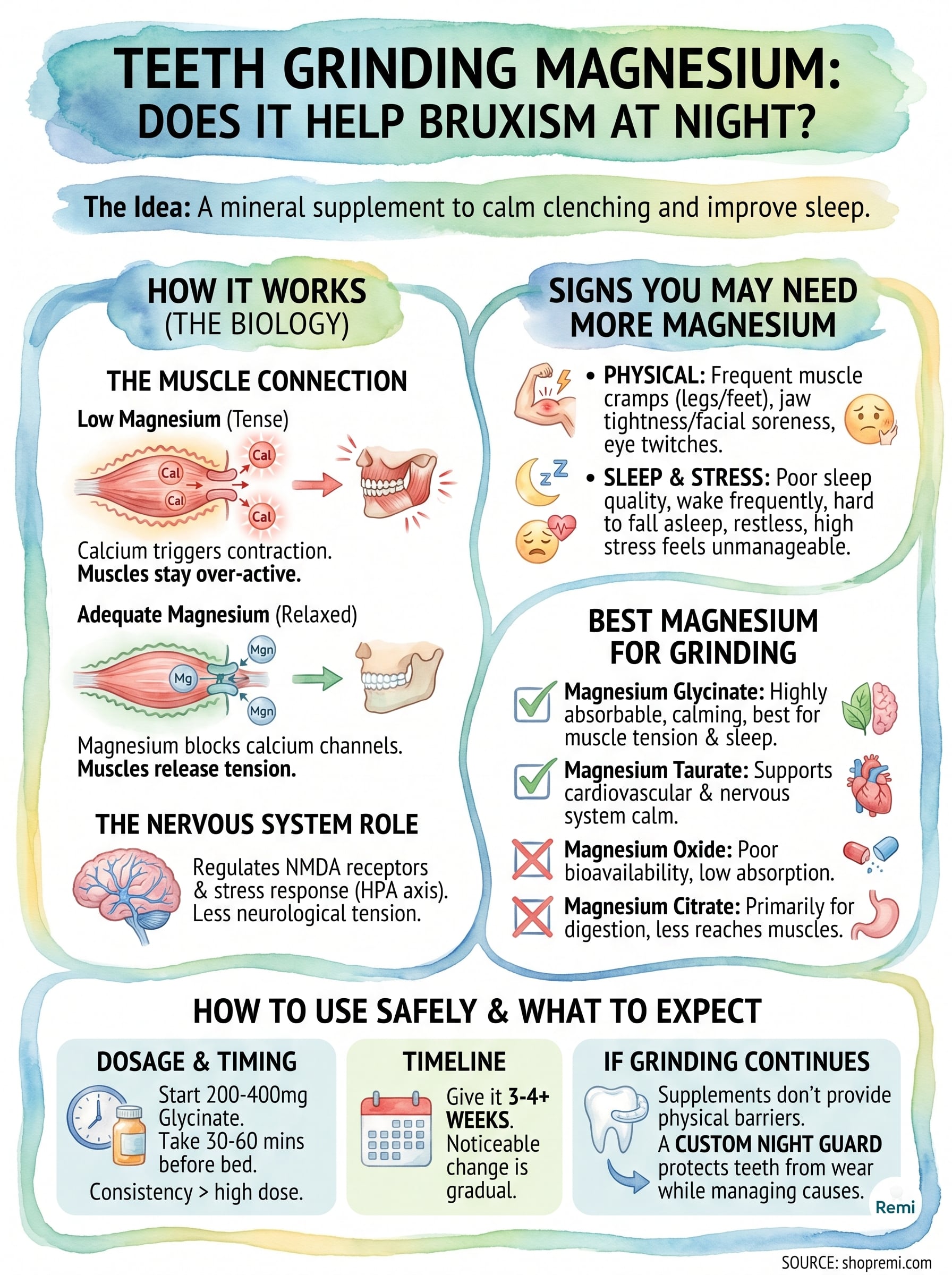
Magnesium works by blocking calcium channels in muscle cells. Calcium triggers muscle contractions, and magnesium counters that signal by allowing muscles to release. Without enough magnesium, this balance shifts, and muscles stay in a more activated state throughout the night. For anyone who already clenches or grinds, low magnesium can intensify that activity by keeping the jaw muscles primed rather than resting.
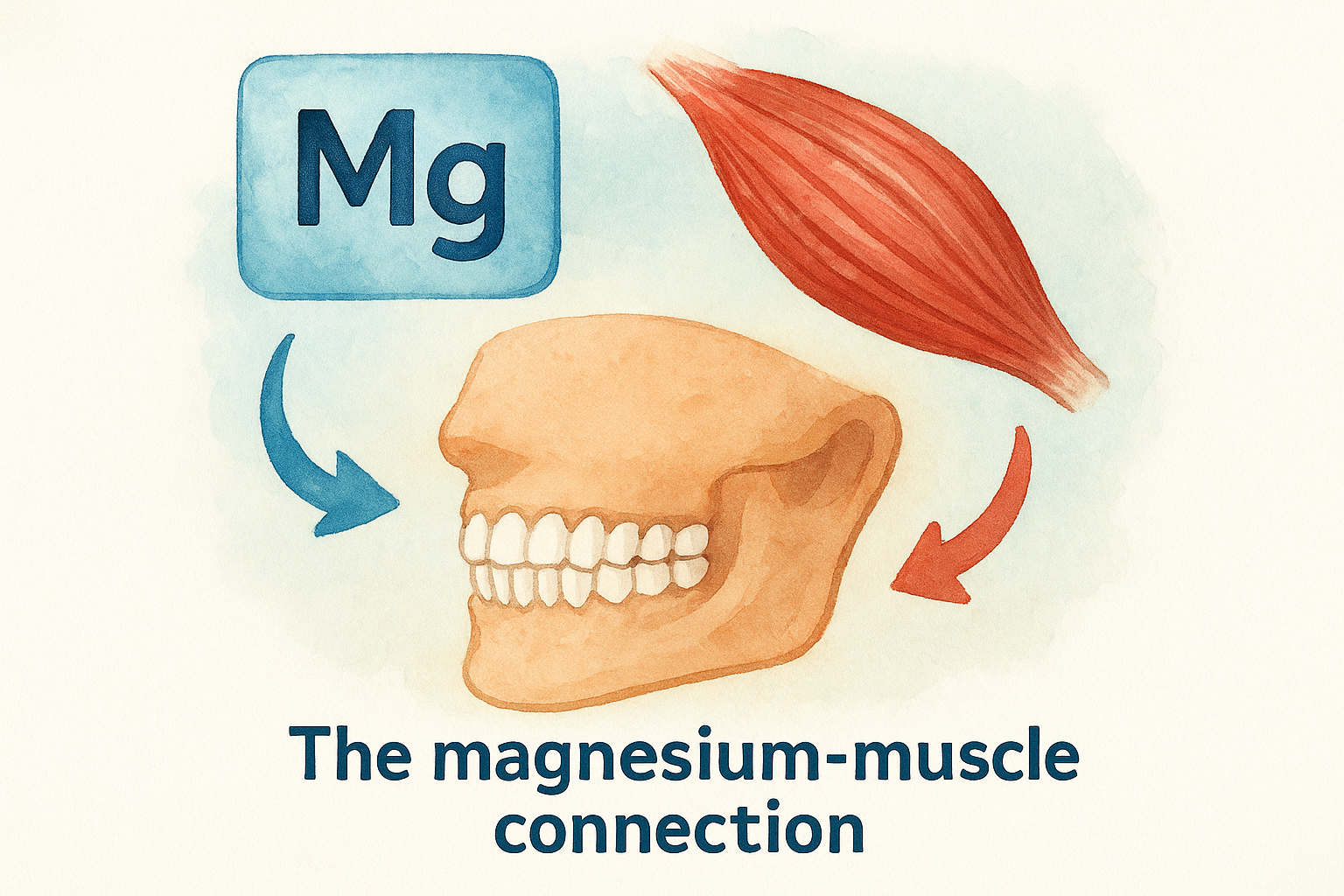
Low magnesium doesn't cause bruxism on its own, but it removes one of the natural buffers that keeps your muscles from over-firing during sleep.
Your nervous system adds another layer to this. Magnesium regulates NMDA receptors, which handle excitatory nerve signaling. When magnesium is low, these receptors become more active, raising overall neurological tension. That tension can surface as jaw clenching and teeth grinding, both of which are associated with elevated nervous system activity during sleep.
What clinical studies have found
Direct research on teeth grinding magnesium supplementation is limited but points in a useful direction. Studies have found that magnesium supplementation improves sleep quality and reduces nighttime disturbances in adults with low magnesium levels. Since bruxism is classified as a sleep-related movement disorder, improving overall sleep architecture may reduce the frequency and intensity of grinding episodes.
A separate line of research focuses on stress and cortisol regulation. Magnesium helps moderate the body's stress response by influencing the HPA axis, which governs cortisol output. Because psychological stress is one of the most well-documented triggers for bruxism, reducing that stress response at night could plausibly lower grinding frequency. The evidence is not definitive, but the biological pathways are logical and consistently supported.
Signs you might need more magnesium
Most people don't know their magnesium is low until symptoms stack up. Before connecting teeth grinding magnesium deficiency to your nighttime habits, it helps to recognize what low magnesium looks like in your daily life. Several warning signs show up in your muscles, sleep, and stress response, and they often appear together.
Physical muscle and jaw symptoms
The most direct signs involve your muscles and how they behave at rest. Frequent muscle cramps, especially in your legs or feet, point to low magnesium because your muscles aren't releasing tension properly. If you also notice jaw tightness or facial soreness during the day, that's your body signaling that the calcium-magnesium balance is off. Eye twitches and general muscle spasms are common physical markers as well.
Daytime jaw tension that you notice while working or driving often reflects the same underlying muscle overactivity that drives nighttime grinding.
Sleep and stress warning signs
Poor sleep quality is another reliable indicator worth paying attention to. If you wake up frequently, struggle to fall asleep, or feel restless during the night, low magnesium may be a contributing factor since magnesium helps regulate melatonin production and promotes a calmer nervous system. You might also find that stress feels harder to manage than usual, your resting heart rate feels elevated without a clear cause, or you carry a general sense of tension that doesn't resolve after rest. When several of these signs appear at the same time, checking your magnesium intake is a reasonable first step.
Which magnesium is best for teeth grinding
Not all magnesium supplements work the same way. The form you choose directly affects how much your body absorbs and how much actually reaches your muscles and nervous system. For anyone using a teeth grinding magnesium strategy, picking the wrong form means you may see little to no benefit even at a reasonable dose.
Forms that absorb well
Two forms stand out for bruxism specifically. Magnesium glycinate combines magnesium with glycine, an amino acid that itself has calming properties, making it one of the best options for reducing muscle tension and improving sleep quality. It absorbs efficiently and is gentle on the stomach, so you can take it consistently without digestive side effects. Magnesium taurate is another strong choice because taurine supports cardiovascular and nervous system calm, which may help lower the overall neurological activation that drives nighttime clenching.
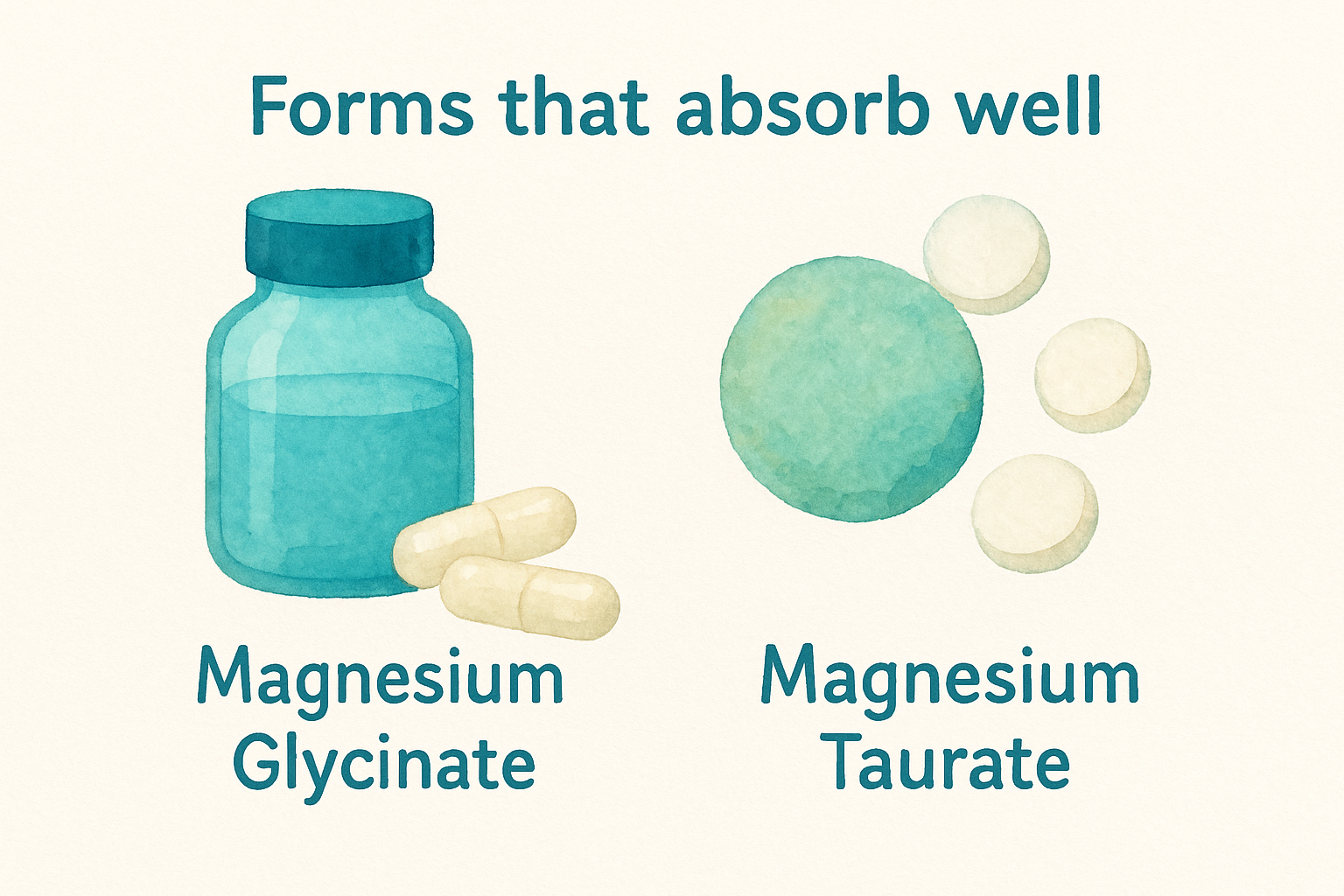
If your main goal is to reduce jaw tension and sleep more deeply, magnesium glycinate is the most straightforward starting point.
Forms to skip or reconsider
Magnesium oxide is the most common form sold in pharmacies, but it has very low bioavailability, meaning your body absorbs a small fraction of what the label lists. Magnesium citrate absorbs better than oxide and works well for general health, but its primary use is digestive, so it rarely delivers enough to muscle and nervous system tissue to make a meaningful difference for grinding. Choosing a poorly absorbed form wastes both your money and the potential benefit.
How to try magnesium safely for night grinding
Starting a teeth grinding magnesium routine is straightforward, but a few basic guidelines help you get real results without wasting money or triggering side effects. Most adults tolerate magnesium well, but starting at a lower dose and increasing gradually gives your body time to adjust and helps you find the amount that actually works for your specific level of jaw tension and sleep disruption.
Dosage and timing
The standard recommendation for magnesium glycinate is 200 to 400 mg taken roughly 30 to 60 minutes before bed. Taking it at night aligns with when your body needs it most, since muscle relaxation and melatonin regulation both happen during sleep. If you experience loose stools, that's a sign you've taken too much, so scale back by 50 mg and hold at that level for at least a week before adjusting again. Staying consistent with timing is more important than pushing the dose higher.
Consistency matters more than a large dose. A moderate amount taken every night produces better results than an irregular high dose.
What to watch for in the first few weeks
Give yourself at least three to four weeks before deciding whether magnesium is making a difference. Changes in muscle tension and sleep quality build gradually as your levels normalize. Track whether your jaw feels less tight in the morning and whether you wake up less frequently during the night. If you notice no improvement after six weeks at a consistent dose, low magnesium may not be the primary driver of your grinding.
What to do if grinding continues
Even after trying teeth grinding magnesium supplementation consistently for several weeks, some people still wake up with jaw soreness, headaches, or visible wear on their teeth. That's a signal to move beyond supplements alone. Magnesium can reduce the muscle and stress factors contributing to bruxism, but it doesn't address every cause, and it provides no physical barrier between your upper and lower teeth while you sleep.
Waiting too long to protect your teeth means enamel loss that cannot grow back, regardless of what you take to calm the underlying grinding.
Protect your teeth while you manage the cause
A custom-fitted night guard is the most reliable way to prevent further damage while you work on reducing grinding through other means. Unlike store-bought guards that sit loosely and can actually shift your bite over time, a custom guard is molded precisely to your teeth so it stays in place and distributes grinding pressure evenly across the surface. Remi's at-home impression process lets you get that custom fit without a costly dental office visit.
Address the underlying triggers
If grinding persists despite magnesium and a night guard, the cause likely runs deeper. Chronic stress, sleep apnea, and certain medications are all documented bruxism triggers that supplements alone cannot fix. Tracking your stress levels, reviewing any new medications with your doctor, and getting screened for sleep apnea if you snore or wake up exhausted are all practical next steps worth taking before assuming the problem is purely nutritional.
Next steps for a calmer night
Combining teeth grinding magnesium supplementation with physical protection gives you the best chance of waking up without jaw pain or headaches. Magnesium glycinate taken consistently before bed can reduce muscle tension and nervous system overactivity, two factors that directly fuel bruxism. But supplements take weeks to build up, and your teeth need protection starting tonight.
Start with a dose of 200 to 400 mg of magnesium glycinate each evening and track your morning symptoms over four to six weeks. If you notice your jaw feels less tight and your sleep feels more restful, keep going. If grinding continues despite supplementation, a custom-fitted night guard removes the physical damage from the equation while you address the underlying causes.
You can get a professionally made guard without the dental office price tag. Order a custom night guard from Remi and protect your enamel starting the first night you wear it.

