


You spent months (maybe years) wearing braces or aligners to get your teeth perfectly straight. Now a thin piece of plastic or wire stands between you and teeth that slowly drift back to their original positions. Knowing how often to replace retainers matters more than most people realize, a worn-out retainer can't do its job, and your orthodontic investment starts slipping away one millimeter at a time.
The answer isn't one-size-fits-all. Clear plastic retainers, Hawley retainers with their signature wire-and-acrylic design, and permanent bonded retainers each have different lifespans ranging from one year to several decades. How long yours lasts depends on the type you wear, how well you care for it, and whether you grind your teeth at night. Recognizing the warning signs of a failing retainer, cracks, discoloration, loose fit, or visible warping, helps you act before your teeth start shifting.
At Remi, we make custom clear removable retainers using an at-home impression kit, delivering professional-quality fit without the dental office markup. We've helped over 350,000 customers protect their smiles, and we know that understanding retainer replacement timing is essential for long-term results. This guide breaks down exactly when each retainer type needs replacing, the physical signs that indicate it's time, and practical steps to extend your retainer's useful life.
Why retainer replacement matters for your smile
Your teeth sit in bone that constantly remodels itself throughout your life. After braces or aligners straighten your teeth, the surrounding bone and ligaments need months or years to stabilize in their new positions. A retainer holds your teeth steady during this critical period, but only if it maintains its original shape and fit. When you delay replacement too long, your retainer loses its ability to prevent the slow, almost invisible drift that undoes orthodontic work.
Your teeth never stop trying to move
Teeth apply pressure on each other every time you chew, speak, or clench your jaw. The bone around tooth roots responds to this pressure by breaking down on one side and rebuilding on the other, a process called bone remodeling that allows teeth to shift position gradually. Your tongue pushes forward with several pounds of force thousands of times per day, while your lips and cheeks push inward, creating a constant tug-of-war that your retainer must counteract.
Even years after completing orthodontic treatment, your teeth retain a cellular memory of their original positions. The periodontal ligaments that connect teeth to bone contain collagen fibers that stretched during your treatment. These fibers want to contract back to their pre-treatment length, pulling your teeth along with them. A properly fitted retainer prevents this relapse, but a damaged or ill-fitting one creates gaps that let teeth wander.
Understanding how often to replace retainers protects the time, money, and effort you invested in achieving straight teeth.
Worn retainers lose their corrective power
Retainers face daily stress from biting forces, temperature changes, and exposure to saliva. Clear plastic retainers develop microscopic cracks that spread over months, weakening the material until it can't resist the pressure your teeth apply. These invisible stress fractures reduce the retainer's ability to hold teeth in position long before you notice visible damage.
Material fatigue affects different retainer types in distinct ways. Plastic becomes brittle and loses its elastic memory, meaning it no longer springs back to its original shape after you remove it. Metal wires in Hawley retainers can bend slightly from repeated stress, changing the pressure pattern they apply to your teeth. Both scenarios allow controlled tooth movement to become uncontrolled drift.
Financial and time costs of tooth shifting
Retreatment costs dwarf retainer replacement expenses. A new set of braces or clear aligners typically runs $3,000 to $8,000, compared to $100 to $500 for a replacement retainer. Beyond the financial hit, you face another 6 to 18 months of active treatment, dealing with dietary restrictions, discomfort, and the inconvenience of orthodontic appliances all over again.
The psychological impact compounds these practical concerns. Watching your smile deteriorate after achieving perfect alignment creates frustration and regret, especially when the problem could have been prevented with timely retainer replacement. Teeth that shift even slightly can affect your bite pattern, potentially leading to jaw pain, uneven tooth wear, or temporomandibular joint issues that require additional dental intervention.
Typical replacement timelines by retainer type
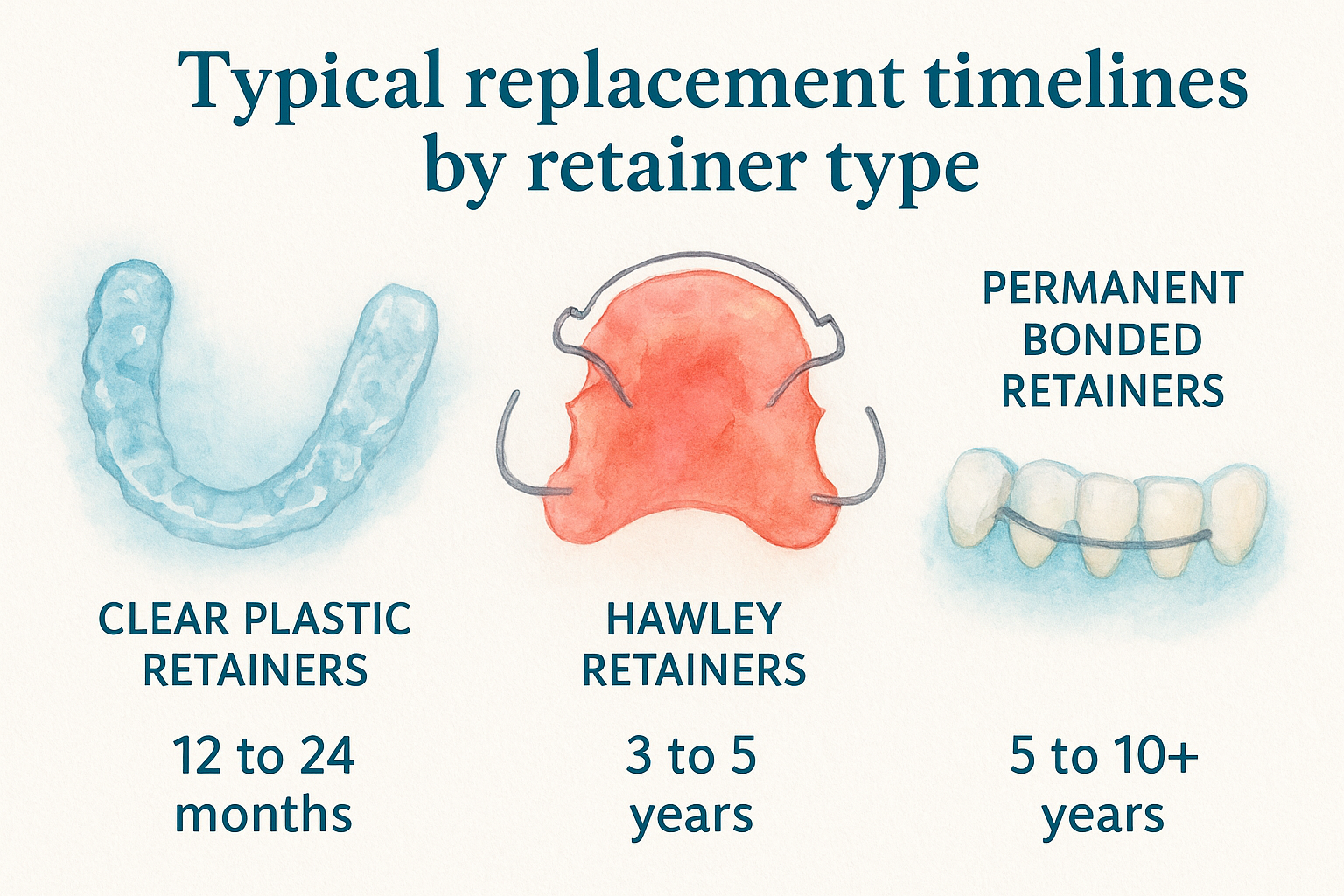
The three main retainer types have vastly different replacement schedules, ranging from 12 months for clear plastic versions to potentially permanent for bonded wire retainers. Your specific timeline depends on which type your orthodontist recommended based on your treatment needs, lifestyle factors, and personal preferences. Understanding how often to replace retainers of each type helps you budget for replacements and watch for signs of wear before they compromise your results.
Clear plastic retainers
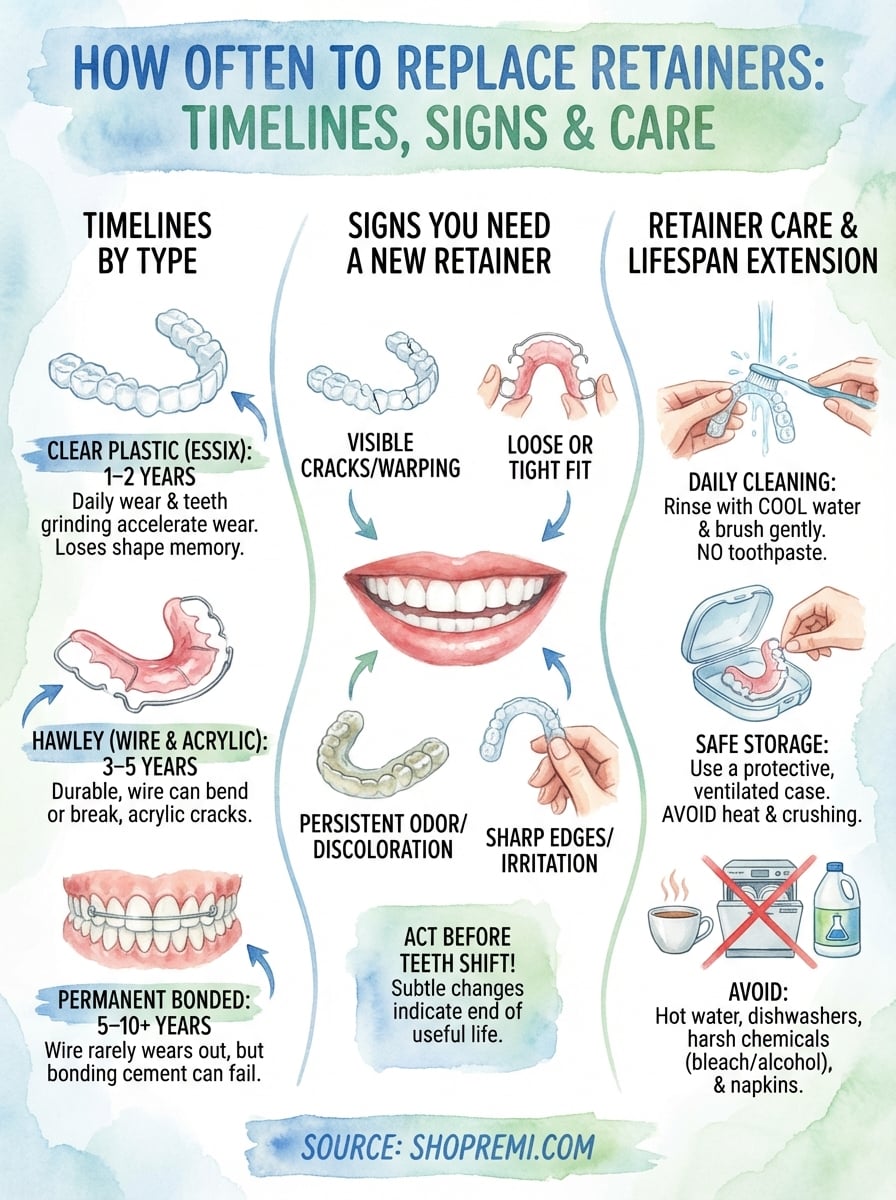
Clear removable retainers (also called Essix retainers) need replacement every 1 to 2 years on average, though some people wear through them faster. These vacuum-formed plastic trays fit snugly over your teeth but gradually accumulate damage from daily handling, cleaning, and the constant pressure of your bite. Nightly teeth grinding accelerates wear, often reducing their useful life to 6 to 12 months.
The thin plastic material loses its shape memory over time. You might notice the retainer feels looser, develops a cloudy appearance, or shows visible cracks along the edges where your teeth apply the most pressure. Temperature fluctuations from hot beverages or aggressive cleaning methods can warp the plastic, creating an imperfect fit that allows subtle tooth movement.
Replacing clear retainers every 12 to 18 months maintains the precise fit needed to hold your teeth in their corrected positions.
Hawley retainers
Traditional Hawley retainers with their metal wire and acrylic base last 3 to 5 years with proper care, making them a more durable option than clear plastic alternatives. The metal wire resists bending better than plastic, and the thicker acrylic base withstands daily wear without developing stress fractures as quickly. Your orthodontist can adjust a Hawley retainer if your teeth shift slightly, extending its useful life beyond what's possible with molded plastic versions.
These retainers fail when the metal wire bends permanently, the acrylic cracks, or the clasps that hook around your molars loosen. Daily removal and insertion stresses the wire clasps, eventually causing metal fatigue that compromises retention strength.
Permanent bonded retainers
Bonded retainers (fixed or lingual retainers) consist of a thin wire cemented to the back of your front teeth, typically lasting 5 to 10 years or longer. Some people keep the same bonded retainer for decades with routine dental checkups. The wire itself rarely wears out, but the bonding cement can fail, allowing the wire to detach from one or more teeth.
You'll need replacement or repair when the adhesive breaks down, the wire breaks, or significant buildup of plaque and tartar requires removal for thorough cleaning. Your dentist checks the integrity of bonded retainers during regular cleanings and can reattach loose sections before complete failure occurs.
Signs you need a new retainer now
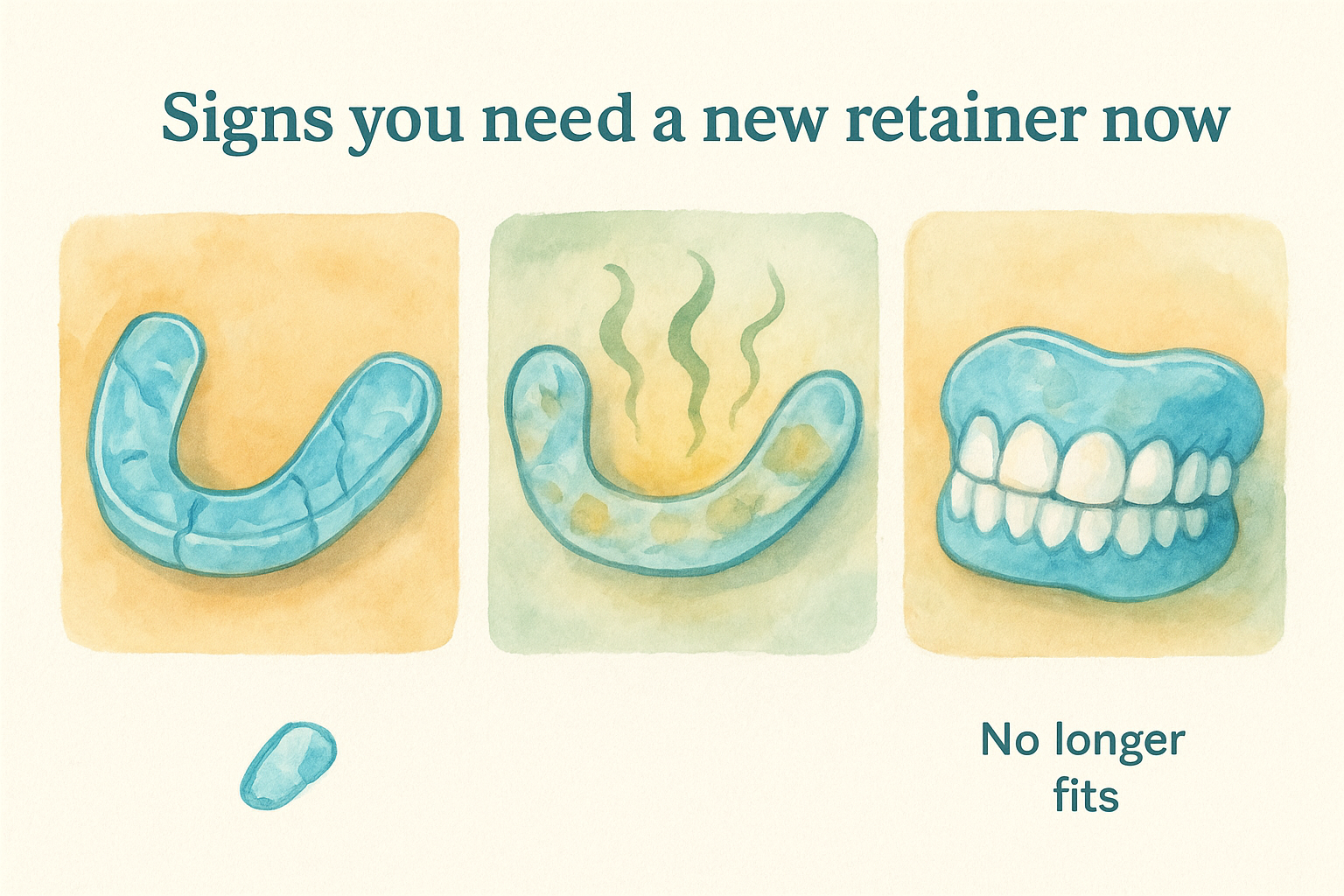
Your retainer gives clear warnings when it can no longer protect your teeth effectively. Visible cracks, persistent odors, or changes in fit tell you the material has degraded beyond repair. Learning to recognize these signs early prevents the tooth movement that happens when you continue wearing a compromised retainer. You don't need to wait for complete failure, subtle changes often indicate your retainer has reached the end of its useful life.
Visible damage and structural changes
Cracks in clear retainers start small but spread quickly under the pressure of daily wear. You might notice hairline fractures along the edges where the plastic wraps around your molars, or star-shaped patterns radiating from high-stress points. These weaknesses compromise the retainer's structural integrity long before it breaks into pieces. White or cloudy patches indicate stress points where the plastic has started to delaminate internally.
Warping changes your retainer's shape in ways that prevent proper tooth contact. Heat exposure from hot water, dishwashers, or leaving the retainer in a car causes the plastic to bend permanently. You'll feel gaps between the retainer and certain teeth, or notice it no longer snaps firmly into place. Hawley retainers show damage through bent wires, cracked acrylic bases, or loose metal clasps that no longer grip your molars securely.
Fit problems that signal replacement
A retainer that feels loose has lost its ability to hold your teeth in position. You can wiggle it with your tongue or remove it without effort, signs that the plastic has stretched or the wire has permanently deformed. The opposite problem, a retainer that suddenly feels tight, indicates your teeth have started shifting because the retainer wasn't maintaining adequate pressure.
When your retainer no longer clicks into place with firm resistance, it has stopped providing the corrective force your teeth need.
Sharp edges or rough spots that irritate your gums or cheeks mean the material has degraded. These rough areas harbor bacteria and can cause mouth sores, making the retainer uncomfortable to wear and potentially harmful to your oral health.
Odor and discoloration issues
Persistent smell that doesn't disappear after thorough cleaning indicates bacterial colonization deep within microscopic cracks in the retainer material. This biofilm compromises hygiene and signals material breakdown. Yellow or brown staining that resists cleaning shows the plastic has become porous, allowing bacteria and debris to penetrate the surface where you can't remove them.
What to do if your retainer feels tight or loose
Changes in how your retainer fits signal important developments in your oral health. A tight retainer indicates your teeth have moved, while a loose retainer means the appliance has lost its shape or your teeth have shifted significantly. Both situations require immediate attention to prevent further problems. Understanding what each sensation means helps you take the right action before minor issues become major orthodontic setbacks.
When tightness means your teeth have shifted
You experience tightness when your retainer struggles to push your teeth back into their intended positions. Skipping retainer wear for several nights allows teeth to drift, creating resistance when you try to reinsert the appliance. This pressure feels uncomfortable but indicates the retainer still fits well enough to correct minor movement. You should wear your retainer consistently for several days to guide your teeth back into alignment.
Contact your orthodontist if the tightness persists beyond three consecutive days of full-time wear. Forcing a retainer that causes sharp pain or won't seat completely can damage your teeth or the retainer itself. Your orthodontist can assess whether the shifting requires professional intervention or if continued retainer wear will resolve the problem naturally. Some cases need brief orthodontic treatment to reposition teeth before a retainer can maintain them effectively.
If your retainer feels tight after just one missed night, your teeth are particularly prone to movement and you need stricter wear compliance.
Why looseness requires immediate attention
A loose retainer has stopped protecting your teeth from shifting. The plastic has stretched, the wire has bent, or your teeth have moved beyond the retainer's corrective range. Wearing a loose retainer provides false security, you think you're preventing movement while your teeth gradually migrate. You need a replacement retainer immediately to halt further shifting before retreatment becomes necessary.
Schedule an orthodontic appointment within days rather than weeks when you notice looseness. Your orthodontist can take new impressions and fabricate a replacement that fits your current tooth positions, stopping the drift before it progresses. Delaying this appointment allows more movement, potentially requiring additional orthodontic correction rather than simple retainer replacement. This situation directly affects how often to replace retainers, since a loose fit indicates your current device has reached the end of its functional life regardless of its age.
Stop wearing a loose retainer if it causes discomfort or feels like it's shifting your teeth in the wrong direction. An ill-fitting retainer can actually worsen tooth positions by applying pressure in unintended directions.
Retainer care that extends lifespan
Proper daily care dramatically increases how long your retainer remains functional and how often to replace retainers becomes a less frequent concern. Simple habits like removing your retainer before eating and storing it in a protective case prevent most of the damage that forces premature replacement. The difference between a retainer that lasts six months and one that serves you well for two years often comes down to consistent protective routines rather than product quality.
Daily handling practices
Remove your retainer before every meal, snack, or beverage except water. Food particles trapped under your retainer create pressure points that crack the plastic and provide breeding grounds for bacteria. Even small amounts of sugar or acid from drinks like coffee, tea, or juice can weaken the retainer material over time. You should rinse your retainer with cool water immediately after removal to prevent saliva from drying and hardening on the surface.
Handle your retainer with clean, dry hands to avoid introducing oils or contaminants. Dropping your retainer causes immediate structural damage, from obvious cracks to invisible stress fractures that worsen over weeks. Place it directly into its case rather than setting it on counters, napkins, or tables where you might forget it or accidentally throw it away. Many retainers end up in landfills because people wrapped them in napkins at restaurants.
Treating your retainer like the valuable medical device it is, rather than a disposable accessory, extends its useful life by months or years.
Storage habits that prevent damage
Keep your retainer in a ventilated case that allows air circulation while protecting against physical damage. Sealed containers trap moisture and promote bacterial growth, while leaving your retainer exposed risks contamination and breakage. Store the case in a consistent location at home, work, or school so you develop automatic habits that reduce the chance of loss or damage.
Avoid leaving your retainer anywhere temperature can fluctuate significantly. Heat exposure from car dashboards, windowsills, or pockets causes irreversible warping that ruins the precise fit needed for tooth retention. Your retainer contains no electronics or batteries, so extreme cold won't damage it, but rapid temperature changes from cold to hot create stress in the material that accelerates failure.
Replace your storage case every few months when it becomes cracked, develops odors, or loses its protective closure. A damaged case fails to protect your retainer from drops, crushing, or contamination during storage or transport.
Cleaning methods that won't warp or scratch
Your cleaning routine directly impacts how often to replace retainers by either preserving or destroying the material integrity. Harsh chemicals, abrasive scrubbing, and temperature extremes cause more retainer damage than years of normal wear. The right cleaning approach removes bacteria and debris without compromising the plastic's shape or creating microscopic scratches that harbor additional contamination. You can double or triple your retainer's lifespan simply by switching from damaging cleaning methods to gentle alternatives that achieve the same hygiene results.
Daily rinsing basics
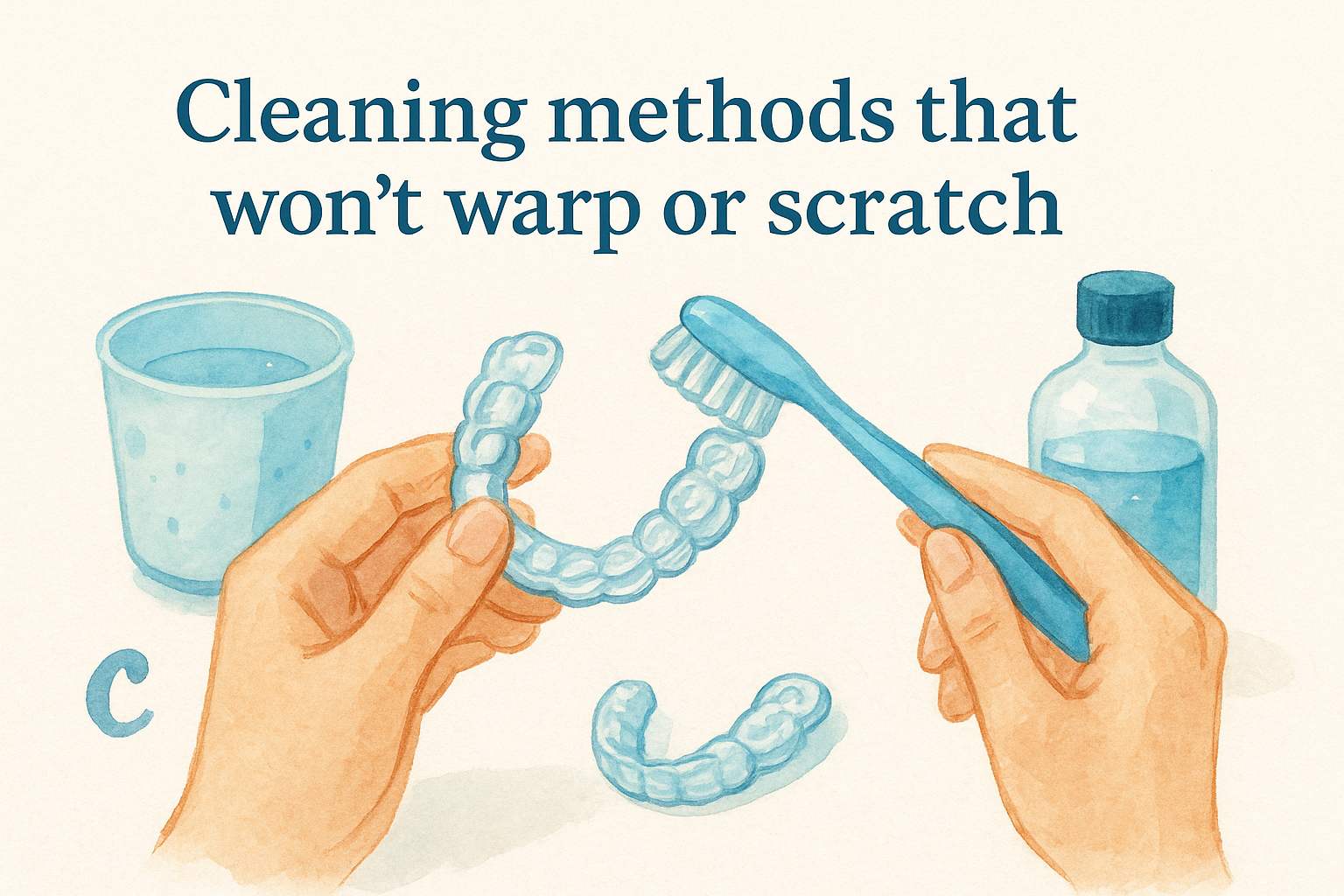
Rinse your retainer with cool or lukewarm water immediately after removing it from your mouth. This simple step prevents saliva from drying into a hard film that requires aggressive scrubbing to remove later. Use your fingers to gently rub away any visible debris under running water, avoiding brushing until you've loosened surface particles. Water temperature matters more than most people realize, hot water above 110°F can soften and warp plastic retainers permanently.
Cool water rinses after every removal prevent 90% of the buildup that leads people to use damaging cleaning methods later.
Brush your retainer once daily using a soft-bristled toothbrush dedicated solely to retainer cleaning. Plain water or mild hand soap provides enough cleaning power for daily maintenance without introducing chemicals that degrade plastic. Never use toothpaste on your retainer, the abrasive particles that polish tooth enamel create scratches in softer plastic that collect bacteria and stains.
Safe deep cleaning approaches
Soak your retainer once or twice weekly in a solution specifically designed for dental appliances. White vinegar diluted with equal parts water provides an effective, inexpensive option that breaks down mineral deposits and kills bacteria without damaging plastic or metal components. Limit soaking time to 15 to 30 minutes, longer exposure to acidic solutions can eventually weaken the material.
Specialized retainer cleaning tablets dissolve in water to create a gentle cleansing bath. These effervescent products remove stains and odors without the harsh chemicals found in denture cleaners or bleach. Follow package directions precisely, as leaving your retainer in solution too long can cause discoloration or weakening.
Products and temperatures to avoid
Never expose your retainer to boiling water, dishwashers, or water above body temperature. These heat sources destroy the precise molding that makes your retainer fit properly. Avoid alcohol-based mouthwashes, which dry out and crack plastic over time, and bleach products that weaken material structure while causing permanent discoloration.
Skip baking soda pastes and hydrogen peroxide solutions stronger than 3% concentration. These common household cleaners seem gentle but accelerate material degradation through chemical reactions with retainer plastics.
Replacing a retainer after braces or Invisalign
Your first retainer arrives immediately after your orthodontist removes your braces or you complete your final Invisalign tray. This initial retainer represents your teeth in their corrected positions, serving as the baseline for all future replacements. Understanding when and how often to replace retainers after orthodontic treatment differs from the standard replacement cycle because your retention needs change as your teeth stabilize in their new positions over months and years.
First retainer replacement timing
Your initial retainer typically needs replacement 6 to 12 months after your braces come off or you finish Invisalign treatment. Teeth move more readily during this early retention phase because the surrounding bone and ligaments haven't fully adapted to the new tooth positions. You wear your retainer constantly during these first months, often 22 hours daily, creating accelerated wear that shortens its lifespan compared to later retainers you wear only at night.
Orthodontists schedule checkup appointments at 3, 6, and 12 months post-treatment to monitor tooth stability and retainer condition. Your first replacement often happens at the 6-month mark when daily wear has created visible stress on the plastic or wire. This frequent replacement schedule protects your investment during the critical stabilization period when tooth movement happens fastest and most dramatically.
Your teeth face the highest risk of shifting during the first year after treatment, making timely replacement of your initial retainer particularly important.
Transitioning from passive to active retention
You move from full-time to nighttime retainer wear once your orthodontist confirms your teeth have stabilized, usually 3 to 6 months after treatment ends. This transition reduces daily stress on your retainer and extends replacement intervals to the standard 12 to 24 months for clear plastic versions or 3 to 5 years for Hawley retainers. You still need consistent nightly wear indefinitely, but the reduced wearing time means less material fatigue.
Some orthodontists prescribe different retainer types for active versus passive retention phases. You might start with a Hawley retainer that allows minor adjustments during early stabilization, then switch to a clear retainer for long-term maintenance. Others provide bonded retainers for lower front teeth while using removable retainers on upper teeth, creating a dual-retention system that distributes replacement needs across different timelines.
Replacement options and what to expect
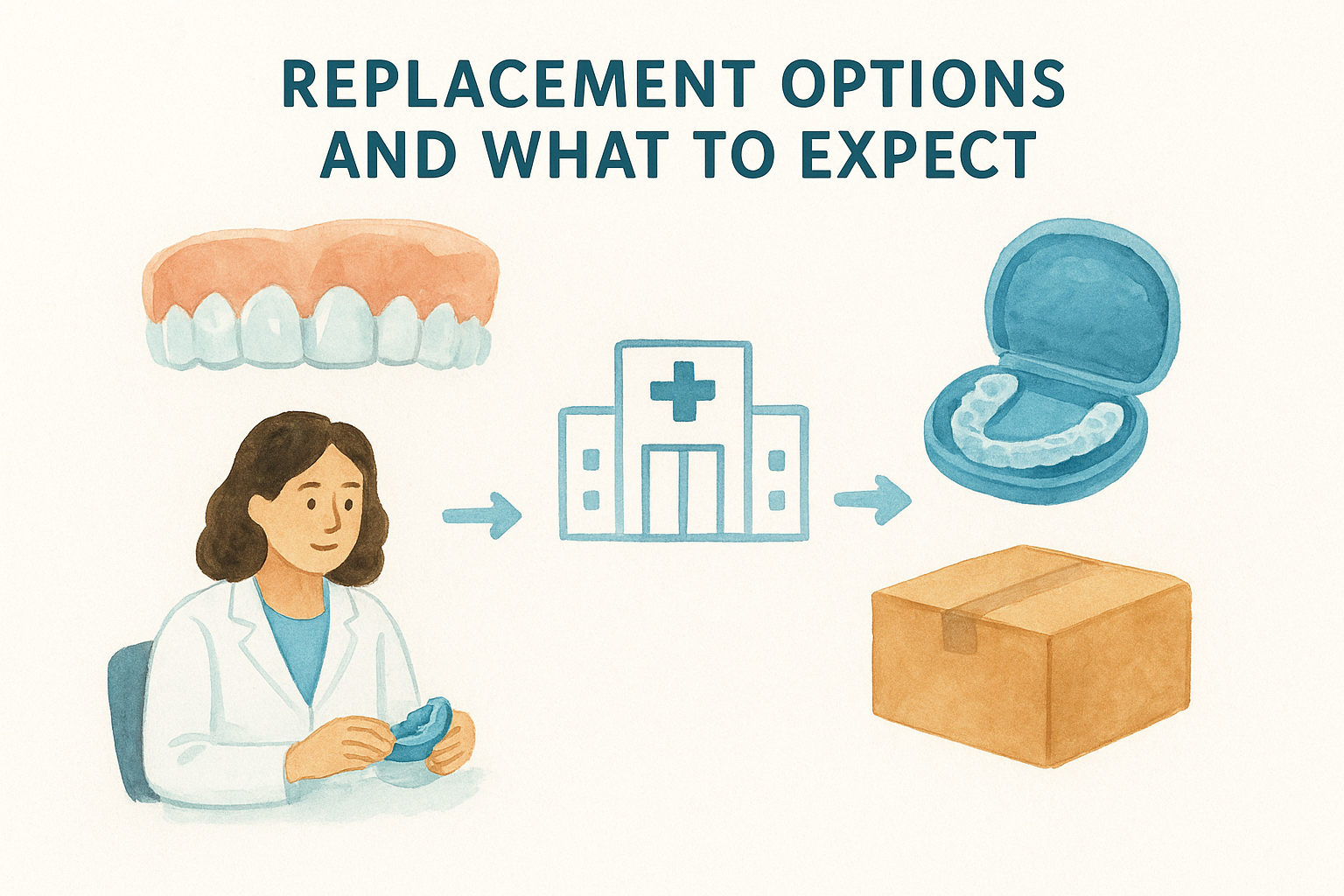
You have several paths to getting a new retainer when your current one reaches the end of its useful life. Your choice between returning to your original orthodontist, visiting a new dental provider, or using a direct-to-consumer service affects turnaround time, cost, and convenience. Each option delivers functionally equivalent retainers, though the process and price point differ significantly. Understanding what each replacement method involves helps you select the approach that fits your schedule and budget.
Getting replacements from your orthodontist
Your original orthodontist keeps digital scans or physical molds of your teeth from when you completed treatment. This existing record streamlines the replacement process because you skip the impression-taking step and move directly to fabrication. You schedule an appointment for a brief checkup where your orthodontist confirms your teeth haven't shifted, then orders your new retainer from their lab. Turnaround time ranges from one to three weeks depending on the lab's workload.
New orthodontists or general dentists can also provide replacements if you've relocated or your original provider retired. You need new impressions or digital scans during your first visit, adding time and cost compared to working with your original orthodontist. The replacement process then follows the same timeline as any first-time retainer order.
Working with your original orthodontist typically provides the fastest replacement because they already have your dental records on file.
Direct-to-consumer retainer services
Mail-order retainer companies like Remi eliminate office visits by sending you an at-home impression kit. You take your own dental impressions using the provided materials and instructions, mail them back to the company, and receive custom retainers within two weeks. This approach costs substantially less than dental office replacements while delivering the same professional-grade quality you'd get from an orthodontist's lab.
What happens during the replacement process
Regardless of which option you choose, someone needs current records of your tooth positions to fabricate a properly fitting retainer. In-office visits involve sitting still for two to three minutes while dental putty sets around your teeth, or having your mouth scanned with a digital wand. At-home impression kits provide step-by-step guidance for achieving lab-quality results without professional supervision. Your replacement retainer arrives ready to wear immediately, requiring no adjustments or fitting appointments.
Knowing how often to replace retainers helps you plan ahead for these replacement cycles, ordering new retainers before your current one fails completely.
Cost factors and insurance basics
Replacement retainer costs vary widely based on which type you need, where you get it, and whether insurance covers orthodontic retention. Understanding the price range for each option helps you budget for replacements throughout your life, since you'll need multiple retainers over the years regardless of how well you care for them. Most people underestimate the long-term cost of retention when they finish orthodontic treatment, then feel surprised by the cumulative expense of keeping their smile straight.
What replacement retainers actually cost
Orthodontist offices typically charge $150 to $500 per retainer for clear plastic or Hawley designs, with fees varying by geographic location and practice overhead. Bonded retainer repairs or replacements cost $250 to $800 depending on how many teeth need reattachment and whether the wire requires replacement. These prices include the office visit, impressions or scans, and laboratory fabrication time.
Direct-to-consumer services like Remi offer custom clear retainers for significantly less than dental office prices by eliminating intermediary costs and office visit fees. You complete the impression process at home using a professional-grade kit, then receive lab-quality retainers delivered to your door. This pricing structure makes replacing retainers more affordable, particularly when you need replacements every 12 to 18 months as recommended for clear plastic types.
Geographic location affects costs substantially. Urban dental practices in high-cost-of-living areas charge premium prices compared to suburban or rural providers. The same retainer that costs $500 in New York City might run $200 in smaller markets, though quality remains consistent across locations.
Knowing how often to replace retainers helps you calculate lifetime retention costs and choose the most economical replacement strategy.
Insurance coverage and reimbursement
Most dental insurance plans consider retainers part of orthodontic treatment rather than routine dental care. Your initial retainers after braces or Invisalign usually fall under your orthodontic benefit, which typically covers 50% of costs up to a lifetime maximum of $1,000 to $2,000. Replacement retainers ordered months or years after treatment ends rarely qualify for insurance coverage because you've exhausted your orthodontic benefit.
Some insurance plans offer separate allowances for replacement appliances if you can demonstrate medical necessity. You need documentation from your dentist or orthodontist explaining why the replacement prevents health problems rather than serving purely cosmetic purposes. This distinction matters for insurance approval, though many plans still deny coverage for replacements.
Ways to reduce replacement expenses
Purchase multiple retainers during your initial fitting when insurance covers costs. Having backup retainers on hand eliminates emergency replacement fees and the tooth movement that happens while waiting for a new retainer. Your orthodontist can fabricate extra sets from the same impressions at reduced per-unit costs.
Ask about payment plans or bulk ordering discounts if you're paying out of pocket. Some dental offices and direct-to-consumer companies offer subscription models that spread replacement costs over monthly payments while ensuring you receive new retainers on schedule.
FAQs and quick answers
Retainer replacement questions come up repeatedly in orthodontic offices and online forums. These direct answers address the most common concerns about replacement timing, costs, and what happens when things go wrong. You can use this section as a quick reference whenever doubt creeps in about your retainer's condition or replacement schedule.
Can I skip wearing my retainer for a few days?
Missing a few consecutive nights puts your teeth at risk of shifting, particularly during the first year after orthodontic treatment ends. Your teeth can move noticeably within 72 hours of stopping retainer wear, creating tightness when you try to reinsert the appliance. You should resume wearing your retainer immediately if you've missed several days, but contact your orthodontist if it feels extremely tight or causes pain.
How do I know if my retainer still fits properly?
A properly fitting retainer clicks firmly into place without gaps between the plastic and your teeth. You feel resistance when inserting it, then a secure snap once it seats completely. Conversely, a poor fit feels loose enough to wiggle with your tongue, leaves visible spaces between retainer and teeth, or causes sharp pain in specific spots. These signs indicate you need to evaluate how often to replace retainers based on current wear patterns.
If your retainer slides on and off effortlessly without any pressure or clicking sensation, it has lost its corrective fit.
What happens if I lose my retainer?
Order a replacement immediately rather than waiting to see if your teeth shift. Your teeth begin moving within days of stopping retainer wear, making rapid replacement critical for protecting your orthodontic results. Direct-to-consumer services deliver replacements in one to two weeks, while orthodontist offices typically require two to three weeks from impression to delivery.
Can I get a retainer years after finishing braces?
Your orthodontist or a new dental provider can fabricate retainers even decades after your original treatment ended. The new retainers fit your current tooth positions rather than your post-braces alignment, which means they maintain wherever your teeth have settled instead of correcting previous shifting. You may need brief orthodontic treatment first if you want to restore your original post-braces alignment before getting retainers.
A simple plan to keep your teeth in place
You've learned that clear plastic retainers need replacement every 12 to 24 months, Hawley retainers last 3 to 5 years, and bonded retainers can serve you for a decade or more. Recognizing signs of wear, cracks, discoloration, loose fit, or persistent odors, tells you when replacement becomes necessary regardless of age. Your teeth never stop trying to move back to their original positions, making consistent retainer wear and timely replacement the only reliable protection for your orthodontic investment.
Start checking your retainer monthly for visible damage and fit changes. Clean it daily with cool water and a soft brush, store it in a protective case, and never expose it to heat. Schedule replacement before complete failure occurs, not after your teeth have already shifted. When you need a new retainer, Remi delivers custom clear retainers using an at-home impression kit that saves you time and money compared to dental office visits. Protecting your smile requires planning ahead rather than reacting to problems after they develop.

