
 Guards + Retainers
 Custom Night Guard
 Retainer
 Emergency Order

 Whitening
 Whitening Kit
 Teeth Whitening Gel
 Dual-Action Foam
 Cleaning + Care
 Ultrasonic Cleaner Pro
 Water Flosser
 UV Toothbrush Sanitizer
 Deep Clean + Freshening Tablets
 Accessories
 Guard Removal Tool
 Replacement Nozzles
 Bundles

Retailers take a cut. Distributors mark up your price. Third parties sit between you and the people who actually buy your products. You lose margin, customer insight, and control over how your brand shows up. Meanwhile, you're funding someone else's relationship with your customers.
Going direct to consumer changes that equation. You keep more revenue. You own the data. You decide how customers experience your brand from first click to delivery. The model creates room to invest in better products, smarter marketing, and actual customer relationships instead of paying intermediaries.
This guide breaks down five specific advantages that make direct to consumer work for brands ready to grow. You'll see how margin becomes reinvestment fuel, why customer data drives smarter decisions, how brand control protects your positioning, why direct feedback accelerates innovation, and how digital operations scale without the overhead of physical retail. Each advantage builds on the others to create compounding returns.
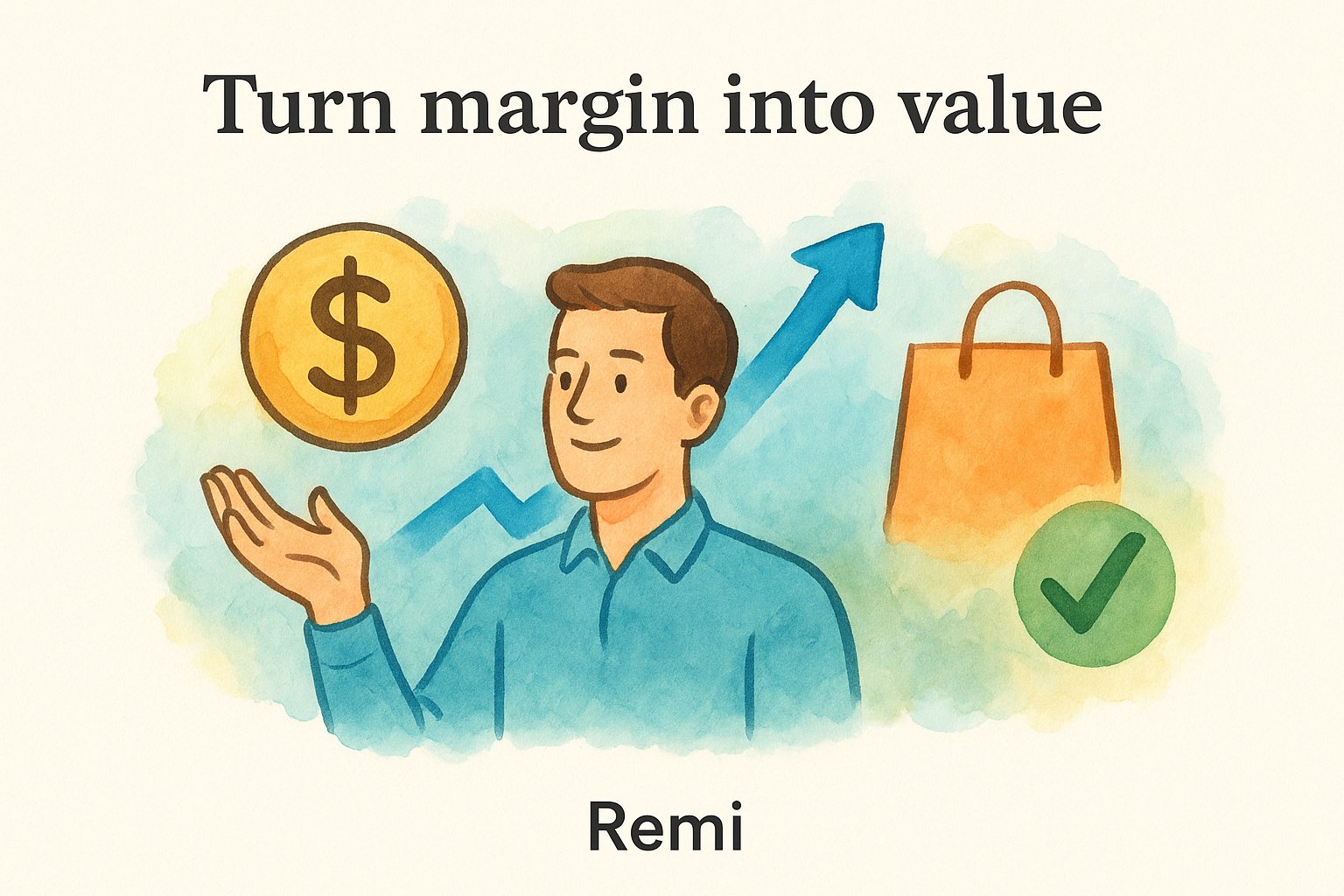
1. Turn margin into value like Remi does
Traditional retail chains typically take 30% to 50% of your product's selling price. Distributors add their cut before that. You design the product, handle production, and carry inventory risk while intermediaries capture most of the economic upside. Direct to consumer flips this model by eliminating those layers and putting margin back in your control.
Why advantages of direct to consumer start with margin
Retail markup structures force you into impossible choices. You either price high enough to preserve margin after channel costs, making your product expensive for customers, or you accept thin margins that leave no budget for quality improvements or customer acquisition. Most brands get squeezed from both sides, watching competitors undercut them while retailers demand deeper trade discounts. Direct channels remove this constraint by letting you capture the full difference between your cost and the final price.
How direct to consumer unlocks savings
Cutting out wholesalers and retailers means you keep every dollar above your landed cost. A custom night guard that costs $40 to produce and ship might sell for $300 through a dentist or $120 through pharmacy chains after their markups. Selling direct at $165 gives you $125 in margin instead of $20 to $60, tripling your working capital per unit. That extra margin funds better materials, faster shipping, responsive support, and the marketing needed to reach new customers without outside investment.
The margin you reclaim from intermediaries becomes the budget for everything that makes your brand competitive.
How Remi turns savings into customer value
Remi applies this principle to dental protection. Traditional dentist offices charge $600 to $800 for custom night guards because of overhead and lab fees. Remi produces the same professional-grade product for a fraction of that cost and prices custom guards at $165, saving customers hundreds while maintaining healthy margins. Those savings fund free impression kits, responsive customer support, and product improvements. You win when customers recognize they're getting dentist-quality protection without the dentist-office markup.
2. Build direct customer relationships and data
Retailers own the transaction data when customers buy through their channels. You get aggregate reports weeks after the sale if you're lucky. You never learn who bought your product, why they chose it, what else they considered, or whether they'd buy again. Direct to consumer reverses this asymmetry by making every customer interaction a source of actionable intelligence you control from day one.
What you gain from owning customer data
Direct sales give you names, emails, purchase histories, and behavioral signals that third-party channels never share. You see which product pages convert, what messaging resonates, how customers use support resources, and which segments generate repeat orders. This visibility lets you segment audiences for personalized campaigns instead of broadcasting generic messages. Retention improves when you can identify customers at risk of churning and re-engage them with targeted offers based on actual purchase patterns rather than guesswork.

How to turn insights into smarter decisions
Raw data becomes valuable when you connect it to decisions. Track which acquisition channels deliver customers with the highest lifetime value, not just the lowest cost per click. Monitor product reviews and support tickets to spot quality issues or feature requests before they become widespread problems. Test pricing changes, bundle offers, and new product launches with small customer segments before full rollout. Each test generates learning that compounds over time, making your next decision more informed than the last.
Customer data stops being surveillance and starts being service when you use it to solve real problems faster.
Privacy, consent, and earning real trust
Collecting data creates responsibility. You need transparent opt-in processes and clear privacy policies that explain what you track and why. Customers trust brands that respect their information and use it to improve their experience, not exploit it. Advantages of direct to consumer include building this trust directly rather than hoping retail partners handle data ethically on your behalf.
3. Control your brand, pricing, and experience
Retail partners decide how your products appear on shelves, what promotional calendar you follow, and which competing brands sit next to yours. They bundle your premium item in clearance bins or feature competitors more prominently. Your brand identity gets diluted through inconsistent presentation, and you watch pricing integrity collapse during unauthorized discount events. Direct to consumer eliminates these compromises by putting every brand touchpoint under your control.

Why channel control protects your brand
Retailers prioritize their own margins and store strategies over your brand positioning. They might display your product poorly, create confusing bundles with unrelated items, or train staff inadequately about your differentiation. Your carefully crafted messaging gets reduced to a price tag competing with substitutes. Direct channels let you control photography, copy, product education, and the entire visual identity customers encounter. You decide what story to tell and how to tell it without retail partners reinterpreting or oversimplifying your value proposition.
Setting pricing and promotion on your terms
Third-party sellers frequently undercut your suggested retail price to move inventory faster or compete with other channels carrying your brand. This trains customers to wait for discounts and erodes perceived value. Advantages of direct to consumer include setting your own prices based on actual costs and desired positioning rather than accepting whatever markdown retailers demand. You choose when to run promotions, which products to bundle, and how to structure loyalty programs that reward repeat purchases instead of one-time bargain hunters.
Pricing control means you can invest in quality instead of racing to the bottom against unauthorized resellers.
Designing a seamless end to end journey
Direct relationships let you design the entire customer journey from discovery through post-purchase support. Your website reinforces brand values. Product pages answer common questions before they become objections. Packaging arrives branded consistently. Follow-up emails provide usage tips and gather feedback that improves future iterations. Every interaction strengthens customer connection rather than fragmenting it across retail environments you don't control.
4. Innovate faster with real time feedback
Retail partners need six to twelve months of lead time before they'll stock new products. You commit to production runs, wait for shelf space, hope buyers notice, and learn whether it worked long after launch costs are sunk. Direct to consumer compresses this cycle by connecting you straight to customer reactions. You test faster, learn cheaper, and adjust before scaling instead of betting everything on retailer predictions.
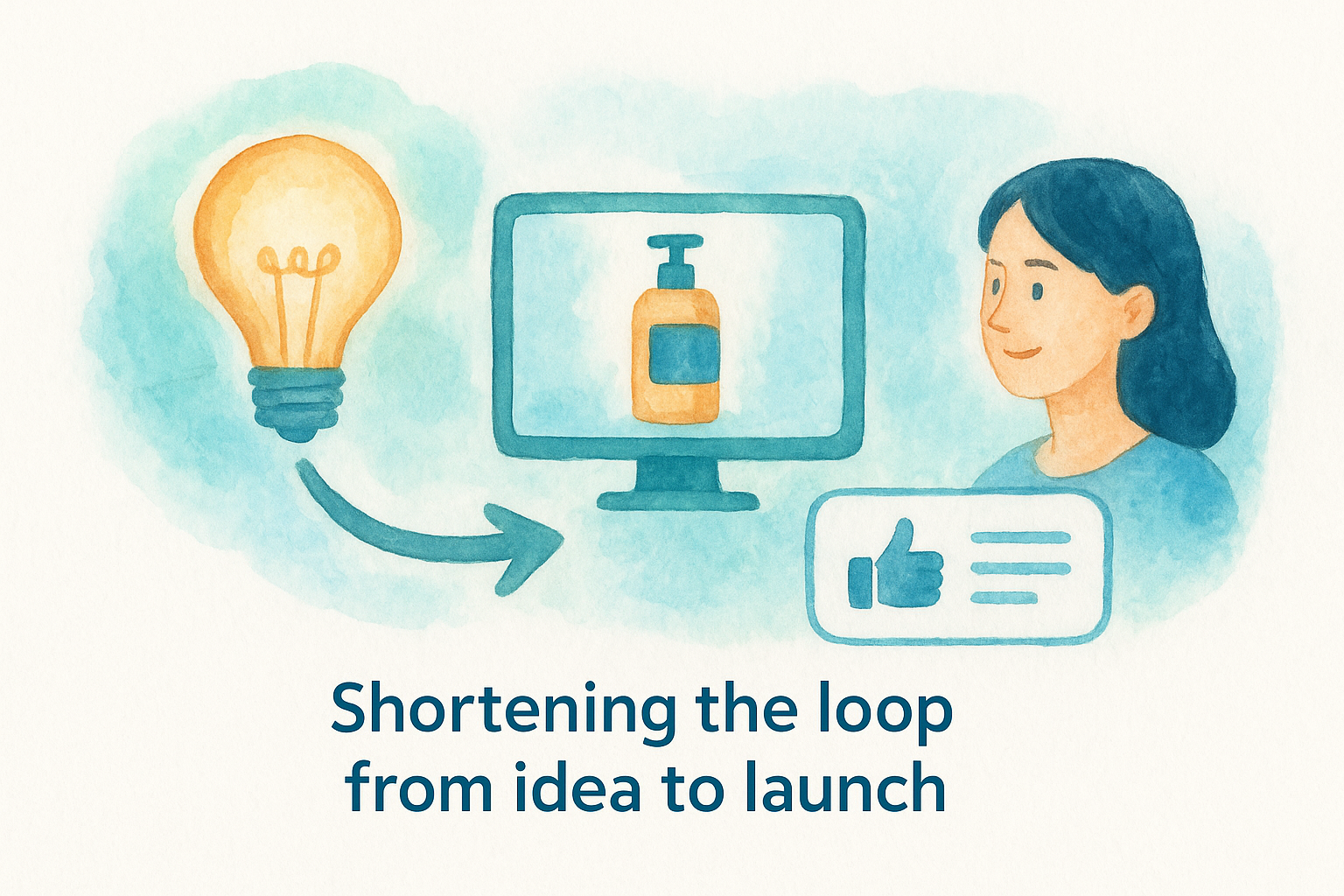
Shortening the loop from idea to launch
Direct channels let you introduce new products in weeks instead of quarters. You skip buyer meetings, planogram negotiations, and distribution coordination. Launch a new night guard material, updated packaging, or complementary product directly on your site. Customer response appears immediately in conversion rates, support inquiries, and review sentiment. This tight feedback loop means you identify winners and cut losers before wasting budget on inventory that retail schedules would force you to carry for months.
Using experiments instead of guesswork
Test product variations, pricing tiers, and bundle combinations with small customer segments before full rollout. Run A/B tests on product descriptions, photography angles, and educational content. Track which changes improve conversions and which fall flat. Advantages of direct to consumer include treating every launch as a controlled experiment that generates data rather than a bet on what buyers think might sell.
Real customer behavior tells you what works better than any focus group prediction ever could.
Balancing speed with product quality
Speed doesn't mean cutting corners. You still validate safety, efficacy, and manufacturing standards before launch. The difference is launching at smaller scale to real customers who provide actionable feedback instead of waiting for perfect before entering market. Iterate based on actual usage patterns rather than assumed needs.
5. Scale efficiently with digital first operations
Physical retail forces you to think in terms of store locations, shelf space, and geographic coverage. Each new market requires distribution partnerships, local inventory, and physical presence that locks capital into fixed assets before you know demand exists. Digital first operations flip this constraint by letting you reach customers anywhere with internet access and scale revenue without proportional infrastructure costs.
Reaching customers beyond physical retail
Your website serves customers in Maine and California with the same infrastructure and no incremental real estate costs. You avoid negotiating with regional distributors or waiting for retail chains to expand into new territories. Advantages of direct to consumer include testing geographic markets through targeted digital ads rather than committing to physical distribution before validating demand. Ship nationally from a single fulfillment center instead of maintaining inventory across multiple warehouses to support retail footprints.
Planning operations for spikes and growth
Digital operations scale variably rather than in fixed increments. You adjust ad spend, hosting capacity, and fulfillment partnerships based on actual order volume instead of building excess capacity ahead of uncertain growth. Third-party logistics providers absorb seasonal spikes. Cloud infrastructure handles traffic surges without buying servers you'll underutilize most of the year.
Digital infrastructure costs track revenue growth instead of requiring upfront investment in physical capacity you might never fill.
Choosing tools that keep you flexible
Build your stack around platforms that scale usage-based pricing and integrate cleanly with other systems. Avoid custom enterprise software that locks you into rigid processes or expensive migrations. Choose fulfillment partners who handle inventory fluctuations smoothly and ship fast enough to meet customer expectations without forcing you into long-term warehouse leases.
Key takeaways
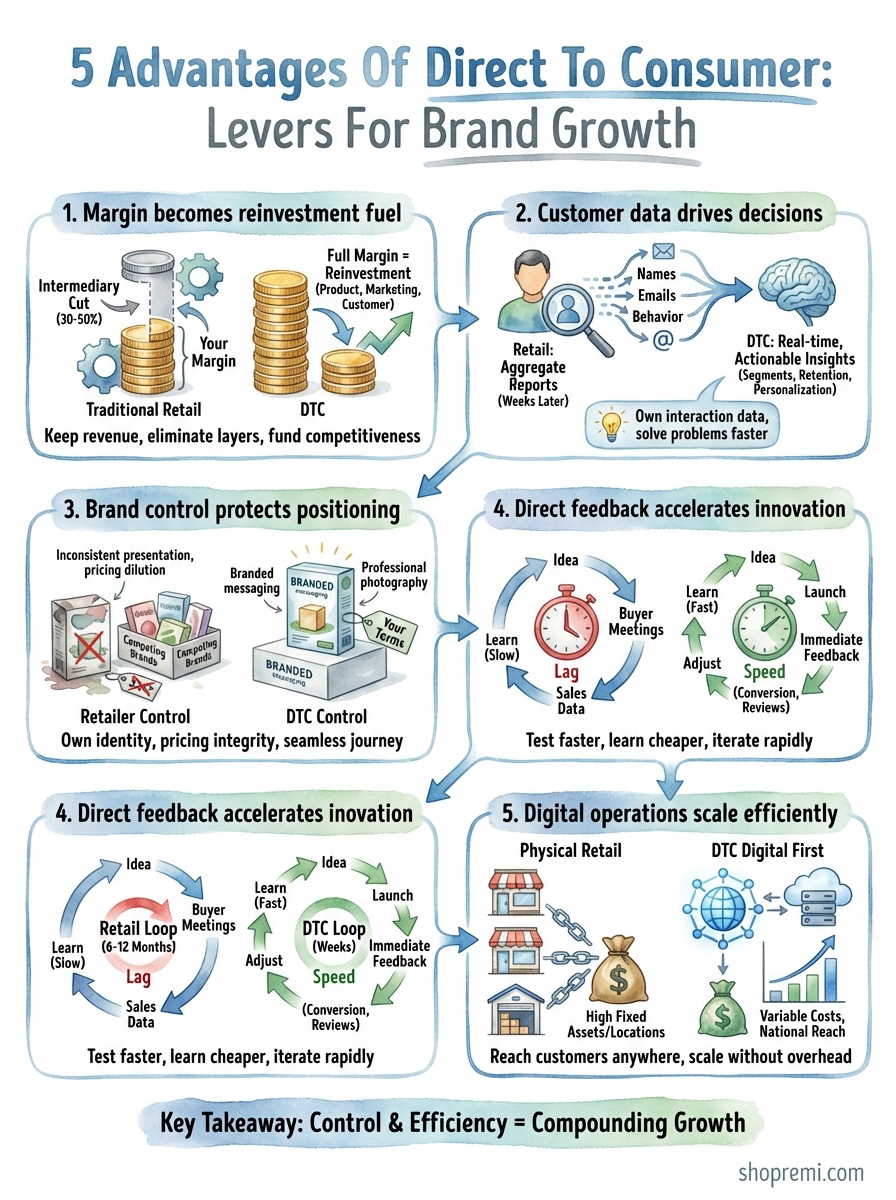
The advantages of direct to consumer boil down to control and efficiency. You keep margin that would go to intermediaries and reinvest it in better products and customer experience. You own customer data that drives smarter decisions instead of relying on secondhand reports. You protect your brand positioning and pricing without retail partners diluting your message. You innovate faster with direct feedback loops that cut months from product development cycles. You scale through digital infrastructure instead of physical distribution networks.
Remi built its entire business on these principles. We eliminated dental office markup on custom night guards and retainers, keeping prices 80% lower while maintaining professional quality. Our customers get dentist-grade protection delivered directly to their door. Start with a custom night guard and experience the difference direct relationships make.

